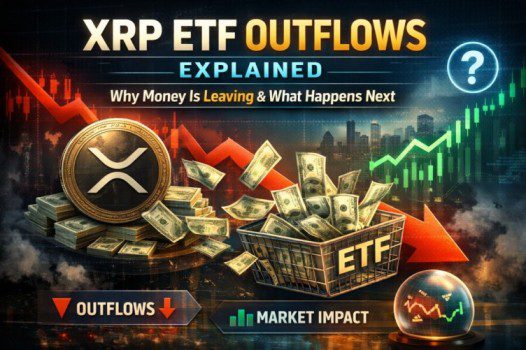
XRP ETF Outflows Explained: Why Money Is Leaving & What Happens Next
In recent weeks, investors and crypto watchers have noticed a trend that’s causing questions — outflows from XRP-linked ETFs. Capital that once flowed into these funds is now moving out, prompting debates about sentiment, regulation, and XRP’s future. This blog post breaks down what’s happening, why it matters, and what could come next.
📌 What Is an ETF? And What Is an XRP ETF?
Before diving into outflows, let’s clarify the basics.
ETF stands for Exchange-Traded Fund — a pooled investment that trades on stock exchanges like a stock. ETFs let investors get exposure to assets (like stocks, bonds, or crypto) without owning the asset directly.
An XRP ETF would be a fund designed to track the price of XRP (Ripple’s digital asset). Investors buy ETF shares to speculate on XRP’s price or hold it as a crypto exposure tool.
👉 Think of ETFs as “buckets of exposure” without the complexity of managing wallets or private keys.
💼 What Are ETF Outflows?
Fund outflows happen when investors redeem ETF shares, pulling capital out of the fund. Outflows mean there is more selling than buying, reducing the total assets under management (AUM).
Outflows aren’t unique to XRP ETFs — they occur in traditional finance too. But outflows from a newly launched or hyped crypto ETF catch attention quickly.
❓ Why Are Investors Pulling Money Out of XRP ETFs?
There’s no single reason for capital outflows — it’s usually a mix of market behavior, regulation, and sentiment. Here are the key drivers:
🔹 1. Market Volatility & Risk Appetite
Cryptocurrencies are inherently volatile. When markets turn choppy, risk-averse investors often reduce exposure to high-beta assets — including crypto ETFs like those tied to XRP.
When Bitcoin or Ethereum prices skid, XRP often follows due to correlated market sentiment.
🔹 2. Regulatory Uncertainty
XRP’s regulatory roller coaster — especially in the United States — has been well documented.
The SEC’s lawsuit against Ripple (alleging XRP was an unregistered security) hung over the asset for years. Although progress has been made, regulatory ambiguity persists in many jurisdictions. This encourages investors to exit until clarity arrives.
👉 Investors hate uncertainty — with ETFs, confidence in the underlying asset’s legal status matters.
🔹 3. Performance vs. Expectations
Investors compare assets based on performance. If Bitcoin and Ethereum ETFs outperform XRP funds over time, capital naturally flows toward winners.
Poor short-term performance or stagnation can trigger outflows as traders rotate elsewhere.
🔹 4. Macro Risk Environment
Bearish macro conditions — rising interest rates, inflation concerns, or geopolitical instability — often shift capital from risk assets to safer havens like cash or bonds. Crypto funds, including XRP ETFs, can feel the squeeze.
🔹 5. Competition from Other Crypto Products
The crypto ETF landscape is expanding: Bitcoin ETFs, Ethereum ETFs, multi-crypto baskets, and futures funds. Some investors view XRP ETFs as less diversified or less liquid, choosing broader exposure instead.
📊 What Do Outflows Mean for XRP Price?
Outflows do not directly cause price drops in XRP itself, but they can influence sentiment:
- Negative Perception — Large ETF outflows can signal waning confidence, making retail investors more cautious.
- Reduced Liquidity — ETFs often hold significant amounts of the underlying asset. Outflows may lead to selling pressure if the ETF needs to liquidate holdings.
- Market Psychology — Traders pay attention to flows as an indicator of institutional interest.
However, correlation isn’t causation — retail demand, exchange order books, and broader crypto trends also drive price movement.
📉 Are Outflows Always Bad?
Not necessarily.
✅ Healthy Market Rotation
Outflows can simply mean investors are reallocating to other assets or strategies — not necessarily abandoning XRP forever.
✅ Short-Term Traders vs Long-Term HODLers
Many ETF transactions are tactical. Long-term believers in XRP may hold outside of ETFs, reducing sell pressure.
✅ Opportunity for Value Investors
Some investors view outflows as a buying opportunity — lower ETF prices can attract capital once sentiment stabilizes.
🧮 What Happens Next?
Predicting exact moves is impossible — but we can outline plausible scenarios:
📈 Scenario 1: Regulatory Clarity Drives Inflows
If major markets (especially the U.S.) provide clearer rules around XRP and similar cryptocurrencies, confidence could return. ETFs would benefit from renewed institutional interest, reducing outflows.
Catalysts could include:
- Favorable court decisions
- Clear SEC guidance on digital asset classifications
- Approval of more XRP-related financial products
📉 Scenario 2: Prolonged Stagnation or Continued Outflows
If macro pressures and regulatory uncertainty persist, outflows may continue. That doesn’t mean a collapse — simply slower adoption.
Potential outcomes:
- Smaller AUM in XRP ETFs
- Narrower spread between bid/ask
- Retail investors dominate price action
🔄 Scenario 3: Innovation Between Traditional and Crypto Finance
Some analysts believe hybrid financial products — like tokenized ETFs or decentralized ETF analogues — could reshape how investors gain exposure to crypto including XRP. Institutional demand may re-emerge outside conventional ETF structures.
🧠 Takeaways: What Every Investor Should Know
| Factor | Impact on XRP ETF Flows |
|---|---|
| Market volatility | 📉 Can increase outflows |
| Regulatory clarity | 📈 Boosts confidence |
| Relative performance | 🔄 Influences allocation |
| Macro economic conditions | 📉 Often favors risk off |
| Product competition | 🔄 Shifts capital around |
📍 Pros & Cons of XRP ETFs
✅ Pros
✔️ Easier access for traditional investors
✔️ Removes need to self-custody XRP
✔️ Can attract institutional capital
✔️ Regulated exchange trading
❌ Cons
❌ Can add selling pressure during redemptions
❌ Subject to regulatory risks
❌ May trade at premiums/discounts vs NAV
❌ Liquidity dependent on market demand
XRP ETF outflows are a snapshot of broader market sentiment, not a death knell. They reflect a combination of macro trends, regulatory ambiguity, performance dynamics, and investor rotation. For long-term enthusiasts, these outflows may simply represent noise within a maturing financial landscape.
The next key drivers are likely:
- Regulatory clarity
- Institutional adoption trends
- Macro environment stabilization
- Product innovation
Whether you’re a trader, investor, or crypto observer, understanding ETF flows offers valuable insight into market confidence — but it’s just one piece of a larger puzzle.