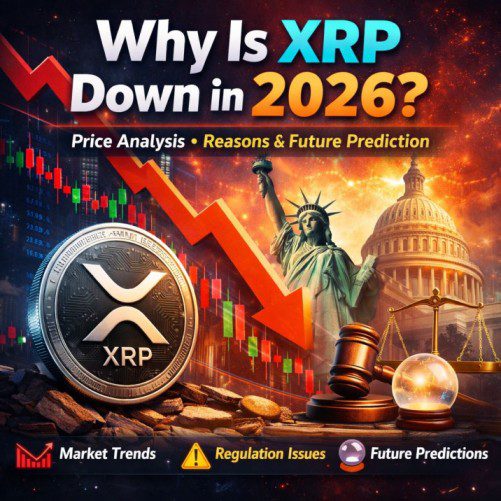
Why Is XRP Down? A Detailed Analysis & What to Expect Next
XRP, the native token of Ripple ,is one of the most popular cryptocurrencies for fast and low-cost cross-border payments. However, like most digital assets, XRP often goes through strong ups and downs.
If you’re wondering why XRP is down and what the future may hold, here’s a complete breakdown.
🔍 1. Overall Crypto Market Weakness
XRP rarely moves alone. When Bitcoin and major altcoins fall, XRP usually follows.
Key Reasons:
- 📉 Bitcoin corrections pull the whole market down
- 😨 Fear and uncertainty reduce buying pressure
- 💰 Investors move money to safer assets
When the broader crypto market is bearish, even strong projects like XRP struggle to rise.
⚖️ 2. Legal Pressure & Regulatory Uncertainty
One of XRP’s biggest challenges has been regulation, especially in the United States.
Ripple’s long legal battle with the U.S. Securities and Exchange Commission created years of uncertainty.
Impact:
- ❌ Some exchanges delisted XRP in the past
- 😕 Institutional investors stayed cautious
- 📉 Price volatility increased
Even after partial legal clarity, any new regulatory news can still push XRP down.
🐋 3. Whale Selling & Profit-Taking
Large holders (called “whales”) own millions of XRP. When they sell:
- Supply suddenly increases
- Prices drop fast
- Retail investors panic
Also, after rallies, many traders take profits, leading to short-term declines.
🌍 4. Weak Network Adoption (Short-Term)
Ripple aims to power global payments, but real-world adoption grows slowly.
Current Challenges:
- Banks take time to integrate blockchain tech
- Competition from USDT, USDC, and CBDCs
- Regulatory hurdles in major countries
If adoption news is slow, investor confidence weakens.
📊 5. Technical Factors & Chart Patterns
From a trading perspective, XRP often drops due to:
- Breaking support levels
- Overbought conditions
- Bearish indicators (RSI, MACD)
When key price supports fail, automated trading bots accelerate selling.
👨💼 6. Leadership & Public Sentiment
Statements from Ripple’s CEO, Brad Garlinghouse, and company updates heavily influence XRP.
Negative news, delays, or unclear roadmaps can reduce market confidence—even temporarily.
📈 What to Expect from XRP in 2026 and Beyond
Now let’s look at the future.
✅ 1. Bullish Scenario (Best Case)
If everything goes right, XRP could perform strongly.
Possible Drivers:
✔️ Clear global regulations
✔️ More banks using RippleNet
✔️ Strong crypto bull market
✔️ ETF or institutional adoption
Potential Price Range:
💎 $1.50 – $5+ (long term, market-dependent)
⚠️ 2. Neutral Scenario (Most Likely)
In this case, XRP grows slowly.
Characteristics:
- Sideways movement
- Moderate adoption
- Periodic pumps and dumps
Potential Range:
📊 $0.60 – $1.50
❌ 3. Bearish Scenario (Worst Case)
If regulation tightens or adoption slows:
- Exchanges reduce support
- Institutions avoid XRP
- Demand falls
Possible Range:
📉 Below $0.50
🧠 Is XRP Still a Good Investment?
👍 Pros
- Very fast transactions
- Extremely low fees
- Strong brand recognition
- Real-world use case
👎 Cons
- Regulatory risks
- Centralization concerns
- Heavy dependence on Ripple
- Competition from stablecoins
XRP is better suited for long-term believers rather than short-term speculators.
📌 Investment Strategy for XRP Holders
If you’re holding or planning to buy XRP:
🔹 1. Use Dollar-Cost Averaging (DCA)
Buy small amounts regularly instead of all at once.
🔹 2. Follow Legal & Adoption News
Regulation = price movement for XRP.
🔹 3. Set Risk Limits
Never invest money you can’t afford to lose.
🔹 4. Diversify
Don’t put all funds into one coin.
Why XRP Is Down & What’s Next
Why XRP Is Down:
✅ Market weakness
✅ Regulatory uncertainty
✅ Whale selling
✅ Slow adoption
✅ Technical breakdowns
What to Expect:
🔮 Short-term volatility
🔮 Medium-term consolidation
🔮 Long-term growth depends on adoption
XRP remains one of the most utility-focused cryptocurrencies—but its success depends heavily on regulation and institutional usage.