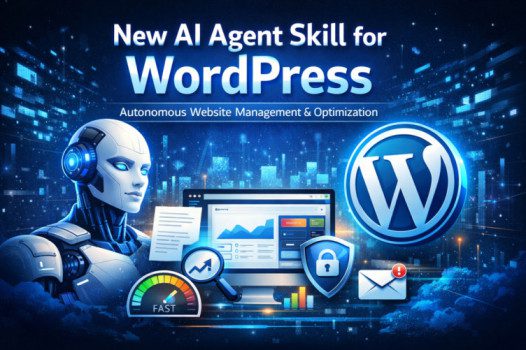
New AI Agent Skill for WordPress: The Future of Smart Website Management
AI Agents for WordPress are transforming how websites are built, managed, and optimized. In 2026, the newest AI agent skill focuses on autonomous decision-making, allowing WordPress websites to operate, improve, and scale with minimal human effort.
This guide covers:
- What AI agents are in WordPress
- The latest AI agent skills
- SEO, content, security, and performance automation
- Benefits for bloggers, developers, and businesses
- Why AI agents represent the future of WordPress
What Are AI Agents in WordPress?
An AI agent in WordPress is an intelligent system capable of analyzing data, making decisions, and taking actions automatically to achieve specific website goals.
Unlike traditional WordPress plugins that rely on fixed rules, AI agents:
- Understand user intent
- Adapt to changing website conditions
- Learn from historical data
- Execute multiple tasks independently
In simple terms, AI agents function as a smart website manager for WordPress.
New AI Agent Skill for WordPress Explained
The latest AI agent skill introduces autonomous website intelligence. Instead of waiting for manual instructions, AI agents proactively monitor, optimize, and improve WordPress websites in real time.
This shift marks a move from manual website management to self-optimizing WordPress systems.
Key AI Agent Capabilities for WordPress
1. AI Content Creation & Content Refresh (SEO Focused)
AI agents can:
- Generate SEO-optimized blog posts
- Update outdated content automatically
- Improve readability, tone, and structure
- Add internal and external links contextually
SEO Advantage: Google prioritizes fresh, relevant content. AI agents ensure your content stays updated without manual effort.
SEO best practices reference: Google SEO Starter Guide
2. Automated SEO Optimization (Advanced Auto-SEO)
AI agents continuously optimize:
- Meta titles and meta descriptions
- Heading hierarchy (H1–H6)
- Keyword placement and density
- Search intent alignment
They can also analyze competitors and update your content to maintain or improve rankings.
Result: Higher Google rankings with consistent optimization.
3. AI Website Performance Optimization
AI agents enhance WordPress performance by:
- Optimizing images and assets dynamically
- Identifying and disabling unused plugins
- Adjusting caching rules automatically
- Monitoring and improving Core Web Vitals
SEO Impact: Faster websites lead to better rankings and improved user experience.
Performance metrics explained here: Google Core Web Vitals
4. AI Security & Threat Detection
AI agents provide proactive security by:
- Detecting suspicious login behavior
- Blocking brute-force attacks
- Scanning for malware continuously
- Automatically patching vulnerabilities
SEO Benefit: Secure websites maintain trust, uptime, and search engine credibility.
WordPress security basics: Hardening WordPress
5. Personalized User Experience (AI-Driven UX)
AI agents analyze visitor behavior to:
- Display personalized content
- Optimize calls-to-action (CTAs)
- Improve conversion rates
- Reduce bounce rates
This is especially valuable for blogs, WooCommerce stores, SaaS platforms, and service websites.
6. AI Customer Support & Chat Automation
AI agents can:
- Handle FAQs instantly
- Understand user intent and context
- Manage multiple conversations simultaneously
- Learn from previous interactions
This improves customer satisfaction while reducing operational costs.
AI Agents vs Traditional WordPress Plugins
| Feature | Traditional Plugins | AI Agents |
|---|---|---|
| Automation Level | Basic | Advanced & autonomous |
| Learning Capability | No | Yes |
| Decision Making | Rule-based | AI-driven |
| Cross-Task Execution | No | Yes |
| Proactive Optimization | No | Yes |
The new AI agent skill for WordPress represents a major evolution in website management. From automated SEO and content creation to advanced security and performance optimization, AI agents are redefining how WordPress websites operate.
To stay competitive in Google search results, AI-powered WordPress is no longer optional—it’s essential.