How SEO Works in the AI Era: A Complete Guide to AI SEO, GEO, and AEO
SEO Is Changing, but It Is Not Dead
For many years, Search Engine Optimization (SEO) has been about helping websites rank higher on Google. Website owners researched keywords, optimized their pages, built backlinks, improved loading speed, and created content to attract visitors from search results.
But the way people search for information is changing.
Instead of typing a few words into Google, users increasingly ask complete questions to AI-powered platforms such as ChatGPT, Google AI Overviews, Google AI Mode, Gemini, and Perplexity.
For example, someone who wants to build a business website might search Google for:
Best WordPress plugins for building a directory website.
The same person might ask an AI assistant:
I want to build a directory website using WordPress, with custom listings, filters, user submissions, and paid memberships. Which plugins should I use?
The second question gives the AI more context. The system may retrieve information from multiple sources, compare possible solutions, and generate a response with links to relevant websites.
This creates a new opportunity for website owners. Instead of competing only for a position in traditional search results, websites can also aim to become useful sources for AI-generated answers.
This is where AI SEO comes in.
AI SEO is the practice of improving a website’s visibility in AI-powered search and answer experiences while maintaining the technical and content foundations of traditional SEO.
Google’s own guidance confirms that established SEO practices remain important for its AI search features. It also emphasizes the value of original, useful content rather than special tricks designed exclusively for AI systems.
Source: Google’s Guide to Optimizing for Generative AI Features
Let’s explore how AI SEO works, what has changed, and how you can prepare your website for this new search environment.
1. What Is AI SEO?
AI SEO refers to optimizing website content and accessibility so that AI-powered search systems can discover, understand, retrieve, and potentially reference it when answering user questions.
Traditional SEO focuses heavily on visibility in search engine results pages. AI SEO extends that goal to experiences in which a system generates an answer using information from websites and other sources.
Consider these three approaches:
Traditional SEO: Your article ranks in Google’s search results for a relevant keyword.
Answer Engine Optimization (AEO): Your content clearly answers a specific question, making it useful for systems that provide direct answers.
Generative Engine Optimization (GEO): Your content is optimized to be a useful, trustworthy source in AI-generated responses.
These terms overlap considerably. They describe different aspects of a broader shift toward making content discoverable and useful across search experiences.
There is no universal GEO formula, and no technique guarantees that an AI system will mention your website.
The practical objective is straightforward: create valuable content, make it accessible to search systems, demonstrate credibility, and provide information that deserves to be referenced.
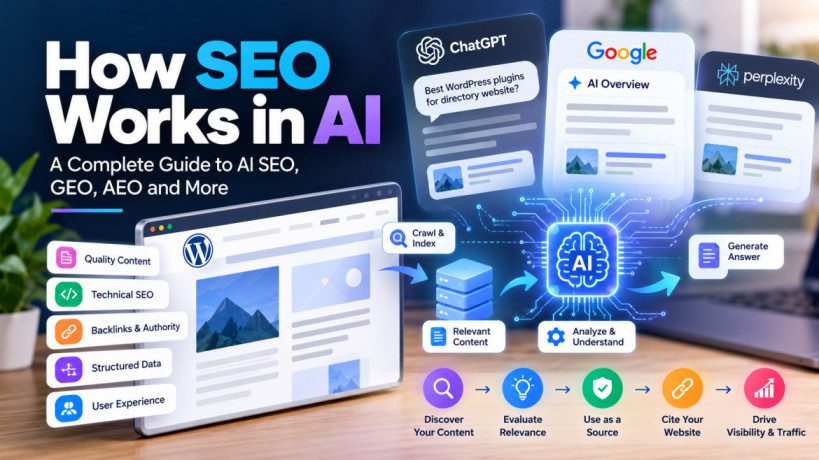
2. How Does AI Search Work?
Understanding the process helps explain why good SEO still matters.
Although different AI platforms use different technologies, an AI-powered search experience commonly involves several stages.
Step 1: A user asks a question
The user submits a question, describes a problem, or requests a recommendation.
For example:
“How can I create a custom post type directory in WordPress without writing a lot of code?”
The system may need information about WordPress, custom post types, plugins, pricing, compatibility, and implementation.
Step 2: The system retrieves relevant information
Depending on the platform and query, the AI may search the web, retrieve indexed documents, use its existing knowledge, or combine several sources.
Search-enabled AI systems can identify pages relevant to the user’s question. Some may also expand a question into several related searches to gather more comprehensive information.
This is one reason it is useful to cover a subject thoroughly and connect related articles through internal links.
Step 3: The AI evaluates and combines information
The system processes the retrieved material and generates an answer.
It may combine information from multiple websites rather than selecting a single page to reproduce.
Relevance, usefulness, reliability, freshness, and the system’s retrieval and ranking methods can all influence which sources are used.
The exact selection process varies by platform and is not completely public.
Step 4: The AI presents an answer
The user receives a generated response. Depending on the product, the answer may include citations, source links, product recommendations, images, or follow-up questions.
If your website is selected as a relevant source, it may receive a citation or link.
However, not every answer includes external sources, and not every useful webpage will be cited.
Step 5: The user decides what to do next
The user might click a source, visit a business, compare products, sign up for a service, or continue asking questions.
Some users will visit your website. Others may get enough information from the AI-generated answer without clicking through.
This is an important difference between traditional search and AI-powered search.
3. Traditional SEO vs. AI SEO
The two approaches are related, but the way users discover information can differ.
| Area | Traditional SEO | AI SEO |
|---|---|---|
| Discovery | Search results and other search features | AI-generated answers and search experiences |
| Main objective | Earn relevant rankings and clicks | Earn relevant visibility, citations, and referrals |
| Content strategy | Satisfy search intent and compete in results | Satisfy search intent and provide useful source material |
| Keywords | Important for understanding demand and relevance | Still useful, alongside natural questions and context |
| Content structure | Clear headings, links, and readable pages | The same foundations help AI systems interpret content |
| Authority | Relevant reputation, links, expertise, and trust | Credibility and useful source material remain important |
| Measurement | Rankings, impressions, clicks, conversions | Those metrics plus AI referral traffic and visibility checks |
AI SEO should not replace traditional SEO.
A website with indexing problems, inaccessible content, weak internal links, or poor-quality information is unlikely to benefit simply because its owner adds an AI-focused plugin.
The strongest approach is to build a technically sound website and publish content that serves users exceptionally well.
4. Why Is AI SEO Becoming Important?
AI-powered search creates several opportunities and challenges for website owners.
People can discover information differently
A user may not know which keywords to search for or which websites to visit. Instead, the user describes a problem and asks AI for a solution.
This creates opportunities for websites that publish detailed tutorials, original research, product comparisons, and practical explanations.
Visibility is not limited to the first search result
A traditional search results page presents a collection of links. An AI-generated answer can reference multiple sources within a single response.
Being a useful source may create another discovery opportunity, although inclusion is not guaranteed.
Some searches may produce fewer website visits
If an AI answer provides everything a user needs, that user may not click any source.
As a result, website owners should not measure success only by the number of visits they receive.
A smaller number of highly relevant visitors may be more valuable than a large volume of visitors who leave without taking action.
Original expertise becomes more valuable
Basic definitions and generic explanations are easy for AI systems to generate.
Content that includes real-world experience, original testing, detailed examples, implementation steps, and evidence of results can offer something more useful.
For example, a generic article about WordPress performance is less distinctive than a documented case study explaining how a specific caching configuration affected a real website.
The lesson is not that every article must be complicated. It is that your content should offer meaningful value beyond repeating information already available everywhere.
5. How to Optimize Your Website for AI Search
The following practices form a practical foundation for AI SEO.
5.1 Create helpful, original content
Start by answering questions your audience genuinely wants to solve.
Before writing an article, ask:
- What problem is the reader trying to solve?
- What information is missing from existing resources?
- Can I provide a more practical explanation?
- Do I have original examples, screenshots, or test results?
- Will the reader be able to take action after reading?
For example, instead of publishing another article titled “What Is WordPress?”, create a detailed guide explaining how to choose a WordPress hosting provider, configure a theme, secure a website, and troubleshoot common problems.
Originality does not require inventing something completely new. A clearer explanation, verified solution, useful comparison, or real implementation example can add substantial value.
5.2 Answer the main question early
Readers should not have to scroll through several paragraphs of introductory text before discovering the answer.
Begin with a concise explanation of the problem and the recommended solution. Then provide the reasoning, examples, limitations, and detailed steps.
For example:
Question: Can AI search engines find my WordPress website?
Answer: Yes, provided the relevant pages are accessible and the search system can discover them. Visibility also depends on indexing, relevance, the platform’s retrieval methods, and other factors.
The rest of the article can explain how crawling works, how to check robots.txt, and how to troubleshoot access problems.
This structure serves readers while making the main topic clear.
5.3 Use descriptive headings
Organize articles with meaningful H2 and H3 headings.
For a guide about WordPress security, headings might include:
- How WordPress Security Works
- Common WordPress Security Risks
- How to Protect Your WordPress Login
- Which Security Plugins Are Worth Considering?
- How to Recover From a Security Incident
Avoid using headings only to repeat keywords. Every heading should help the reader navigate the article.
5.4 Use natural language and related questions
People often ask AI systems questions in conversational language.
Your content can address those questions naturally.
For an article about WordPress caching, related questions might include:
- What is WordPress caching?
- Does caching improve page speed?
- Can caching break a website?
- How do you clear a WordPress cache?
- Which caching settings should you use?
You do not need a separate article for every variation. Cover related questions together when doing so creates a more useful resource.
5.5 Demonstrate first-hand experience
Experience can distinguish your content from generic summaries.
Include real screenshots, tested code, configuration examples, performance measurements, and the reasoning behind your recommendations.
For a technical tutorial, explain:
- The original problem.
- The environment in which it occurred.
- The steps used to investigate it.
- The solution that was tested.
- Any limitations or compatibility concerns.
Do not invent test results, claim to have tested products you have not used, or publish unverified code as a confirmed solution.
Google’s people-first content guidance emphasizes original information, clear authorship, expertise, and useful content.
5.6 Strengthen credibility
Make it easy for visitors to understand who publishes your content and why the information deserves their trust.
Useful practices include:
- Provide accurate author information and relevant experience.
- Maintain an informative About page.
- Cite authoritative sources when making factual claims.
- Update outdated tutorials and remove incorrect instructions.
- Explain how product comparisons or tests were conducted.
- Distinguish verified facts from opinions and recommendations.
Not every article needs formal credentials. What matters is being transparent and providing reliable information appropriate to the subject.
5.7 Improve internal linking
Internal links connect related pages on your website.
Suppose you publish a central guide about WordPress performance. You might link to separate articles about image optimization, caching plugins, database cleanup, and Core Web Vitals.
These connections help visitors explore related information and help search systems discover the relationships between pages.
Use descriptive anchor text that explains what the reader will find after clicking.
Avoid adding links that are unrelated to the surrounding content.
5.8 Keep content technically accessible
Even excellent content can struggle to appear in search if search systems cannot access or index it.
Check that:
- Important pages return a successful response.
- Pages intended for search are not accidentally marked
noindex. - Canonical URLs are configured appropriately.
- Your XML sitemap is valid and submitted where applicable.
- Robots.txt does not unintentionally block important content.
- Security tools and firewalls are not blocking legitimate search crawlers.
- Important content is available in crawlable HTML.
- Pages work well on mobile devices and load reliably.
Technical SEO is still fundamental to AI search visibility.
6. How to Make Your Website Visible in ChatGPT Search
ChatGPT Search can discover and reference information from public websites.
OpenAI provides a crawler called OAI-SearchBot, which is used to help surface websites in ChatGPT search results.
If you want your website to be eligible for discovery through ChatGPT Search, check the following.
Step 1: Check your robots.txt file
Visit:
https://yourdomain.com/robots.txt
Replace yourdomain.com with your actual domain.
Look for rules that might block OAI-SearchBot. If you want to allow it, a robots.txt rule can look like this:
User-agent: OAI-SearchBot
Allow: /
This is an illustrative rule, not a complete robots.txt configuration. Preserve any existing rules that your website needs, and verify the actual response from your site.
Step 2: Review firewall and security settings
Your hosting provider, CDN, or security plugin may block automated requests.
If the crawler cannot access your pages, review the relevant logs and security settings before changing protections. Allow only the access you intend to permit.
Step 3: Keep important pages accessible
Make sure your important articles do not require a login and are not accidentally excluded from indexing.
Allowing a crawler does not guarantee that a page will be cited. It only removes one possible barrier to discovery.
Step 4: Understand the difference between search and model training
OpenAI documents separate controls for different crawler purposes.
OAI-SearchBotsupports discovery for ChatGPT Search.GPTBotrelates to crawling for potential use in training OpenAI’s generative AI foundation models.
These controls are independent. A site owner can allow search discovery while separately deciding whether to permit GPTBot.
For current details, consult the official OpenAI crawler documentation.
7. How to Optimize for Google AI Overviews and AI Mode
Google’s AI search experiences build on its existing search systems.
According to Google, there are no additional technical requirements or special AI-only optimizations required to appear in AI Overviews or AI Mode.
The foundational work remains important:
Make pages accessible and indexable. Google needs to be able to access eligible content.
Publish original information. Provide helpful explanations, original research, and practical insights rather than simply reproducing other sources.
Satisfy the user’s intent. Answer the question comprehensively and make it easy to explore related information.
Use relevant media. Include useful images, videos, diagrams, and other content where they help explain the topic.
Maintain accurate structured data. Implement supported schema markup where appropriate, ensuring it matches the visible page content.
Monitor search performance. Use Google Search Console and other available reporting tools to understand how your pages perform.
Read Google’s official AI search optimization guide for current recommendations.
8. Does Schema Markup Help With AI SEO?
Schema markup is structured data that describes information on a webpage in a format search engines can interpret.
For example, a WordPress tutorial may use Article schema to identify its headline, author, and publication information.
A local business may use LocalBusiness schema, while a product page may use Product schema when applicable.
Structured data can help search engines understand page content and may support eligible search features.
However, schema markup is not a shortcut to AI citations.
Adding FAQ schema, Article schema, or other structured data does not automatically make an AI system recommend your website. Use relevant, supported markup accurately and focus on the quality of the underlying content.
9. Is AI-Generated Content Good for SEO?
AI can be a useful assistant in the content creation process.
It can help you brainstorm topics, research questions, create outlines, improve readability, generate examples, and identify missing sections.
The risk arises when publishers use AI to produce large volumes of unverified, repetitive content with little original value.
Consider two approaches.
Approach A: Mass-produced content
A website generates 100 articles from similar prompts, makes few changes, and publishes them without checking accuracy.
The result may contain repetitive explanations, factual mistakes, generic recommendations, and little value beyond existing search results.
Approach B: AI-assisted expertise
A writer uses AI to develop an outline, verifies facts, adds real examples, tests code, includes original screenshots, and edits the article to answer the audience’s needs.
The second approach has a much stronger foundation because the final content is useful and carefully reviewed.
Google’s guidance focuses on the quality and purpose of content rather than automatically penalizing a page simply because AI was involved.
Read Google’s guidance on AI-generated content.
The goal should not be to make AI content appear human. The goal should be to publish accurate, original, valuable information.
10. Common AI SEO Myths to Avoid
Myth 1: Traditional SEO no longer matters
False. Search engines still rely on established discovery, indexing, relevance, and quality systems. Traditional SEO provides an important foundation.
Myth 2: You need a special AI SEO plugin
False. Plugins can help with technical SEO, metadata, sitemaps, and structured data, but installing an AI SEO plugin does not guarantee inclusion in AI answers.
Myth 3: Every article must contain an FAQ section
False. Add FAQs when they answer useful questions. Do not add repetitive sections simply because you believe AI systems require them.
Myth 4: You must publish an llms.txt file
There is no general requirement to create an llms.txt file to appear in Google’s AI search features or ChatGPT Search. Do not treat it as a substitute for accessible, high-quality content.
Myth 5: Keyword density determines AI visibility
False. Keywords help clarify a page’s subject, but repeating the same phrase unnaturally does not create authority or guarantee citations.
Myth 6: Backlinks are no longer important
False. Links and broader reputation signals can still help with discovery and trust. Focus on earning relevant, genuine links by publishing resources worth referencing rather than buying links to manipulate rankings.
Myth 7: Being cited by AI guarantees traffic
False. A citation may create an opportunity for a visit, but users do not click every source. Measure referral traffic and conversions instead of assuming that visibility will always lead to clicks.
11. How to Measure AI SEO Performance
AI SEO requires a broader view of website performance.
Traditional metrics remain useful, but it is also worth understanding whether AI platforms are introducing visitors to your content.
Google Search Console
Monitor impressions, clicks, search queries, and the performance of individual pages.
Where Google provides reporting for its generative search features, use the available data to understand how your content is performing.
Google Analytics
Review referral traffic from AI services. Depending on how visits are recorded, you may see referrals from domains associated with ChatGPT, Perplexity, or other platforms.
Look at what those visitors do after arriving:
- Do they read other articles?
- Do they sign up for a newsletter?
- Do they contact your business?
- Do they purchase a product or service?
Manual AI visibility checks
Test relevant questions in different AI search platforms and check whether your website is cited.
For example, a WordPress publisher might ask:
- How do I create a custom post type in WordPress?
- Which plugins help build a WordPress directory?
- How can I troubleshoot a Themify Builder issue?
- What is the difference between WordPress page builders?
Repeat checks periodically, but remember that answers may change based on the query, location, timing, and platform.
Manual checks are useful observations, not a complete measurement of your website’s AI visibility.
Business outcomes
Ultimately, focus on whether your content helps achieve your business goals.
A website receiving fewer visits but generating more qualified leads may be performing better than one receiving substantial traffic without meaningful engagement.
12. A Practical AI SEO Strategy for WordPress Websites
WordPress website owners can start by improving their existing content and technical foundations instead of rebuilding their entire SEO strategy.
Here is a practical 30-day plan.
Week 1: Audit your website
Review your important pages, sitemap, robots.txt, indexing settings, internal links, and performance.
Identify pages that are outdated, inaccessible, duplicated, or missing useful information.
Week 2: Improve existing articles
Choose five important articles and update them.
Add clear introductions, better headings, relevant screenshots, practical examples, accurate information, and links to related resources.
Prioritize pages that already attract impressions or serve an important business purpose.
Week 3: Publish one original, detailed guide
Choose a topic you know well.
For example, a WordPress developer could publish a detailed tutorial about building a directory website using custom post types, taxonomies, dynamic templates, and filtering.
Include the actual implementation process, code where appropriate, screenshots, limitations, and troubleshooting steps.
The objective is to produce something more useful than a generic overview.
Week 4: Review results and build connections
Monitor search performance and referral traffic.
Link the new guide to relevant existing articles, and link those articles back where appropriate.
Document what improved and identify the next set of pages to update.
This is a starting plan, not a guarantee of rankings or AI citations. Search visibility often takes longer than 30 days to change meaningfully.
13. The Future of SEO: From Ranking Pages to Becoming a Trusted Source
AI-powered search is changing how information is presented and how people discover websites.
However, the underlying need remains the same: people want accurate answers, useful recommendations, and reliable solutions to their problems.
Website owners who focus exclusively on gaming algorithms may find it difficult to build lasting visibility. Those who consistently create useful resources have a stronger foundation for both traditional search and AI-driven discovery.
For WordPress publishers, the opportunity is especially practical.
Instead of publishing another generic article about a plugin, demonstrate how to use it. Instead of repeating a list of SEO tips, explain how you implemented them. Instead of producing dozens of similar pages, create a smaller number of comprehensive resources that solve real problems.
The strongest AI SEO strategy combines technical accessibility, clear content structure, original expertise, and consistent measurement.
No one can guarantee that a particular article will be selected by an AI system. But you can make your website more useful to readers and more accessible to the systems that help them discover information.
Frequently Asked Questions About AI SEO
What is AI SEO?
AI SEO is the process of improving website visibility in AI-powered search and answer experiences, including ChatGPT Search and Google’s AI search features. It builds on traditional SEO practices while emphasizing useful, accessible, and trustworthy content.
Is AI SEO different from traditional SEO?
AI SEO focuses more explicitly on visibility within AI-generated answers and citations. However, traditional SEO remains important because many AI search experiences use established search indexes and quality systems.
How do I get my website cited by ChatGPT?
Make your public pages accessible, check that you are not unintentionally blocking OAI-SearchBot, publish relevant and reliable content, and build a technically sound website. These steps improve eligibility for discovery but cannot guarantee citations.
Does Google penalize AI-written articles?
Not simply because AI was used. Google’s guidance emphasizes helpful, reliable, people-first content. Using automation primarily to manipulate rankings or publishing large amounts of low-value content can violate its spam policies.
Do I need schema markup for AI SEO?
There is no universal AI-specific schema requirement. Use relevant structured data correctly to help search engines interpret your pages and qualify for supported search features.
How long does AI SEO take to work?
There is no fixed timeline. Crawling, indexing, rankings, and AI citations can change at different speeds. Results depend on the website, content, competition, technical accessibility, and individual search systems.
Can small websites compete in AI search?
Yes, small websites can provide useful specialist information. Detailed tutorials, original experience, focused expertise, and accurate explanations can make a small publisher’s content valuable, although visibility is never guaranteed.
What is the best AI SEO tool for WordPress?
There is no single plugin that guarantees AI visibility. Start with tools that help manage technical SEO, metadata, sitemaps, structured data, and performance. Use analytics and search reporting to evaluate results.
Conclusion
AI is changing the search experience, but it has not removed the need for good SEO.
The goal is no longer just to publish a page and hope it ranks. Website owners should also consider whether their content answers meaningful questions, demonstrates genuine expertise, remains technically accessible, and provides enough value to be referenced by other systems.
For WordPress websites, begin with the fundamentals: improve existing content, resolve technical SEO issues, publish original tutorials, strengthen internal links, and measure meaningful outcomes.
Do not optimize only for AI. Build a website that deserves to be discovered by both people and AI-powered search systems.