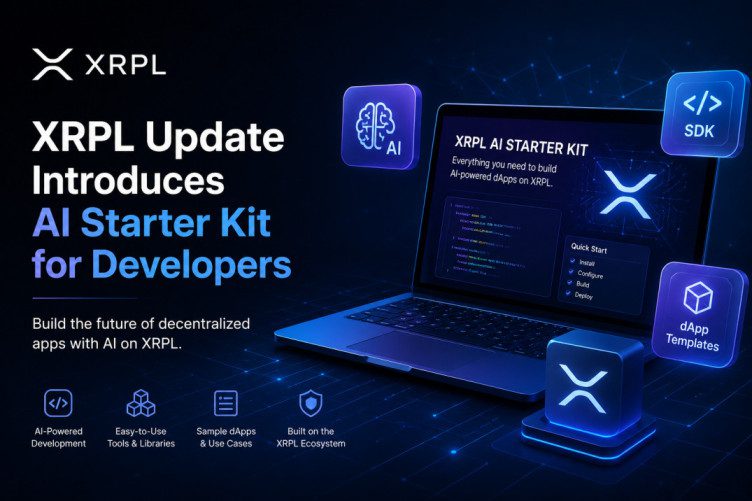
XRPL Update Introduces AI Starter Kit for Developers: A Major Step Toward Agentic Payments
The intersection of artificial intelligence and blockchain technology is evolving rapidly, and the XRP Ledger (XRPL) is positioning itself at the center of this transformation. In a significant development, Ripple has unveiled the XRPL AI Starter Kit, a new toolkit designed to help developers build applications where AI agents can autonomously perform financial transactions on the XRP Ledger. This initiative marks an important milestone in the emerging world of agentic payments, where intelligent software systems can pay for services, settle invoices, and interact economically without direct human intervention.
As AI agents become more capable and autonomous, the need for efficient payment infrastructure is growing. Traditional payment systems were built for human approval workflows, but AI-driven systems require faster, programmable, and machine-friendly financial rails. The XRPL AI Starter Kit aims to solve this challenge by providing developers with tools, integrations, and documentation specifically designed for machine-to-machine commerce.
What Is the XRPL AI Starter Kit?
The XRPL AI Starter Kit is a collection of developer resources that simplify the process of creating AI-powered payment applications on the XRP Ledger. The toolkit enables developers to integrate autonomous payment capabilities into AI systems using XRP and Ripple USD (RLUSD).
The launch is being rolled out in phases, with the first phase focused on developer onboarding and ecosystem accessibility. Developers can leverage the toolkit to build applications where AI agents independently execute transactions, access APIs, purchase computing resources, and pay for digital services.
Rather than building every component from scratch, developers receive a ready-made foundation that significantly reduces development complexity and accelerates time to market.
Why Agentic Payments Matter
Artificial intelligence is moving beyond chatbots and content generation. Modern AI agents are increasingly capable of making decisions, executing tasks, and interacting with digital environments independently.
Examples include:
- Paying for API requests
- Purchasing cloud computing resources
- Settling invoices automatically
- Accessing premium datasets
- Managing subscription services
- Conducting machine-to-machine transactions
However, traditional payment systems introduce friction because they require human authorization, manual approvals, and delayed settlement processes. Agentic systems need payment rails that are:
- Fast
- Predictable
- Low-cost
- Programmable
- Autonomous
The XRP Ledger was designed with many of these characteristics, making it a strong candidate for powering AI-native commerce.
Key Features of the XRPL AI Starter Kit
1. XRPL Documentation MCP Server
Developers can access XRPL documentation directly through the XRPL Docs MCP Server.
This integration allows AI development tools and coding assistants to retrieve XRPL-related information dynamically. Supported environments include:
- Claude Code
- Claude Desktop
- Cursor
- Custom AI frameworks
This feature enables AI agents to reference official XRPL documentation during development and execution workflows.
2. XRPL Agent Wallet Skill
The toolkit introduces an Agent Wallet Skill that gives AI systems structured access to common wallet operations.
Capabilities include:
- Wallet creation
- Wallet management
- Balance inquiries
- Transaction monitoring
This allows developers to build agents capable of managing digital assets without requiring extensive custom infrastructure.
3. XRPL Payment Skill
The XRPL Payment Skill enables AI agents to initiate and manage transactions directly on the XRP Ledger.
Supported functions include:
- Sending payments
- Transaction tracking
- Payment confirmation
- Balance verification
By abstracting complex blockchain interactions, the toolkit makes XRPL payments more accessible to AI applications.
4. x402 Payment Protocol Integration
One of the most important additions is support for the x402 protocol.
The x402 protocol is an HTTP-native payment standard that enables machine-to-machine transactions over the internet. Through this integration, AI agents can automatically pay for:
- API calls
- Model inference
- Cloud computing
- Digital services
- Data access
The protocol supports both XRP and RLUSD, creating a flexible payment framework for autonomous commerce.
XRP and RLUSD: Dual Payment Infrastructure
The XRPL AI Starter Kit supports two primary digital assets:
XRP
XRP serves as the native asset of the XRP Ledger and offers:
- Fast settlement
- Low transaction fees
- High throughput
- Native interoperability
For machine-driven payments that require speed and efficiency, XRP provides a strong foundation.
RLUSD
Ripple USD (RLUSD) is Ripple’s stablecoin and plays a critical role in agentic commerce.
Benefits include:
- Price stability
- Reduced volatility
- Predictable transaction values
- Improved budgeting for autonomous systems
For applications that require stable purchasing power, RLUSD can be more suitable than volatile cryptocurrencies.
Why Developers May Choose XRPL for AI Applications
Several technical advantages make XRPL attractive for AI-powered financial systems:
Fast Settlement
Transactions on the XRP Ledger typically settle within seconds, allowing AI agents to receive immediate payment confirmation.
Predictable Costs
Unlike some blockchain networks that experience fluctuating gas fees, XRPL provides predictable transaction costs, an essential requirement for automated systems operating at scale.
Native Payment Functionality
The XRP Ledger was designed specifically for payments, reducing the need for complex smart-contract logic for many financial operations.
Reliable Infrastructure
XRPL’s long operational history and focus on stability make it suitable for applications where transaction reliability is critical.
Potential Real-World Use Cases
The XRPL AI Starter Kit opens the door to a wide range of applications:
Autonomous API Marketplaces
AI agents can automatically purchase API access based on real-time needs.
Cloud Resource Procurement
Agents can acquire computing power on demand without human intervention.
Intelligent SaaS Billing
Software systems can manage subscriptions and payments dynamically.
AI-to-AI Commerce
Autonomous agents can exchange services and settle payments directly with each other.
Decentralized Data Markets
AI models can purchase datasets and information resources in real time.
These use cases represent the foundation of what many experts call the machine economy, where software entities become active economic participants.
Industry Impact
The launch of the XRPL AI Starter Kit reflects a broader trend across the technology industry. As AI systems become more autonomous, payment infrastructure must evolve to support machine-native commerce.
By combining blockchain payments, stablecoins, and AI integrations, Ripple is positioning XRPL as a platform for the next generation of digital transactions. While adoption remains the ultimate test, the release provides developers with a practical starting point for building applications that were previously difficult to implement.
The move also places XRPL into the growing competition among blockchain networks seeking to become the preferred settlement layer for AI-driven economic activity.
Conclusion
The introduction of the XRPL AI Starter Kit represents a significant advancement for both the XRP Ledger ecosystem and the broader field of autonomous finance. By providing developer-friendly tools, AI integrations, and support for x402-powered payments using XRP and RLUSD, Ripple is helping lay the groundwork for a future where AI agents can participate directly in the digital economy.
As agentic commerce continues to evolve, developers now have a comprehensive toolkit for building applications that combine artificial intelligence, blockchain technology, and autonomous payments. Whether this becomes a defining moment for AI-powered finance will depend on adoption, innovation, and the real-world applications that emerge from the ecosystem in the coming years.