Looping Engineering: Why It Could Make Traditional Prompt Engineering Obsolete
Over the last few years, Prompt Engineering became one of the hottest skills in artificial intelligence. Companies hired prompt engineers, online courses exploded in popularity, and thousands of professionals learned how to write better prompts for ChatGPT, Claude, Gemini, and other large language models.
But AI is evolving rapidly.
Instead of depending on humans to continuously rewrite prompts until the output becomes acceptable, modern AI systems are beginning to improve themselves through iterative reasoning, evaluation, and refinement.
This new approach is often called Looping Engineering.
Rather than asking:
“How do I write the perfect prompt?”
developers are now asking:
“How do I design an AI system that improves its own output until it reaches the desired result?”
This shift represents one of the biggest changes in AI engineering.
In this article, we’ll explore:
- What Looping Engineering is
- Why Prompt Engineering has limitations
- How Looping Engineering works
- Real-world applications
- Whether Prompt Engineering is actually becoming obsolete
- Skills developers should learn next
What is Prompt Engineering?
Prompt Engineering is the practice of writing carefully designed instructions that guide an AI model toward producing better responses.
Instead of asking:
Write an article.
A prompt engineer writes:
Act as an experienced SEO copywriter.
Write a 2,500-word article on electric vehicles.
Include headings, FAQs, examples, and optimize for the keyword “Electric Vehicles 2026.”
The better the prompt, the better the output.
Prompt engineering involves:
- Context creation
- Role assignment
- Few-shot examples
- Chain-of-thought prompting
- Output formatting
- Constraints
- Iterative refinement
For today’s LLMs, prompt engineering has become an essential skill.
The Problem with Prompt Engineering
Although powerful, prompt engineering has several weaknesses.
1. Too Much Trial and Error
Most users spend time writing prompts like:
- Try again
- Make it longer
- Be more professional
- Add examples
- Improve SEO
- Rewrite paragraph three
This process becomes repetitive.
2. Doesn’t Scale
Imagine generating:
- 10 blog posts
- 500 product descriptions
- 20 software projects
Writing and refining prompts manually becomes impossible.
3. Human Bottleneck
Every improvement depends on a human noticing problems.
The AI itself doesn’t know:
- whether the answer is complete
- whether facts are missing
- whether grammar needs improvement
- whether another version would be better
The human must evaluate everything.
4. No Continuous Learning
Traditional prompting is:
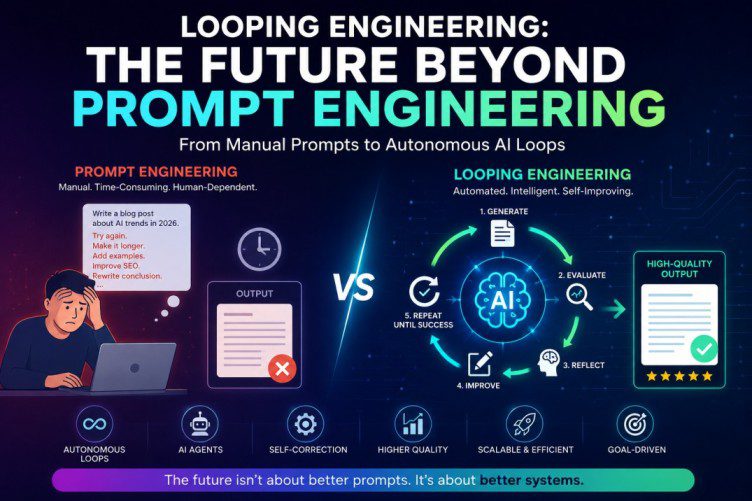
Input → AI → Output
Every request starts from scratch.
Nothing improves automatically.
Enter Looping Engineering
Looping Engineering changes the entire workflow.
Instead of one prompt producing one response, the AI continuously evaluates and improves its own work.
The workflow becomes:
Generate
↓
Evaluate
↓
Find mistakes
↓
Improve
↓
Repeat
↓
Final Answer
Instead of human iteration, the AI performs the iteration.
What Exactly is Looping Engineering?
Looping Engineering is the design of autonomous AI systems that repeatedly execute a cycle until a predefined goal is achieved.
Rather than optimizing prompts, engineers optimize feedback loops.
These loops often contain:
- Generation
- Reflection
- Validation
- Tool usage
- Memory
- Planning
- Self-correction
The AI becomes an autonomous worker rather than a simple text generator.
A Simple Example
Imagine asking AI:
Write a blog about electric cars.
Traditional Prompt Engineering
Prompt
↓
Article
↓
Human reviews
↓
Human edits prompt
↓
Generate again
Looping Engineering
Generate article
↓
AI checks SEO
↓
AI checks grammar
↓
AI checks plagiarism
↓
AI checks factual accuracy
↓
AI rewrites weak sections
↓
AI scores quality
↓
Repeat until quality score >95%
Only then does it return the article.
Why Looping Engineering Is Better
1. Self-Correction
Instead of waiting for humans,
the AI identifies its own mistakes.
Examples:
- spelling
- missing headings
- duplicate content
- weak introductions
- poor conclusions
2. Higher Quality
Every iteration improves the answer.
Version 1
↓
Version 2
↓
Version 3
↓
Version 7
↓
Final
The final response is usually much stronger.
3. Handles Complex Tasks
Prompt engineering struggles with:
- software development
- research
- multi-step planning
- business analysis
Looping Engineering excels because every step is independently evaluated.
4. Uses External Tools
Modern AI agents don’t only generate text.
They can:
- Search the web
- Run Python
- Execute code
- Read databases
- Access APIs
- Analyze spreadsheets
- Generate charts
- Edit images
Every tool becomes part of the loop.
5. Memory
Looping systems remember previous attempts.
Instead of repeating mistakes,
they improve from previous iterations.
The Core Components of Looping Engineering
Planning
The AI creates a roadmap before starting.
Instead of immediately answering,
it asks:
“What tasks must I complete?”
Generation
Produces an initial solution.
Evaluation
Scores its own output.
Checks include:
- completeness
- grammar
- SEO
- code quality
- readability
Reflection
The AI asks itself:
“What could be improved?”
Revision
Updates weak areas.
Validation
Ensures the final output satisfies all requirements.
Prompt Engineering vs Looping Engineering
| Feature | Prompt Engineering | Looping Engineering |
|---|---|---|
| Human effort | High | Low |
| Iteration | Manual | Automatic |
| Scalability | Limited | High |
| Self-improvement | No | Yes |
| Uses tools | Limited | Extensive |
| Memory | Minimal | Persistent |
| Handles complex workflows | Moderate | Excellent |
Real-World Applications
Software Development
AI writes code.
Tests it.
Finds bugs.
Fixes bugs.
Runs tests again.
Repeats until successful.
Content Creation
Generate article.
Check SEO.
Rewrite.
Improve readability.
Fact-check.
Create meta description.
Generate featured image.
Publish.
Customer Support
Understand customer intent.
Search documentation.
Generate answer.
Evaluate confidence.
Escalate if necessary.
Research
Search multiple sources.
Summarize.
Compare findings.
Detect inconsistencies.
Generate final report.
Data Analysis
Import spreadsheet.
Clean data.
Analyze trends.
Create charts.
Write executive summary.
The Rise of AI Agents
Looping Engineering is closely related to AI Agents.
Unlike traditional chatbots,
AI agents can:
- plan
- execute
- remember
- evaluate
- retry
- collaborate
Examples include coding assistants, autonomous research agents, and workflow automation systems.
Does This Mean Prompt Engineering Is Dead?
Not entirely.
Prompt Engineering remains valuable because every AI system still needs an initial instruction.
However, its role is changing.
Instead of spending hours crafting the “perfect prompt,” developers increasingly focus on designing intelligent systems that can refine and validate their own work.
Prompt Engineering is becoming one component of a much larger engineering discipline.
Skills Developers Should Learn
To stay relevant, developers should expand beyond prompt writing and learn:
- Agentic AI design
- Workflow orchestration
- AI evaluation techniques
- Retrieval-Augmented Generation (RAG)
- Function calling and tool integration
- AI memory systems
- Multi-agent collaboration
- Python automation
- API integration
- AI safety and validation
These skills enable the creation of autonomous AI systems rather than simple prompt-based interactions.
The Future of AI Development
The future isn’t about finding the perfect prompt.
It’s about building intelligent systems that:
- think
- evaluate
- learn
- retry
- improve
- collaborate
- solve problems autonomously
As AI models become more capable, engineers will spend less time instructing models and more time designing robust feedback loops that guide them toward better outcomes.
Looping Engineering represents this shift—from “prompting” AI to engineering AI processes.
Final Thoughts
Prompt Engineering played a crucial role in the early adoption of large language models, helping users unlock better results through carefully crafted instructions. But as AI evolves into autonomous, agentic systems capable of planning, evaluating, and refining their own work, the focus is shifting.
Looping Engineering doesn’t eliminate prompt engineering—it builds upon it. Prompts remain the starting point, but the real innovation lies in creating feedback loops that allow AI to improve without constant human intervention.
For developers, businesses, and AI enthusiasts, understanding Looping Engineering today is like learning cloud computing in its early days. It is quickly becoming a foundational skill for building the next generation of intelligent applications.
The future of AI isn’t just about asking better questions—it’s about designing systems that continuously discover better answers.