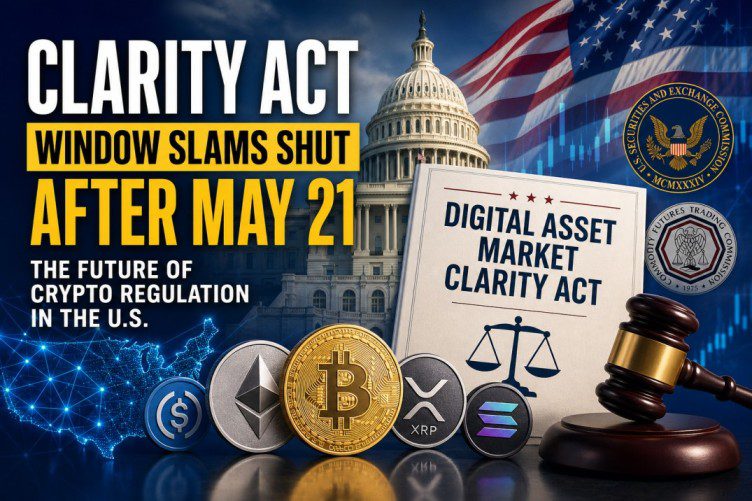
CLARITY Act Window Slams Shut After May 21: What It Means for Crypto Investors in 2026
The U.S. crypto industry may be approaching a major turning point as the legislative window for the Digital Asset Market CLARITY Act narrows after May 21. Lawmakers, crypto exchanges, blockchain startups, and investors are closely watching Congress because the bill could reshape cryptocurrency regulation in the United States.
For years, the American crypto market has operated under uncertainty. Questions about whether digital assets are securities or commodities have triggered lawsuits, confusion, and fear among investors and companies alike. The CLARITY Act was introduced to finally provide a clear regulatory framework — but delays in Congress now threaten its future.
If the bill fails to advance soon, the United States could risk losing crypto innovation, blockchain investment, and Web3 talent to other countries with clearer regulations.
What Is the CLARITY Act?
The Digital Asset Market CLARITY Act is a proposed U.S. crypto regulation bill designed to establish clear rules for digital assets and blockchain companies.
The legislation aims to:
- Define which cryptocurrencies are securities
- Clarify the role of the SEC and CFTC
- Create legal standards for crypto exchanges
- Protect consumers and investors
- Encourage blockchain innovation in the U.S.
One of the biggest goals of the bill is ending the long-running confusion between the:
Currently, both agencies claim authority over parts of the crypto market, creating uncertainty for projects like XRP, Ethereum, and many altcoins.
Why the May 21 Deadline Matters
The phrase “window slams shut after May 21” reflects growing concern that Congress may lose momentum on crypto legislation if progress is not made quickly.
After May:
- Political focus may shift toward elections
- Congressional priorities could change
- Crypto legislation may face delays into 2027
- Regulatory uncertainty could continue
This timeline is critical because lawmakers are still debating several key issues, including stablecoin regulation and investor protections.
Industry experts believe this may be one of the best opportunities in years for the United States to pass comprehensive crypto legislation.
SEC vs CFTC: The Core Battle
One of the biggest problems facing the crypto industry is the lack of clarity around which regulator controls digital assets.
SEC Position
The SEC has argued that many cryptocurrencies qualify as securities under U.S. law.
CFTC Position
The CFTC believes several major cryptocurrencies function more like commodities.
This disagreement has resulted in:
- Lawsuits against crypto exchanges
- Delisting of certain tokens
- Reduced investor confidence
- Uncertainty for blockchain developers
The CLARITY Act attempts to solve this issue by creating clearer definitions and regulatory pathways for crypto assets.
How the CLARITY Act Could Impact Crypto Markets
If passed, the bill could significantly affect the future of cryptocurrencies in America.
Bitcoin (BTC)
Bitcoin would likely benefit from:
- Greater institutional investment
- Stronger regulatory certainty
- Increased adoption by financial firms
As the most established cryptocurrency, Bitcoin is already widely viewed as a commodity.
Ethereum (ETH)
Ethereum’s future classification remains one of the most important questions in crypto regulation.
The CLARITY Act could:
- Clarify Ethereum’s legal status
- Support institutional Ethereum products
- Improve developer confidence
XRP and Ripple
XRP has become central to the crypto regulation debate because of Ripple’s legal battle with the SEC.
Many XRP supporters believe:
- The CLARITY Act could help define XRP more clearly
- Future enforcement-based regulation may decrease
- Similar blockchain projects could benefit
Altcoins and Web3 Projects
Smaller crypto projects may face:
- Registration requirements
- Compliance obligations
- Disclosure standards
However, clearer regulations may also:
- Reduce uncertainty
- Increase investor trust
- Encourage long-term growth
Stablecoin Debate Is Slowing Progress
One major issue delaying the bill involves stablecoins and crypto-related interest rewards.
Lawmakers and financial institutions disagree on:
- Whether stablecoins should offer yield
- How reserves should be regulated
- Whether stablecoins threaten traditional banks
These disagreements have complicated negotiations and slowed progress in Congress.
Stablecoins are considered critical because they play a major role in:
- Crypto trading
- Decentralized finance (DeFi)
- Blockchain payments
- Cross-border transfers
Why the Crypto Industry Supports the Bill
Many crypto companies strongly support the CLARITY Act because they believe the U.S. is falling behind other countries in blockchain innovation.
Regions already moving ahead with crypto regulations include:
- European Union
- Singapore
- United Arab Emirates
- Hong Kong
Supporters argue the bill could:
- Bring crypto businesses back to the U.S.
- Increase blockchain investment
- Create jobs
- Encourage responsible innovation
- Reduce lawsuits and enforcement actions
Several industry leaders warn that continued uncertainty may push developers and companies overseas.
What Happens If the CLARITY Act Fails?
If Congress fails to pass meaningful crypto legislation, the market could face continued uncertainty.
Possible consequences include:
- More SEC lawsuits
- Slower institutional adoption
- Crypto companies leaving the U.S.
- Reduced blockchain innovation
- Increased market volatility
Without regulatory clarity, investors may remain uncertain about:
- Which tokens are legal
- Which exchanges are compliant
- How future regulations will evolve
Why Crypto Investors Should Watch Closely
The outcome of the CLARITY Act could shape the next decade of the cryptocurrency industry.
Whether you invest in:
…the bill may influence how digital assets are regulated and adopted across the United States.
For crypto investors, this is more than politics — it could determine the future growth of the entire blockchain ecosystem.
The CLARITY Act represents one of the most important crypto regulation proposals in U.S. history. Supporters see it as a necessary step toward legal certainty and innovation, while critics remain cautious about financial risks and oversight.
With the legislative window shrinking after May 21, the coming weeks could become a defining moment for the future of cryptocurrency regulation in America.
If Congress succeeds, the U.S. could finally establish a clearer path for blockchain innovation and institutional crypto adoption. If not, uncertainty may continue for years.