Ripple’s Institutional Adoption and Strategic Partnerships: Driving the Future of Global Finance
Ripple has spent more than a decade positioning itself as a bridge between traditional finance and blockchain technology. While much of the cryptocurrency industry has focused on retail users and speculative trading, Ripple has pursued a different strategy—building enterprise-grade infrastructure for banks, payment providers, asset managers, and financial institutions.
In 2025 and 2026, Ripple accelerated this vision through a series of strategic partnerships, product launches, and institutional integrations that demonstrate growing confidence in blockchain-based financial infrastructure. From cross-border payments and digital asset custody to stablecoins and tokenized assets, Ripple is increasingly becoming a key player in the institutional digital asset ecosystem.
The Shift Toward Institutional Finance
The financial industry is undergoing a significant transformation. Institutions are exploring blockchain technology to improve payment efficiency, reduce settlement times, lower operational costs, and unlock new forms of liquidity.
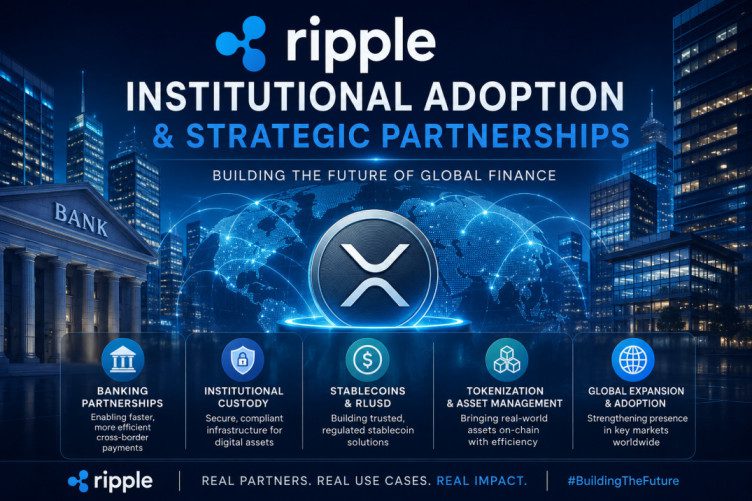
Ripple’s ecosystem addresses several of these challenges through:
- Ripple Payments for cross-border settlements
- Ripple Custody for secure digital asset storage
- RLUSD, Ripple’s enterprise-focused stablecoin
- XRP Ledger (XRPL) for tokenization and financial infrastructure
- Treasury and liquidity management solutions
This comprehensive approach has made Ripple attractive to financial institutions seeking regulated and scalable blockchain solutions.
AMINA Bank: A Landmark European Banking Partnership
One of Ripple’s most significant recent achievements was its partnership with Swiss-regulated AMINA Bank.
The collaboration marked the first time a European bank adopted Ripple Payments for cross-border transactions. Through the integration, AMINA Bank can connect blockchain-based assets with traditional banking infrastructure, enabling faster international transfers and improved access to stablecoin-based settlement solutions.
The partnership is particularly important because it demonstrates that regulated banks are increasingly willing to integrate blockchain technology into their core financial operations rather than treating digital assets as a separate experimental business line.
Ripple Custody: Building Institutional Infrastructure
Institutional adoption depends heavily on secure custody solutions. Banks, asset managers, and regulated entities require robust security, compliance, and governance before deploying digital asset services.
Ripple strengthened its custody offering through several strategic initiatives:
- Partnership with Figment to provide institutional staking services
- Integration with Chainalysis for compliance and transaction monitoring
- Partnership with Securosys for enterprise-grade security infrastructure
- Expansion of wallet and transaction-signing capabilities through acquisitions and technology integrations
These enhancements allow institutions to offer digital asset services while maintaining regulatory compliance and operational security.
RLUSD Expansion and Stablecoin Adoption
Stablecoins have become one of the fastest-growing sectors in digital finance, and Ripple’s RLUSD is emerging as a major institutional contender.
A significant milestone came in June 2026 when Ripple announced partnerships with Turkish digital asset platforms BiLira, Bitexen, and Bitlo. These partnerships expanded institutional access to RLUSD within Türkiye, allowing businesses and financial institutions to utilize the stablecoin for payments, collateral management, and tokenized finance applications.
Ripple reported that RLUSD reached approximately $1.7 billion in market capitalization, reflecting growing institutional demand for compliant and regulated stablecoin solutions.
Tokenization: Bringing Traditional Assets On-Chain
Perhaps the most exciting development for institutional finance is asset tokenization.
In 2026, Aviva Investors, one of Europe’s largest asset managers, partnered with Ripple to explore fund tokenization on the XRP Ledger. The initiative represents Ripple’s first major collaboration with a European asset management company and highlights growing interest in bringing traditional financial assets onto blockchain infrastructure.
Tokenization offers numerous benefits:
- Faster settlement times
- Reduced operational costs
- Improved transparency
- Increased liquidity
- Fractional ownership opportunities
Many industry experts believe tokenization could become one of the largest blockchain use cases over the next decade.
Expanding Into Capital Markets
Ripple’s institutional strategy extends beyond payments.
A notable example was the collaboration involving DBS Bank, Franklin Templeton, and Ripple. The initiative allows institutional investors to trade and utilize tokenized money market funds alongside RLUSD on regulated infrastructure. Franklin Templeton also selected XRP Ledger as part of the tokenization framework.
This development demonstrates how Ripple is moving into broader capital markets infrastructure rather than focusing solely on remittances.
Regional Growth: Brazil and Emerging Markets
Ripple continues to expand aggressively in high-growth markets.
In Brazil, the company announced a major expansion of its payments, custody, treasury management, and digital asset services. Ripple also signaled plans to seek additional regulatory approvals under Brazil’s evolving digital asset framework.
This strategy reflects Ripple’s long-term focus on regions where cross-border payments remain expensive and inefficient, creating strong demand for blockchain-based alternatives.
Institutional DeFi and the Future of XRPL
Ripple is also positioning XRP Ledger as a foundation for institutional decentralized finance (DeFi).
The company’s roadmap emphasizes:
- Compliance-friendly DeFi infrastructure
- Tokenized real-world assets
- Permissioned financial markets
- Identity verification systems
- Privacy-enhancing technologies
- Institutional lending and liquidity solutions
The goal is to create a blockchain environment that satisfies the requirements of regulated financial institutions while preserving the efficiency benefits of decentralized networks.
Why These Partnerships Matter for XRP
Institutional adoption has implications beyond Ripple’s business growth.
Every new bank, asset manager, fintech company, or payment provider that integrates Ripple’s technology strengthens the broader XRP Ledger ecosystem. Increased usage of Ripple’s infrastructure can drive:
- Higher transaction volumes
- Greater liquidity
- Expanded tokenization activity
- Stronger demand for blockchain settlement solutions
- Increased credibility among traditional financial institutions
While institutional adoption does not guarantee immediate price appreciation for XRP, it strengthens the fundamental utility and long-term value proposition of the ecosystem.
Conclusion
Ripple’s recent partnership announcements reveal a company that is evolving beyond its origins as a cross-border payments provider. Through collaborations with banks, asset managers, custody providers, stablecoin platforms, and financial institutions, Ripple is building a comprehensive digital finance infrastructure designed for institutional adoption.
The partnerships with AMINA Bank, Aviva Investors, Figment, Securosys, DBS, Franklin Templeton, and numerous regional financial institutions illustrate a broader trend: blockchain technology is increasingly moving from experimentation to real-world implementation.
As tokenization, stablecoins, digital custody, and on-chain finance continue to mature, Ripple appears well-positioned to play a central role in the next generation of global financial infrastructure.