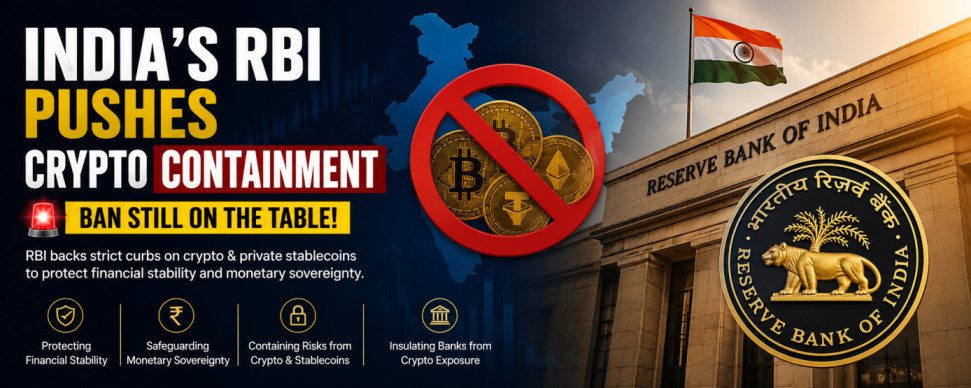
India’s RBI Pushes Crypto Containment: Is a Crypto Ban Coming? Everything Investors Need to Know
India’s RBI Wants to Keep Crypto Away from Banks. Does That Mean a Ban Is Coming?
India’s cryptocurrency industry is once again facing uncertainty after reports revealed that the Reserve Bank of India (RBI) reaffirmed its tough stance on digital assets during discussions with a parliamentary panel.
According to multiple reports, senior RBI officials believe that banks and regulated financial institutions should remain insulated from cryptocurrencies and privately issued stablecoins. The central bank argues that these assets provide little economic value, encourage speculation, and could eventually weaken India’s monetary sovereignty.
While India has not announced a cryptocurrency ban, the RBI’s latest comments show that one of the world’s largest economies remains highly cautious about integrating crypto into its financial system.
For investors, exchanges, and blockchain businesses, this signals that stricter regulation—not necessarily an outright ban—is likely to remain India’s preferred direction in the near term.
Key Takeaways
| Topic | Current Situation |
|---|---|
| Is crypto banned in India? | ❌ No |
| Is Bitcoin legal to own? | ✅ Yes, but heavily taxed |
| RBI supports banks offering crypto? | ❌ No |
| RBI supports private stablecoins? | ❌ No |
| 30% crypto tax remains? | ✅ Yes |
| 1% TDS still applies? | ✅ Yes |
| Digital Rupee supported? | ✅ Strongly |
Why Is RBI Still Against Cryptocurrencies?
The Reserve Bank of India has consistently warned about cryptocurrencies for several years. Its concerns extend beyond market volatility and focus on protecting India’s long-term financial system.
The RBI believes cryptocurrencies could introduce systemic risks if they become deeply connected with banks, payment networks, or everyday financial services.
Let’s examine the primary reasons behind its position.
1. Protecting India’s Monetary Sovereignty
One of the RBI’s biggest responsibilities is maintaining control over India’s money supply.
This allows the central bank to:
- Control inflation
- Manage liquidity
- Set interest rates
- Stabilize the economy during crises
If millions of people begin using cryptocurrencies or privately issued stablecoins instead of the Indian Rupee, the RBI’s ability to conduct effective monetary policy could gradually weaken.
This concern is commonly referred to as monetary sovereignty, and it is one of the strongest arguments behind the RBI’s cautious approach.
2. The RBI Views Most Cryptocurrencies as Speculative Assets
Unlike stocks or bonds that may represent ownership or cash flows, many cryptocurrencies derive their value largely from market demand.
The RBI has repeatedly argued that:
- cryptocurrencies lack intrinsic value,
- prices are highly volatile,
- markets are vulnerable to speculation, and
- retail investors can suffer significant losses during sharp corrections.
Events such as the collapses of major crypto firms in recent years have reinforced regulators’ concerns about investor protection.
3. Why Private Stablecoins Concern the RBI
Stablecoins are designed to maintain a relatively stable value, often by being pegged to fiat currencies like the US dollar.
Although they reduce price volatility compared with many cryptocurrencies, the RBI remains concerned because privately issued stablecoins could:
- compete with sovereign currencies,
- become widely used for payments,
- reduce reliance on the Indian Rupee, and
- shift financial influence toward private companies.
Global regulators have also increased scrutiny of stablecoins following several high-profile failures and reserve management controversies.
4. Consumer Protection Remains a Priority
The crypto market operates 24/7 and is known for rapid price swings.
Indian regulators worry that retail investors may be exposed to:
- exchange failures,
- fraud,
- scams,
- rug pulls,
- hacking incidents,
- misleading promotions, and
- extreme market volatility.
The RBI argues that stronger safeguards are necessary before cryptocurrencies become more integrated with the broader financial system.
What Does “Crypto Containment” Actually Mean?
The term crypto containment does not automatically mean banning cryptocurrencies.
Instead, it refers to limiting the connection between crypto markets and India’s regulated financial system.
Possible measures include:
- restricting banking services for crypto businesses,
- preventing banks from holding crypto assets,
- limiting institutional investment,
- tightening compliance standards,
- increasing reporting requirements, and
- restricting payment infrastructure used by crypto firms.
The objective is to reduce systemic financial risks while allowing policymakers additional time to develop a long-term regulatory framework.
Is India Planning to Ban Cryptocurrency?
Short answer: No—not at this time.
There is currently no law that bans owning or trading cryptocurrencies in India.
However, the RBI has consistently favored stricter controls and has previously expressed support for stronger restrictions.
Ultimately, only the Government of India and Parliament can introduce legislation that would impose a nationwide cryptocurrency ban.
At present, India’s regulatory approach remains focused on:
- taxation,
- compliance,
- anti-money laundering measures,
- investor disclosures, and
- monitoring crypto-related activities.
Current Crypto Rules in India (2026)
Indian crypto investors currently operate under one of the world’s stricter tax regimes.
30% Tax on Crypto Profits
Profits from virtual digital assets are taxed at a flat 30%, with limited ability to offset losses.
1% TDS on Eligible Transactions
A 1% Tax Deducted at Source (TDS) applies to many qualifying crypto transactions above prescribed thresholds, helping authorities track activity in the sector.
AML and KYC Compliance
Many crypto service providers must comply with anti-money laundering (AML) and know-your-customer (KYC) obligations.
These measures show that India has chosen oversight and taxation rather than an outright prohibition.
How Does India’s Crypto Policy Compare with Other Countries?
| Country | Crypto Policy |
|---|---|
| United States | Multiple regulators oversee exchanges and crypto products |
| European Union | MiCA provides a unified regulatory framework |
| Singapore | Strict licensing with strong compliance rules |
| Japan | Licensed exchanges under financial regulators |
| China | Broad restrictions on crypto trading and mining |
| India | High taxation, compliance requirements, cautious banking integration |
India’s approach sits between permissive regulation and complete prohibition.
What Could Happen Next?
Several developments could shape India’s crypto policy over the coming months:
- New parliamentary discussions
- RBI policy recommendations
- Global stablecoin regulations
- Expansion of the Digital Rupee (CBDC)
- G20 and Financial Stability Board guidance
- International crypto standards
Most experts expect India to continue favoring measured regulation and financial containment rather than making abrupt policy changes.
Frequently Asked Questions
Is cryptocurrency banned in India?
No. Cryptocurrency ownership and trading are not banned in India, although they are subject to taxation and regulatory compliance.
Does the RBI want to ban crypto?
The RBI has consistently expressed serious concerns about cryptocurrencies and has advocated limiting their integration with the banking system. However, any nationwide ban would require government legislation.
Can Indians still buy Bitcoin?
Yes. Indian residents can buy and sell cryptocurrencies through compliant platforms, subject to applicable laws, taxes, and regulatory requirements.
Why is the RBI promoting the Digital Rupee?
The RBI views the Digital Rupee as a government-issued digital currency that preserves monetary sovereignty while enabling secure digital payments under central bank oversight.
The RBI’s latest comments reinforce a long-standing policy preference: keep cryptocurrencies at arm’s length from India’s regulated financial system while continuing to evaluate their risks. Although this does not amount to an immediate ban, it signals that policymakers remain cautious about allowing digital assets and private stablecoins to become deeply embedded in the country’s financial infrastructure.
For investors, the key takeaway is to stay informed, comply with current tax and reporting obligations, and avoid assuming that today’s regulatory framework will remain unchanged. As India continues refining its approach to digital assets, future policy decisions will likely seek to balance innovation with financial stability, consumer protection, and the integrity of the monetary system.