

























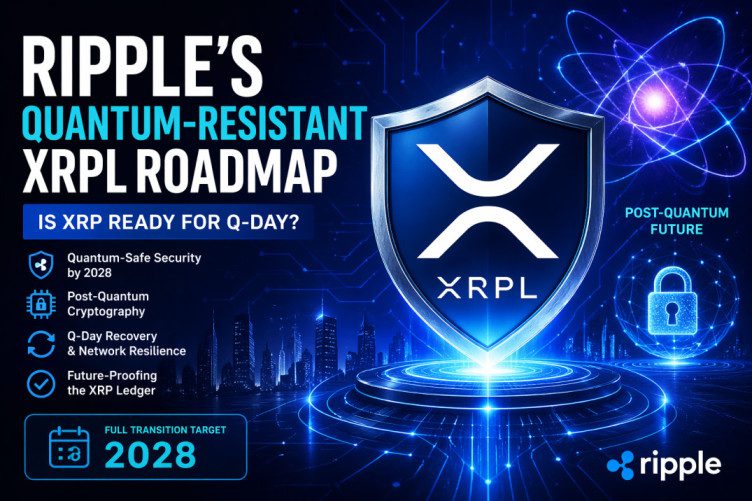
Ripple’s Quantum-Resistant XRPL Roadmap by 2028: Is XRP Preparing for the Future of Blockchain Security?
The blockchain industry is entering a new era — one where quantum computing could become both a revolutionary breakthrough and a massive cybersecurity threat. While many crypto projects are still discussing the risks, Ripple, creator of XRP Ledger (XRPL), has already announced a roadmap aimed at making the XRP Ledger quantum-resistant by 2028.
But what does this actually mean for investors, developers, and the future of crypto security?
Could quantum computers really break blockchains?
And why is Ripple moving early while most of the crypto market remains focused on price speculation?
Let’s dive deep into Ripple’s post-quantum strategy, XRPL’s security evolution, and what it could mean for the future of decentralized finance.
What Is Quantum Computing? 🤖⚛️
Quantum computing is a next-generation computing technology that uses qubits instead of traditional binary bits.
Unlike classical computers:
- A normal bit = 0 or 1
- A qubit = 0 and 1 simultaneously
This allows quantum computers to solve extremely complex mathematical problems exponentially faster than current machines.
Companies heavily investing in quantum technology include:
While quantum computing could revolutionize medicine, AI, and science, it also creates a serious issue:
Quantum Computers Could Break Current Cryptography
Most blockchains — including Bitcoin, Ethereum, and XRPL — rely on public-key cryptography.
Specifically:
- Elliptic Curve Cryptography (ECC)
- ECDSA signatures
- RSA systems
A sufficiently advanced quantum computer could theoretically crack these systems using Shor’s Algorithm.
That means:
❌ Wallet signatures could be forged
❌ Private keys could be extracted
❌ Blockchain security models could fail
This future event is often called:
“Q-Day” 🚨
Q-Day refers to the moment when quantum computers become powerful enough to break today’s encryption standards.
Ripple’s Quantum-Resistance Roadmap Explained 🛡️
Ripple recently revealed a phased plan to make the XRP Ledger quantum-resistant by 2028.
The roadmap includes:
1. Q-Day Contingency Recovery Planning
Ripple is preparing emergency procedures in case quantum threats emerge faster than expected.
This includes:
- Network recovery mechanisms
- Emergency validator coordination
- Wallet migration strategies
- Signature upgrade frameworks
This proactive preparation is significant because most blockchain projects have not publicly discussed operational Q-Day recovery plans.
2. Post-Quantum Cryptography (PQC) Testing
Ripple plans to test and integrate post-quantum cryptography algorithms recommended by:
National Institute of Standards and Technology (NIST)
These algorithms are specifically designed to resist attacks from quantum computers.
Potential technologies include:
- CRYSTALS-Dilithium
- Falcon
- SPHINCS+
These quantum-safe systems are already being studied globally for future internet security standards.
3. Hybrid Signature Systems
Ripple may initially deploy:
- Traditional cryptography
- Quantum-safe cryptography
…together in a hybrid model.
This approach helps ensure compatibility while gradually transitioning the network.
Benefits include:
✅ Lower migration risk
✅ Backward compatibility
✅ Easier developer adoption
✅ Network stability
4. XRPL Validator & AlphaNet Testing
Ripple plans extensive testing across:
- Devnets
- AlphaNet environments
- Validator infrastructure
The company is evaluating:
- Signature size increases
- Storage requirements
- Transaction speeds
- Bandwidth impacts
Quantum-safe cryptography typically requires much larger signatures than current systems, so performance optimization is critical.
5. Full Quantum-Safe Migration by 2028
Ripple’s final objective is a full transition toward:
Quantum-safe signatures on XRPL
This would make XRPL one of the first major blockchains to publicly target large-scale quantum resistance.
Why This Matters for XRP Holders 📈
For investors, Ripple’s roadmap is important for several reasons.
Long-Term Infrastructure Vision
Most crypto projects focus heavily on:
- Token price
- Marketing hype
- Meme culture
- Short-term adoption
Ripple’s quantum-resistance initiative signals long-term infrastructure thinking.
This appeals to:
- Institutional investors
- Banks
- Enterprise partners
- Governments
Enterprise Confidence
Ripple already works with financial institutions worldwide.
Future banking infrastructure will require:
- Regulatory-grade security
- Long-term resilience
- Future-proof encryption
Preparing for quantum threats strengthens Ripple’s institutional narrative.
XRPL Could Gain Competitive Advantage
If quantum computing advances rapidly, blockchains without migration plans may struggle.
Projects already testing post-quantum systems could gain major advantages.
XRPL’s early preparation may position it as:
✅ More secure
✅ More enterprise-ready
✅ Better prepared for future regulation
Is Quantum Computing an Immediate Threat? 🤔
Not yet.
Experts believe practical quantum attacks against major blockchains are still years away.
Current quantum computers:
- Lack sufficient stable qubits
- Have high error rates
- Cannot yet crack large-scale blockchain cryptography
However:
Security experts warn that preparation must happen early because migrating entire blockchain ecosystems takes years.
That’s why Ripple is acting now.
Could Bitcoin and Ethereum Face Similar Risks?
Yes.
Quantum computing is not an XRP-specific issue.
Major cryptocurrencies using elliptic curve cryptography could theoretically be vulnerable, including:
Some blockchain developers are already researching:
- Quantum-resistant wallets
- New signature standards
- Layer-2 protection systems
But Ripple is among the few major blockchain ecosystems publicly discussing a structured migration roadmap.
Potential Challenges Ripple May Face ⚠️
Despite the ambitious vision, several challenges remain.
1. Larger Transaction Sizes
Post-quantum signatures are significantly larger.
This could impact:
- Network throughput
- Storage
- Transaction efficiency
2. Ecosystem Migration Complexity
Wallets, exchanges, validators, and applications must all migrate together.
A fragmented upgrade could create compatibility issues.
3. Unknown Quantum Timeline
No one knows exactly when powerful quantum computers will arrive.
The industry could face:
- A slow transition
- Or a sudden technological leap
Ripple’s roadmap attempts to prepare for both scenarios.
What Experts Are Saying 🧠
Cybersecurity researchers generally agree that:
✅ Quantum threats are real
✅ Migration planning is necessary
✅ Early testing is critical
NIST has already spent years standardizing post-quantum cryptography for future internet infrastructure.
This means the broader tech industry is also preparing.
Ripple’s roadmap aligns XRPL with that larger global cybersecurity trend.
Final Thoughts: Is Ripple Future-Proofing XRP? 🚀
Ripple’s quantum-resistance roadmap represents something rare in crypto:
Long-term infrastructure planning.
Rather than waiting for quantum computing to become an emergency, Ripple is attempting to prepare XRPL years in advance.
While the roadmap is still in development, the initiative shows that Ripple is thinking beyond current market cycles and focusing on the future of secure global financial infrastructure.
If successful, XRPL could become one of the first major blockchains with a fully implemented quantum-safe architecture.
And in a world where cybersecurity threats evolve rapidly, that may become one of the most valuable features in crypto.

April 30, 2026 @ 4:11 am
Thanks for sharing this! If you need fast AI video generation, Pixwit (https://pixwit.ai) generates videos in just 2-5 minutes with professional-grade quality. The Video Agent feature is especially cool — you describe your idea in conversation and it refines across multiple rounds.
April 30, 2026 @ 4:11 am
Really enjoyed this article! For anyone who needs fast AI image generation, Nano Banana 2 (https://nanobanana2.love) is unbeatable — 4-6 seconds per request, up to 3-5x faster than Pro models. You can experiment freely, iterate in real time, and refine on the fly without waiting.