Social Media Ban for Under-16s: Giving Children Their Childhood Back in the Digital Age
“We are banning social media access for under 16s.”
This statement has become a growing policy discussion in countries around the world as governments, educators, psychologists, and parents grapple with the impact of social media on young people.
The argument is simple: today’s children are growing up in a world where technology influences nearly every aspect of their lives. Smartphones, social media platforms, online gaming, and digital entertainment dominate their attention from an increasingly young age.
Supporters of age restrictions argue that children deserve the opportunity to develop socially, emotionally, and mentally without the constant pressures of social media. Their goal is not to ban technology altogether but to help children reclaim a healthier childhood.
This article explores the reasons behind social media bans for under-16s, the data supporting these policies, potential benefits, criticisms, and what the future may hold.
The Rise of Social Media Among Children
Over the past decade, social media usage among children has skyrocketed.
According to research from Common Sense Media:
- More than 90% of teenagers use social media regularly.
- Children aged 8-12 spend an average of 5.5 hours daily on screens.
- Teenagers aged 13-18 spend approximately 8.5 hours daily on entertainment media.
Platforms such as Instagram, TikTok, Snapchat, YouTube, and others have become central to youth culture.
While these platforms provide opportunities for creativity and communication, they also expose children to:
- Cyberbullying
- Online predators
- Misinformation
- Unrealistic beauty standards
- Addictive algorithms
- Mental health risks
Why Governments Are Taking Action
Several governments believe social media companies have failed to adequately protect young users.
Australia Leads the Debate
Australia has emerged as one of the strongest advocates for restricting social media access for minors.
The Australian government argues that social media platforms are contributing to:
- Increased anxiety among young people
- Depression
- Sleep deprivation
- Self-esteem issues
- Online harassment
Policymakers believe that children should be allowed to mature before facing the challenges associated with social media environments.
The Mental Health Crisis Among Young People
One of the strongest arguments for social media restrictions is the growing mental health crisis affecting teenagers.
Anxiety and Depression
Studies have shown a correlation between excessive social media use and increased rates of:
- Anxiety disorders
- Depression
- Loneliness
- Emotional distress
According to the World Health Organization (WHO):
- Mental health conditions affect approximately 1 in 7 adolescents worldwide.
- Depression is among the leading causes of illness and disability among adolescents.
While social media is not the sole cause, researchers increasingly identify it as a contributing factor.
Sleep Disruption
Poor sleep is one of the most documented effects of excessive social media use.
Research indicates that:
- Teenagers who use social media late at night experience reduced sleep quality.
- Blue light exposure suppresses melatonin production.
- Notifications and online interactions encourage nighttime engagement.
The result is chronic sleep deprivation, which can negatively affect:
- Academic performance
- Mood regulation
- Physical health
- Cognitive development
Cyberbullying: A Growing Threat
Traditional bullying once ended when children returned home from school.
Today, cyberbullying can follow young people 24 hours a day.
Statistics show:
- Approximately one in three young people report experiencing some form of online bullying.
- Victims are more likely to experience anxiety, depression, and social withdrawal.
Common forms of cyberbullying include:
- Harassing messages
- Public humiliation
- Exclusion from online groups
- Sharing embarrassing content
Supporters of age restrictions argue that reducing social media exposure could significantly lower these risks.
The Addictive Nature of Social Media
Social media platforms are designed to maximize engagement.
Features such as:
- Infinite scrolling
- Likes and reactions
- Personalized recommendations
- Push notifications
trigger dopamine responses similar to those associated with other addictive behaviors.
Research from neuroscience experts suggests that adolescent brains are particularly vulnerable because they are still developing self-control and decision-making abilities.
This makes children more susceptible to compulsive social media use.
Impact on Academic Performance
Teachers increasingly report that smartphones and social media contribute to classroom distractions.
Several studies have found:
- Students who spend excessive time on social media tend to have lower academic performance.
- Frequent notifications interrupt concentration.
- Multitasking between studying and social media reduces learning efficiency.
By limiting access until age 16, policymakers hope students can focus more effectively on education and skill development.
The Benefits of a Social Media Ban for Under-16s
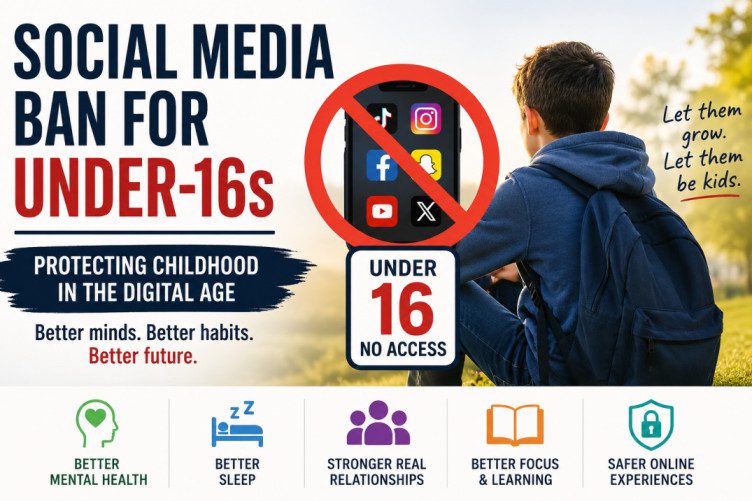
1. Improved Mental Health
Reduced exposure to social comparison and online pressure may lead to:
- Lower anxiety levels
- Improved self-esteem
- Better emotional resilience
2. Better Sleep
Without late-night scrolling and notifications, children are more likely to maintain healthy sleep patterns.
3. Stronger Real-World Relationships
Face-to-face interaction remains essential for social development.
Children may spend more time:
- Playing outdoors
- Participating in sports
- Joining clubs and activities
- Building friendships in person
4. Increased Focus on Learning
Fewer digital distractions can improve:
- Concentration
- Productivity
- Academic achievement
5. Safer Online Experiences
Younger children would be less exposed to:
- Harmful content
- Online predators
- Scams
- Misinformation
Criticisms of Social Media Bans
Not everyone supports banning social media for under-16s.
Critics argue:
Enforcement Challenges
Age verification systems are often easy to bypass.
Children may:
- Use false birth dates
- Access parents’ accounts
- Circumvent restrictions through technology
Social Isolation Concerns
Many young people use social media to:
- Maintain friendships
- Express creativity
- Access support communities
A complete ban may unintentionally isolate some users.
Digital Literacy Matters
Some experts believe the solution is education rather than prohibition.
They advocate teaching children:
- Online safety
- Critical thinking
- Responsible digital behavior
instead of restricting access entirely.
Finding the Right Balance
Most experts agree that technology itself is not the problem.
The challenge lies in creating healthy boundaries.
Parents, schools, governments, and technology companies all have a role to play by:
- Encouraging screen-time limits
- Promoting offline activities
- Improving digital literacy
- Strengthening online safety protections
- Designing child-friendly digital environments
The Future of Childhood in a Digital World
The debate over social media restrictions reflects a broader question:
How can society help children thrive in a world dominated by technology?
Supporters believe age restrictions can protect young minds during critical developmental years. Critics argue that education and responsible use are more effective long-term solutions.
Regardless of where one stands, there is growing agreement that children’s wellbeing must come before platform profits.
As governments continue exploring regulations, the ultimate goal remains the same:
To ensure that children grow up healthy, confident, and capable—while preserving the joy, curiosity, and freedom that define childhood.
Key Statistics at a Glance
| Metric | Figure |
|---|---|
| Adolescents affected by mental health conditions worldwide | 1 in 7 |
| Average screen time (ages 8-12) | 5.5 hours/day |
| Average entertainment media use (ages 13-18) | 8.5 hours/day |
| Youth reporting cyberbullying experiences | Approximately 33% |
| Global social media users | Over 5 billion |
| Teen social media usage rate | More than 90% |
Conclusion
The movement to restrict social media access for under-16s is not simply about limiting technology—it is about protecting childhood. As evidence linking excessive social media use to mental health challenges continues to grow, governments are increasingly considering stronger safeguards. Whether through bans, age verification systems, or digital education programs, the conversation highlights an urgent need to create a healthier relationship between young people and technology.