Nvidia Is Betting Singapore Can Become the World’s Real-World Testing Ground for Physical AI
The next major AI revolution may not happen inside chatbots or search engines. It could happen in streets, factories, hospitals, airports, warehouses, and autonomous delivery systems. That is the future of physical AI — and Nvidia believes Singapore could become one of the best places on Earth to build it.
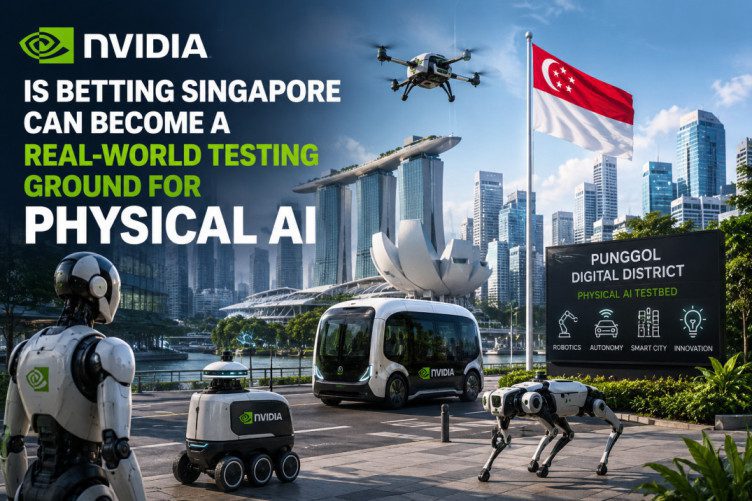
At the 2026 Asia Tech x Singapore Summit, Nvidia announced plans to launch a new AI research hub in Singapore focused on embodied AI and efficient AI computing. At the same time, Singapore revealed a large-scale physical AI testbed inside the Punggol Digital District, where robots, autonomous systems, and AI-powered infrastructure can operate in real-world public environments.
This is not just another AI lab announcement.
It is a signal that the AI industry is shifting from digital intelligence to real-world intelligence.
What Is Physical AI?
Physical AI refers to AI systems that interact with the real world through machines, sensors, robotics, vehicles, cameras, and automation systems.
Unlike traditional generative AI tools that mainly produce text or images, physical AI systems must:
- Understand surroundings
- Navigate unpredictable environments
- Make decisions in real time
- Interact safely with humans
- Learn from physical movement and sensory data
Examples include:
- Autonomous delivery robots
- Self-driving vehicles
- AI-powered manufacturing systems
- Warehouse robotics
- Smart surveillance systems
- Healthcare robots
- Intelligent drones
- Smart city infrastructure
Nvidia has increasingly positioned physical AI as the next frontier of computing. At GTC 2026, the company highlighted robotics, AI factories, autonomous systems, and simulation platforms as core future growth areas.
Why Singapore?
Singapore may look small geographically, but it has several advantages that make it ideal for real-world AI experimentation.
1. Highly Controlled Urban Environment
Singapore is one of the world’s most digitally connected cities. It has:
- Advanced infrastructure
- Dense urban planning
- Smart city systems
- Reliable connectivity
- Strong public transportation
- High regulatory efficiency
For AI companies, this creates a near-perfect “living laboratory” for testing autonomous systems safely and efficiently.
2. Government Support for AI
Singapore’s government has aggressively invested in AI research, deployment, and regulation.
Recent initiatives include:
- National AI strategy expansion
- AI safety evaluation frameworks
- AI “nutrition labels” for transparency
- AI adoption programs for businesses
- Partnerships with Nvidia, OpenAI, and Google DeepMind
Singapore’s leaders have repeatedly said the country wants to become neutral ground for global AI development while building trusted deployment frameworks.
3. Real-World Deployment Focus
Many countries are strong in AI research.
Very few are good at deploying AI into daily life.
Singapore is trying to bridge that gap.
The new Punggol Digital District testbed will allow multiple organizations to deploy physical AI systems simultaneously in public mixed-use environments.
That matters because physical AI cannot mature inside isolated labs alone.
Robots need exposure to:
- Human unpredictability
- Traffic conditions
- Weather
- Public safety constraints
- Infrastructure limitations
- Complex logistics
Singapore offers all of that in a compact, highly organized environment.
Nvidia’s Bigger Vision
Nvidia’s ambitions go far beyond GPUs now.
The company increasingly sees itself as the operating system for the AI economy.
Its strategy includes:
- AI chips
- Robotics platforms
- Simulation engines
- Autonomous vehicle systems
- Digital twins
- AI infrastructure
- Edge AI deployment
Physical AI sits at the center of all of these.
The company recently introduced its “Physical AI Data Factory Blueprint,” designed to automate training data generation and evaluation for robotics and autonomous systems.
This matters because physical AI needs enormous amounts of training data.
A robot learning to navigate a warehouse may need millions of simulated scenarios before operating safely in the real world.
Nvidia wants to provide:
- The hardware
- The simulation software
- The AI models
- The deployment infrastructure
- The testing ecosystem
Singapore could become the real-world proving ground for all of it.
Why Real-World Testing Matters
AI models inside chat apps can fail without major physical consequences.
Physical AI cannot.
A delivery robot crashing into pedestrians or an autonomous forklift malfunctioning inside a warehouse creates real safety risks.
That means physical AI development requires:
- Simulation environments
- Regulatory oversight
- Continuous testing
- Human monitoring
- Real-world validation
Singapore’s approach combines all of these elements.
The government is effectively building a national-scale AI sandbox where companies can test physical AI under controlled but realistic conditions.
That is incredibly valuable for Nvidia and its partners.
The Rise of Embodied AI
One phrase repeatedly appearing in Nvidia’s Singapore announcements is embodied AI.
Embodied AI refers to AI systems that learn through physical interaction with environments rather than only through digital data.
This includes:
- Robots learning movement
- AI systems understanding space
- Machines adapting to dynamic environments
- Human-robot collaboration
Nvidia’s new Singapore research hub will specifically focus on embodied AI and efficient AI computing.
This is important because embodied AI is widely considered one of the hardest problems in artificial intelligence.
Large language models can generate convincing text.
Teaching a robot to safely navigate crowded city streets is much harder.
Singapore’s Physical AI Testbed Could Change Multiple Industries
Manufacturing
Factories are becoming increasingly autonomous.
AI-powered robots can:
- Handle logistics
- Inspect products
- Manage inventory
- Assist assembly lines
Nvidia already works heavily in industrial AI and robotics.
Singapore’s manufacturing sector could become an ideal environment for testing next-generation automation.
Logistics and Delivery
The Punggol testbed reportedly includes collaborations involving delivery and robotics companies.
Possible applications include:
- Autonomous food delivery
- Smart warehouse movement
- AI traffic coordination
- Drone-assisted logistics
As e-commerce grows, physical AI could dramatically reduce delivery and operational costs.
Smart Cities
Singapore has long promoted itself as a smart city leader.
Physical AI could enhance:
- Traffic management
- Public safety
- Infrastructure monitoring
- Energy optimization
- Urban mobility
AI systems operating continuously across a city require both advanced infrastructure and public trust — two areas where Singapore excels.
Healthcare
Physical AI also has enormous healthcare potential.
Possible future applications:
- Hospital service robots
- Elderly care assistance
- Medical logistics automation
- AI-guided rehabilitation systems
With aging populations across Asia, healthcare robotics may become one of the biggest growth areas for embodied AI.
Why This Matters Globally
Singapore’s role here is bigger than local innovation.
It could become a global template.
Countries around the world are trying to figure out:
- How to regulate AI
- How to safely deploy robotics
- How to manage autonomous systems
- How to integrate AI into public spaces
Singapore is attempting to build practical answers.
If successful, the country could become:
- Asia’s physical AI hub
- A regulatory model for AI deployment
- A major robotics innovation center
- A global test environment for autonomous systems
And Nvidia appears eager to help shape that future.
The Geopolitical Angle
There is also a larger geopolitical dimension.
Singapore has positioned itself as neutral territory between U.S. and Chinese tech ecosystems.
That neutrality matters because AI is increasingly tied to:
- National security
- Semiconductor supply chains
- Data sovereignty
- Industrial competitiveness
By building AI partnerships with companies like Nvidia, OpenAI, and Google DeepMind while maintaining regional balance, Singapore becomes strategically important in the global AI race.
Challenges Ahead
Despite the excitement, physical AI still faces major hurdles.
Safety
Robots operating in public environments require extremely high safety standards.
One serious incident could slow adoption dramatically.
Regulation
Governments worldwide still lack mature frameworks for:
- Autonomous systems
- AI liability
- Robotics governance
- Public AI deployment
Singapore’s “AI nutrition labels” initiative shows regulators are already thinking ahead.
Energy Demands
AI infrastructure consumes massive power.
Singapore is also investing in energy-efficient AI systems and infrastructure optimization.
Public Acceptance
People must feel comfortable sharing environments with autonomous systems.
Trust will become one of the biggest competitive advantages in physical AI deployment.
The AI industry is entering a new phase.
The first wave was about digital intelligence:
- Chatbots
- Image generators
- Search assistants
- Coding copilots
The next wave is about machines interacting with the physical world.
Nvidia clearly believes physical AI could become as transformative as the internet or smartphones.
And Singapore may become one of the first places where that future is tested at scale.
If the experiment succeeds, the city-state could evolve into a global launchpad for:
- Robotics
- Autonomous systems
- Smart infrastructure
- Real-world AI deployment
The race for physical AI has already started.
And Nvidia is betting Singapore could become the world’s most important proving ground for it.