Alibaba Wants More Control Over China’s AI Stack
Artificial intelligence is no longer just a software race. The world’s biggest tech companies are now fighting for control over the entire AI ecosystem — from cloud infrastructure and chips to large language models and enterprise platforms. In China, one company pushing aggressively in this direction is Alibaba.
The Chinese tech giant wants deeper control over China’s AI stack as competition intensifies between domestic firms and global leaders like OpenAI, Google, Microsoft, and NVIDIA.
Alibaba’s strategy is about far more than chatbots. The company is positioning itself as a foundational AI infrastructure provider capable of powering China’s next generation of intelligent applications.
Why the AI Stack Matters
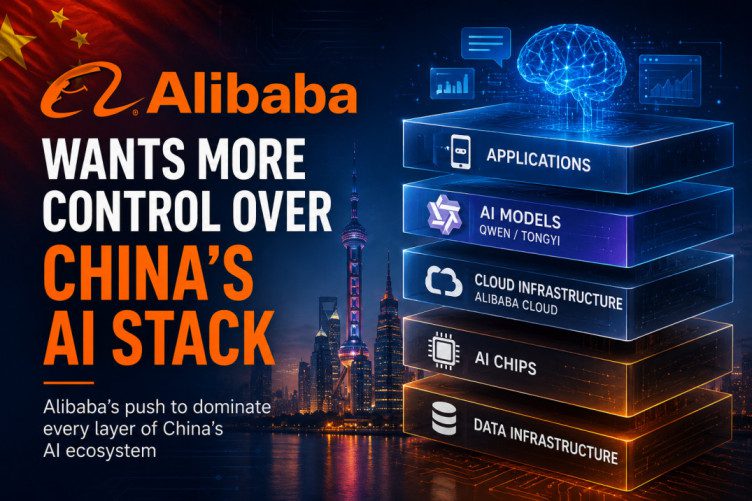
The “AI stack” includes every layer needed to build and deploy artificial intelligence systems:
- AI chips and hardware
- Cloud computing infrastructure
- Large language models (LLMs)
- Training data pipelines
- Developer tools
- Consumer AI products
- Enterprise AI services
Whoever controls the stack controls the future direction of AI innovation.
For years, many Chinese AI companies depended heavily on foreign technologies, especially advanced GPUs from NVIDIA. But increasing U.S. export restrictions and geopolitical tensions have forced Chinese tech firms to become more self-reliant.
Alibaba sees this as both a challenge and a massive business opportunity.
Alibaba’s Expanding AI Ambitions
Alibaba has rapidly expanded its AI ecosystem through its cloud division, AI research labs, and open-source model development.
The company’s AI model family, Tongyi Qianwen (also called Qwen), has become one of China’s most important large language model platforms. Alibaba is pushing these models into:
- E-commerce
- Enterprise automation
- Customer service
- Coding assistants
- AI agents
- Smart devices
- Cloud services
By integrating AI deeply into its existing ecosystem, Alibaba can leverage its massive user base and business infrastructure.
Its cloud computing arm, Alibaba Cloud, plays a crucial role in this strategy. Cloud infrastructure gives Alibaba direct control over how AI models are trained, deployed, and monetized.
China’s AI Race Is Intensifying
Alibaba is not alone.
Several Chinese tech giants are competing aggressively for dominance in AI:
Each company wants to own different layers of China’s AI infrastructure.
However, Alibaba has a major advantage: its enormous cloud ecosystem and enterprise reach. Many businesses in China already rely on Alibaba Cloud, making it easier for the company to integrate AI services directly into existing workflows.
The Hardware Challenge
One of the biggest obstacles for Chinese AI firms is semiconductor access.
Advanced AI models require massive computing power, and NVIDIA currently dominates the global AI chip market. U.S. restrictions on advanced chip exports to China have created uncertainty for Chinese tech companies.
As a result, Alibaba and other firms are investing heavily in domestic alternatives.
Alibaba has reportedly increased work on custom AI chips and partnerships with local semiconductor firms to reduce dependency on foreign hardware suppliers.
This reflects a broader trend in China’s tech industry: building a fully domestic AI supply chain.
Open Source as a Strategic Weapon
Alibaba has also embraced open-source AI development.
Its Qwen models have gained attention globally because developers can access and modify them more freely compared to some closed proprietary systems.
This strategy offers several benefits:
Faster Adoption
Developers and startups can build applications on top of Alibaba’s models.
Ecosystem Expansion
More developers using Qwen increases Alibaba’s influence in China’s AI market.
Reduced Dependence
China gains stronger domestic AI alternatives outside Western ecosystems.
Open-source AI has become a strategic battlefield globally, with companies racing to attract developers and enterprise customers.
AI and Alibaba’s Core Businesses
Alibaba is integrating AI across nearly every part of its empire.
E-Commerce
AI can improve:
- Product recommendations
- Search personalization
- Advertising optimization
- Customer support
- Supply chain forecasting
Platforms like Taobao and Tmall could become heavily AI-driven shopping ecosystems.
Cloud Computing
Enterprise AI services could become a major revenue engine for Alibaba Cloud.
Businesses increasingly want:
- AI copilots
- Automation tools
- AI-powered analytics
- Private enterprise LLMs
Alibaba aims to become the infrastructure provider behind these services.
Logistics
AI can optimize warehouse automation, route planning, and inventory management through Alibaba’s logistics arm, Cainiao.
The Global AI Power Struggle
Alibaba’s AI push is also part of a larger geopolitical shift.
The world is splitting into competing AI ecosystems:
- U.S.-led AI infrastructure
- China-led AI infrastructure
This division affects:
- Chips
- Cloud platforms
- AI models
- Data governance
- Regulations
- Developer ecosystems
China wants technological independence in critical industries, and AI sits at the center of that goal.
Alibaba’s effort to control more of China’s AI stack aligns closely with national priorities around technological self-sufficiency.
Risks and Challenges
Despite its advantages, Alibaba faces several risks.
Heavy Competition
China’s AI market is crowded and highly competitive.
Regulatory Pressure
Chinese tech firms operate under strict government oversight.
Infrastructure Costs
Training large AI models requires enormous investment in data centers and hardware.
Monetization Uncertainty
Many AI companies are still searching for sustainable business models.
Global Restrictions
U.S. sanctions and export controls may continue limiting access to advanced technologies.
Why This Matters Globally
Alibaba’s AI expansion is important not just for China, but for the global technology landscape.
If Alibaba successfully builds a strong domestic AI ecosystem, it could:
- Reduce China’s dependence on Western AI firms
- Accelerate Chinese AI innovation
- Increase global AI competition
- Create alternative AI standards and ecosystems
The battle over AI is increasingly about infrastructure control rather than just consumer-facing applications.
Companies that own the entire AI stack may become the dominant technology powers of the next decade.
Alibaba’s push for greater control over China’s AI stack represents a major strategic shift in the global AI race.
The company is no longer simply an e-commerce giant. It is transforming into a full-scale AI infrastructure provider competing across cloud computing, large language models, semiconductors, and enterprise AI.
As AI becomes central to economic and technological power, controlling the underlying infrastructure may matter more than any single chatbot or application.
Alibaba clearly wants to be one of the companies shaping that future.