How AI Is Transforming WordPress Core — And Why It Matters for the Future of the Web
Artificial intelligence is changing how websites are built, managed, and optimized. From AI-generated content to automated customer support, businesses are already using AI tools to save time and improve productivity.
Now, WordPress is preparing for a much bigger transformation.
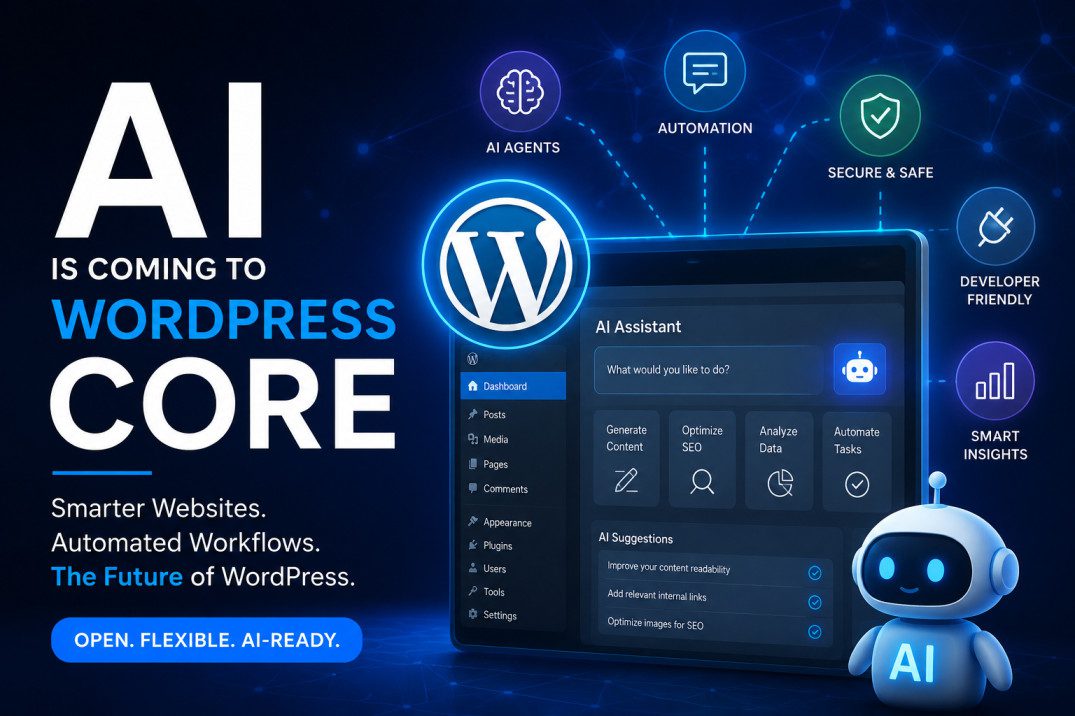
Instead of treating AI as just another plugin feature, the WordPress ecosystem is building a foundation that allows AI systems to work directly with WordPress in a smarter, safer, and more standardized way.
This shift could completely change how developers create plugins, how businesses manage websites, and how users interact with WordPress in the coming years.
In this article, we’ll explore:
- what the WordPress AI initiative actually means
- how AI is being integrated into WordPress Core
- why developers and site owners should care
- what the future of AI-powered WordPress could look like
Why WordPress Needs an AI Infrastructure
For years, AI integration in WordPress has been fragmented.
Every plugin developer created their own system for:
- AI API connections
- prompt handling
- authentication
- workflows
- automation logic
As a result, most AI plugins work independently and rarely communicate with each other efficiently.
This creates several problems:
- duplicated development work
- inconsistent user experiences
- compatibility issues
- limited scalability
To solve this, WordPress contributors are working on a shared AI infrastructure that can be used across the entire ecosystem.
The goal is simple:
Instead of hundreds of disconnected AI solutions, WordPress wants a common framework that developers can build on.
This approach makes WordPress more future-ready while keeping the platform open and flexible.
What Does “AI in WordPress Core” Really Mean?
When people hear “AI in WordPress,” they usually think about:
- AI writing tools
- chatbots
- image generation
- SEO assistants
But the new direction goes far beyond content generation.
The real focus is building systems that allow AI to:
- understand WordPress functionality
- interact with plugins safely
- automate workflows
- manage website tasks
- communicate with external AI assistants
In simple terms, WordPress is becoming more “AI-aware.”
This means AI tools can eventually understand what your website can do and interact with it more intelligently.
The Three Major Building Blocks of WordPress AI
The current AI initiative revolves around three important components.
1. Abilities API
The Abilities API acts like a communication layer between WordPress and AI systems.
It allows plugins and websites to describe their capabilities in a structured format.
For example, a plugin could tell an AI assistant:
- how to create a blog post
- how to edit products
- how to update SEO settings
- how to fetch analytics data
Instead of AI tools guessing how a plugin works, they can read standardized instructions directly from WordPress.
This improves:
- reliability
- security
- automation
- interoperability
It also makes plugin development much easier because developers no longer need to create custom AI integrations from scratch.
2. MCP Integration
Another important technology being introduced is support for MCP (Model Context Protocol).
MCP is a protocol designed to help AI assistants communicate with external tools and applications.
In practical terms, this means AI systems like ChatGPT, Claude, Cursor, and AI coding assistants could eventually interact directly with WordPress websites.
Imagine typing commands like:
- “Publish a new blog post about SEO trends.”
- “Show products with low inventory.”
- “Generate meta descriptions for all pages.”
- “Find broken internal links.”
Instead of manually navigating dashboards, AI agents could perform those tasks automatically.
This is one of the biggest reasons the WordPress AI project is generating attention.
3. WordPress AI Client SDK
The third major piece is a shared AI client system.
Right now, many plugins create separate integrations for:
- OpenAI
- Anthropic
- Google Gemini
- other AI providers
This often leads to duplicate code and inconsistent setups.
A centralized AI client layer allows developers to:
- switch providers more easily
- reuse integrations
- simplify API management
- create consistent AI experiences
Most importantly, WordPress is taking a provider-neutral approach.
That means developers and site owners are not locked into one AI company.
This flexibility is extremely important for the long-term future of open-source AI development.
Why This Matters for Developers
For WordPress developers, AI integration is becoming a major opportunity.
As AI adoption grows, businesses will increasingly look for:
- AI-powered plugins
- workflow automation
- smart admin tools
- AI-enhanced WooCommerce stores
- intelligent content systems
Developers who understand the new WordPress AI architecture will have a strong advantage.
Instead of building isolated tools, developers will be able to create AI-ready plugins that integrate naturally with the broader ecosystem.
This could lead to entirely new categories of WordPress products.
- AI-powered SEO management
- automated content workflows
- conversational dashboards
- smart analytics systems
- autonomous store management tools
Why It Matters for Website Owners
The benefits are not limited to developers.
Site owners and businesses could see major productivity improvements from AI-powered WordPress systems.
In the future, website management may become much simpler.
Instead of spending hours navigating settings and dashboards, users could simply ask AI assistants to perform tasks.
- “Optimize my homepage for SEO.”
- “Create product descriptions for new inventory.”
- “Summarize this week’s sales performance.”
- “Generate social media captions from recent blog posts.”
AI assistants could handle repetitive administrative work automatically.
This saves time while making WordPress easier for beginners and non-technical users.
The Future of AI Agents in WordPress
One of the most exciting developments is the rise of AI agents.
Unlike simple AI chatbots, AI agents can:
- make decisions
- complete workflows
- interact with software systems
- perform multi-step tasks
WordPress is gradually preparing for this future.
By exposing website capabilities through structured APIs and protocols, WordPress can allow AI agents to safely interact with websites.
This could eventually enable:
- automated site maintenance
- intelligent customer support
- AI-driven eCommerce operations
- smart content publishing
- personalized user experiences
Security and Privacy Will Be Critical
Of course, giving AI systems access to websites introduces important security concerns.
That is why the WordPress AI initiative focuses heavily on:
- permissions
- authentication
- structured access control
- safe execution rules
AI should not receive unlimited control over websites.
Instead, developers will define exactly:
- what actions are allowed
- who can access them
- what data can be shared
WooCommerce Could Benefit Massively
AI-powered automation could have a huge impact on WooCommerce stores.
Store owners often spend countless hours managing:
- inventory
- product descriptions
- customer support
- analytics
- marketing campaigns
AI systems could automate many of these processes.
- generating product descriptions
- monitoring stock levels
- creating discount campaigns
- identifying abandoned cart trends
- answering customer questions
WordPress Is Staying Open in the AI Era
One of the most important aspects of this initiative is openness.
Many platforms are building AI features inside closed ecosystems controlled by large companies.
WordPress is taking a different approach.
The ecosystem is focusing on:
- open standards
- interoperability
- flexibility
- provider independence
This keeps WordPress aligned with its open-source philosophy while still embracing modern AI technology.
What the Future Could Look Like
The next generation of WordPress may look very different from today’s CMS experience.
In the coming years, we may see:
- AI-managed websites
- conversational admin dashboards
- autonomous SEO optimization
- smart publishing systems
- AI-driven eCommerce operations
- intelligent plugin ecosystems
Instead of manually configuring every detail, users may collaborate with AI assistants to manage websites more efficiently.
This does not mean developers will disappear.
In fact, developers who understand AI systems will become even more valuable.
The role of developers may simply evolve from building static interfaces to creating intelligent systems and workflows.
AI is no longer just an optional feature in WordPress.
It is becoming part of the platform’s long-term direction.
By introducing shared AI infrastructure, standardized integrations, and support for AI agents, WordPress is preparing for the next era of the web.
For developers, this creates exciting opportunities to build smarter plugins and automation tools.
For businesses, it could simplify website management and improve productivity.
And for the open web, it shows that WordPress intends to remain a major player in the age of artificial intelligence.
The future of WordPress may not just be about managing content.
It may be about managing intelligent digital experiences powered by AI.