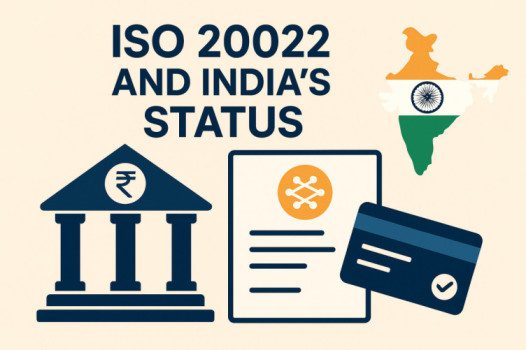
ISO 20022 and India’s Status
What Is ISO 20022?
ISO 20022 is a modern global messaging standard that allows banks and payment systems to send rich, structured, and secure financial data. Unlike old MT messages, ISO 20022 uses XML-based MX messages that support detailed information such as purpose codes, invoice references, and enhanced compliance data.
In simple words:
It is the new language of global payments.
Why ISO 20022 Matters for the Future of Payments
ISO 20022 is becoming the backbone of modern payments across the world because it enables:
1. Richer Payment Data
Banks can include more information, reducing manual checks and reconciliation delays.
2. Improved Fraud & AML Screening
Structured data helps systems detect suspicious transactions more accurately.
3. Better Global Interoperability
Most leading economies are upgrading RTGS systems, cross-border payments, and real-time networks to ISO 20022.
4. Foundation for Faster Payments and CBDCs
Central banks globally consider ISO 20022 essential for digital currencies and instant payment rails.
Global Status: Where the World Stands Today
- SWIFT migration began in March 2023.
- Coexistence of MT + MX ends on 22 November 2025.
- After this date, cross-border payments will rely fully on ISO 20022.
- Europe, U.S., U.K., Australia, and Singapore already run ISO 20022-compliant RTGS systems.
ISO 20022 is no longer “the future” — it is the new normal for global banking.
🇮🇳 ISO 20022 India Status (2025 Update)
India has made important progress, but readiness varies across institutions. Here’s a clear breakdown:
1. RBI’s Status on ISO 20022
The Reserve Bank of India has been steadily upgrading payment infrastructure:
RTGS Upgrade
- India’s RTGS system now supports ISO 20022-compliant formats.
- Banks are expected to migrate message formats for better compatibility with global systems.
Regulatory Direction
RBI has already issued guidance to ensure smooth SWIFT MX migration by November 2025.
Verdict: RBI is aligned with ISO 20022 and pushing banks to complete migration.
2. NPCI & UPI Status
NPCI runs UPI, RuPay, IMPS, and other retail payment systems.
- UPI follows its own message standards (not ISO 20022).
- But for global expansion (like UPI–Singapore PayNow), alignment with ISO 20022 becomes important.
- NPCI is actively exploring ISO-compatible structures for international interoperability.
Verdict: UPI is not ISO 20022-native, but NPCI is preparing for future cross-border alignment.
3. Indian Banks: Ready or Not?
Mixed picture:
Large Banks (SBI, HDFC, ICICI, Axis)
✔️ Already support ISO 20022 for cross-border messaging
✔️ Running MX testing with SWIFT
✔️ Internal upgrades under way
Mid-size and Smaller Banks
⚠️ Many are still behind
⚠️ Testing gaps
⚠️ Legacy systems not upgraded
⚠️ Risk of payment delays after Nov 2025
Industry reports in 2025 warned that several Indian banks needed to accelerate migration to avoid disruptions.
Verdict: Leadership banks are ready; others risk compliance issues by 2025.
4. Corporate Treasuries & Exporters
Companies depending on cross-border payments must ensure:
- Banks support MX messages
- ERP systems can consume ISO 20022 data
- Remittance fields are mapped correctly (invoice, UTR, purpose code)
Many Indian exporters and IT services companies have started upgrading ERP/finance modules accordingly.
⭐ India’s Overall Readiness Score (2025)
7 / 10
- RBI — Ready
- Major banks — Nearly ready
- Smaller banks — Lagging
- NPCI — Preparing for global formats
- Corporates — Partial adoption
📌 Risks for India If Migration Is Delayed
If some banks are not ready by 22 Nov 2025, India may face:
- Failed cross-border transactions
- Payment delays
- Compliance rejections
- Manual reconciliation issues
- Bad customer experience for exporters/importers
This is why RBI, IBA, and SWIFT India are running migration workshops.
💡 ISO 20022 Benefits for India
Once fully adopted, India gains:
1. More Reliable Cross-Border Payments
Faster, transparent, and trackable payments for businesses.
2. Improved Regulation & AML Compliance
Better data → stronger fraud detection.
3. Stronger Position in Global Trade
India becomes more interoperable with global financial systems.
4. Foundation for Digital Rupee (CBDC)
RBI’s CBDC retail/pilot systems can integrate seamlessly with ISO 20022.
🔧 What Indian Banks Must Do in 2025
- Complete MX testing with SWIFT
- Upgrade AML/screening systems
- Fix translation gaps between MT ↔ MX
- Train operations teams
- Update customer communication
- Test cross-border flows end-to-end
🧾 FAQs on ISO 20022 & India
1. Is India already using ISO 20022?
Partially — RTGS supports it, but full SWIFT MX migration is still ongoing.
2. Will UPI adopt ISO 20022?
Not immediately. But NPCI plans ISO-based compatibility for international corridors.
3. What is the deadline for Indian banks?
22 November 2025, when SWIFT ends MT coexistence.
4. Will payments fail if banks are not ready?
Yes — cross-border payments may be rejected or delayed.
Is India Ready for ISO 20022?
India is well positioned thanks to proactive RBI actions and strong adoption by major banks, but the ecosystem is not evenly ready. Smaller banks need rapid migration to avoid disruption after November 2025. With India’s growing trade volume and UPI’s international expansion, full ISO 20022 readiness will be crucial for reliability, compliance, and future innovation.