ISO 20022 & Crypto: The Complete Guide to Tokens Mentioned and Their Eligibility
ISO 20022 & Crypto: What It Means for the Future of Digital Payments
If you’ve been watching the evolution of global finance, you’ve probably seen the term ISO 20022 everywhere. It’s not just another technical upgrade — it’s a massive shift in how financial messages, payments, and settlement systems talk to one another.
For crypto investors, this update matters more than ever.
Because several blockchain projects are being highlighted for their compatibility with the new messaging standard — a move that could play a big role in bridging traditional finance and digital assets.
Below, we break down what ISO 20022 actually is, what’s changing, and the tokens most commonly mentioned in this ecosystem.
What’s Changing With ISO 20022?
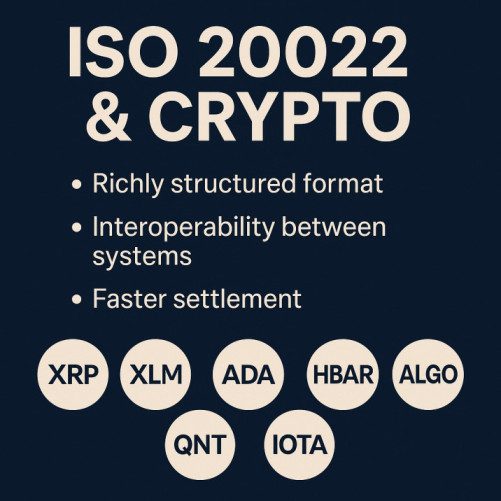
ISO 20022 introduces a richer, more structured format for global financial messaging. Think of it as upgrading from SMS to WhatsApp — more data, more flexibility, better communication.
Key Improvements:
✅ Richly structured format with detailed metadata
Messages now carry more information, improving transparency, risk analysis, and automation.
✅ Enhanced interoperability between systems
Banks, institutions, and payment rails worldwide can connect more smoothly — crucial for global finance.
✅ Faster settlement capabilities
Improved efficiencies could reduce delays and errors in cross-border payments.
Tokens Frequently Mentioned in the ISO 20022 Conversation
While ISO 20022 doesn’t “approve” or officially endorse any crypto, certain blockchain projects are highlighted for building systems aligned with the messaging standards and interoperability goals.
Commonly Mentioned Tokens:
These cryptocurrencies are known for either solving payments, interoperability, scalable settlement, or institutional-grade use cases.
Why These Tokens Stand Out: Eligibility & Use Cases
Below are the tokens mentioned and why they’re considered relevant in conversations around ISO 20022 adoption:
🔹 XRP & XLM — Cross-Border Payment Specialists
-
Known for speed, low fees, and institutional-level infrastructure.
-
Designed for remittances and financial messaging.
-
Ripple and Stellar networks are widely discussed for modernizing cross-border settlements.
🔹 ADA (Cardano) — Smart Contract Capable Blockchain
-
Built for scalability and formal verification.
-
Could support financial-grade smart contracts in the future.
-
Strong academic foundation.
🔹 HBAR (Hedera) — Enterprise & Institutional Use Cases
-
High-speed, energy-efficient hashgraph technology.
-
Governance council includes major global corporations.
-
Suitable for regulated environments.
🔹 ALGO (Algorand) — Scalable Payment Network
-
Fast, secure, and built for high-throughput payments.
-
Known for government and institutional partnerships.
-
Suitable for CBDCs (Central Bank Digital Currencies).
🔹 QNT (Quant Network) — Interoperability Layer
-
Not just a token — an entire blockchain-agnostic OS called Overledger.
-
Designed to connect banks, chains, and enterprise networks.
-
Highly aligned with interoperability goals of ISO 20022.
🔹 XDC — Trade Finance & Tokenization
-
Built for enterprise-grade trade finance solutions.
-
Works with private + public chain hybrid architecture.
-
Popular for real-world tokenization use cases.
🔹 IOTA — Real-Time Value Transfers
-
Focused on IoT and machine-to-machine payments.
-
No fees, scalable structure.
-
Ideal for automation and real-time microtransactions.
Why ISO 20022 Matters for Crypto Investors
ISO 20022 is becoming the global standard for banks, SWIFT, and payment infrastructures.
This upgrade could:
-
Improve acceptance of blockchain-based settlement solutions
-
Enable better integration between banks & crypto networks
-
Bring legitimacy and real-world use cases to compliant projects
-
Drive institutional interest toward efficient digital assets
While crypto involvement is still evolving, tokens aligned with fast settlement, interoperability, and enterprise-grade solutions are positioned to benefit from the shift.
Final Thoughts
ISO 20022 is more than a technical update — it’s a bridge between old banking rails and modern digital financial systems. And blockchain projects that solve real-world settlement, payment, and interoperability challenges naturally fit into this new era.
Whether you’re an investor or simply exploring the future of finance, understanding these token use cases offers a strong glimpse into what’s ahead.