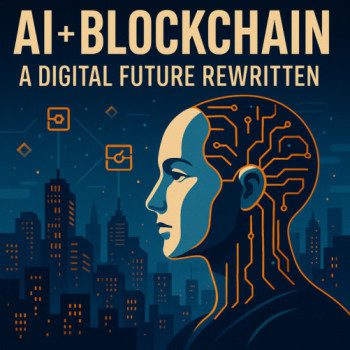
AI + Blockchain: How Artificial Intelligence Is Changing Crypto
In the year 2025, the digital world felt like a bustling city—alive, fast, chaotic. Crypto investors darted through glowing marketplaces, blockchains hummed beneath the streets, and data flowed like energy through invisible wires.
But something new was rising on the horizon.
A silent mind.
A brilliant observer.
An intelligence that didn’t sleep.
AI had entered the city.
And from the moment it arrived, everything began to change.
Chapter 1: The Market That Never Sleeps
Ethan, a young crypto trader, used to stay awake at night staring at charts. Candles went up, candles went down, and his emotions followed every tick.
Then one night, exhaustion took over. Ethan fell asleep on his keyboard.
When he woke up, something strange had happened—
his portfolio had grown… without him.
His AI trading bot had been watching the market the whole time.
It didn’t panic when Bitcoin dipped.
It didn’t get greedy when altcoins pumped.
It analyzed millions of data points—order books, global news, even social media moods—and executed flawless trades.
Ethan realized something profound:
AI wasn’t just helping him trade. It was rewriting the rules of trading itself.
Chapter 2: The Invisible Guardians of Blockchain City
Meanwhile, on the other side of the digital metropolis, a group of developers sat in a dark room staring at lines of smart contract code.
“Something’s wrong,” Maya whispered. “Someone’s trying to exploit the contract.”
Before anyone could react, a small window popped up on her screen:
ALERT: Vulnerability detected. Exploit attempt blocked.
AI Defensive Protocol Activated.
AI didn’t just detect threats—it predicted them, scanned for weaknesses, patched vulnerabilities, and shielded the blockchain like a digital guardian.
Hackers were still clever.
But AI was learning faster than they could attack.
The blockchain city felt… safer.
Chapter 3: The Network That Grew Smarter
There was a problem in the city, though: traffic.
As more people piled into the crypto world, blockchains became congested—slow transactions, soaring gas fees, frustrated users.
Then AI stepped in, studying the network like a doctor listening to a heartbeat.
It predicted congestion before it happened.
It rerouted transactions to keep the system flowing.
It even suggested energy-saving methods for mining rigs.
And one day, for the first time, the network seemed to breathe more easily.
Blockchain wasn’t just running—it was adapting.
Chapter 4: Smart Contracts That Could Learn
A startup called NovaChain Labs was building the next big thing. Their engineers had a dream:
“What if smart contracts weren’t just smart…
What if they were wise?”
So, they trained AI models to analyze data, interpret real-world events, and even adjust contract logic over time.
Suddenly, smart contracts began responding to the world around them:
- Insurance payouts triggered by real weather data
- DeFi protocols that self-corrected based on performance
- DAOs whose decisions were informed by predictive AI governance engines
The line between code and intelligence blurred.
Blockchain felt… alive.
Chapter 5: The New Face of Web3
Not everyone in Blockchain City was a developer or a trader. Many newcomers felt lost—wallets were confusing, dApps were overwhelming, and crypto jargon felt like a foreign language.
AI saw their struggle.
So it became a guide.
A voice in your ear showing where to click.
A helpful assistant suggesting NFTs you might actually like.
A translator explaining gas fees in simple words.
A companion that made Web3 feel welcoming instead of intimidating.
With AI by their side, ordinary users became confident explorers of the decentralized world.
Chapter 6: The Power of Decentralized AI
Deep beneath the city, in the data vaults where information was stored, a revolution was brewing.
AI needed data to learn.
People owned that data.
Blockchain made it possible to share, rent, or sell that data securely.
This birthed AI marketplaces—places where anyone could contribute knowledge, train models, and earn tokens.
No tech giant controlled the AI.
No corporation owned the intelligence.
The people did.
It was AI by the community, for the community.
A new chapter of digital freedom.
Chapter 7: The Birth of the Machine Economy
One morning, the citizens of the blockchain city noticed something unusual.
Wallets were making decisions.
Machines were paying machines.
AI agents were negotiating prices, optimizing yields, and running decentralized apps—all autonomously.
Crypto wasn’t a tool anymore.
It had become an ecosystem where humans and intelligent agents lived side by side.
Some were startled.
Others were excited.
But everyone agreed on one thing:
The future of crypto wouldn’t be built by humans alone…
It would be built with AI.
Epilogue: A Future Rewritten
As night fell over the digital city, lights glowed softly across the blockchain skyline. Networks pulsed with newfound intelligence. Markets moved with machine precision. Smart contracts evolved. DAOs made informed decisions. Ordinary users navigated Web3 with ease.
AI wasn’t here to replace blockchain.
It was here to elevate it.
And together, they were shaping a future more powerful than either could have built alone.
The story of AI + Blockchain had only just begun.