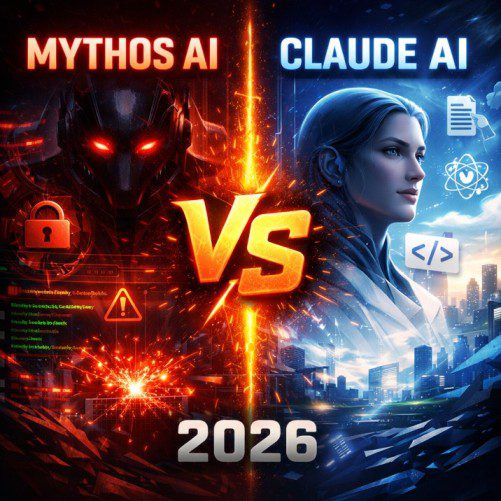
Mythos vs Claude (AI Models Explained – 2026 Deep Dive)
The AI race in 2026 is no longer just about chatbots—it’s about power, safety, and control. While Claude is already widely used for writing, coding, and business tasks, a new name has emerged: Mythos.
But here’s the twist 👉 Mythos is not a separate competitor. It is actually a next-generation experimental version of Claude itself, often referred to as Claude Mythos.
This blog breaks down everything you need to know.
🧠 What is Claude?
Claude is a family of large language models developed by Anthropic, first launched in 2023.
🔑 Key Features
- Advanced natural language understanding
- Strong coding + reasoning abilities
- Handles long documents (100K+ tokens)
- Built using Constitutional AI (safety-first approach)
📌 Popular Versions
- Claude Haiku (fast & lightweight)
- Claude Sonnet (balanced)
- Claude Opus (most powerful)
💼 Use Cases
- Blogging & content writing
- Customer support automation
- Programming & debugging
- Research & summarization
👉 In short: Claude = practical AI for everyday users and businesses
🔮 What is Mythos (Claude Mythos)?
Claude Mythos is an unreleased, experimental frontier AI model created by Anthropic.
⚠️ Important Reality
- Not publicly available
- Not a chatbot like Claude
- Only shared with select organizations
🚀 What Makes Mythos Different?
- Can discover zero-day vulnerabilities at scale
- Can potentially generate exploit strategies automatically
- Can chain multiple vulnerabilities into complex attack paths
- Performs far beyond typical AI in cybersecurity reasoning
👉 It represents a massive leap in AI capability
⚖️ Mythos vs Claude (Core Differences)
| Feature | Claude | Mythos |
|---|---|---|
| Availability | ✅ Public | ❌ Restricted |
| Purpose | General AI assistant | Advanced cybersecurity AI |
| Use Cases | Writing, coding, business | Vulnerability discovery & security research |
| Safety Level | Controlled & aligned | ⚠️ High-risk capability |
| Users | Everyone | Governments, research orgs |
| Capability Level | High | 🚀 Extremely advanced |
🚨 Why Mythos is NOT Public
Here’s where things get serious.
- Mythos can identify and analyze vulnerabilities faster than humans
- It may expose critical weaknesses in software systems
- Experts fear misuse could lead to large-scale cyber risks
👉 Because of this, Anthropic has:
- Restricted access under controlled programs
- Avoided full public release
🧠 Key Insight: Mythos is NOT a Competitor
Many people misunderstand this.
👉 Mythos is NOT:
- A competitor to Claude
- A separate AI company
- A public tool like ChatGPT or Gemini
👉 Instead:
- It is the next evolution of Claude
- Think of it as “Claude in experimental, high-risk mode”
🔥 Real-World Impact
📉 For Businesses
- Could transform cybersecurity workflows
- Reduce need for manual vulnerability testing
🛡️ For Cybersecurity
- Faster detection of threats
- But increased risk if misused
🤖 For AI Industry
- Shift from:
- “Helpful AI” → “Highly autonomous and powerful AI”
📊 When Should You Use Each?
Use Claude if you want:
✅ Blogging
✅ WordPress help
✅ Coding
✅ Daily productivity
Mythos (not available yet) would be used for:
⚠️ Advanced cybersecurity research
⚠️ Enterprise threat modeling
⚠️ High-level vulnerability analysis
🧾
- Claude = Safe, practical, and widely used AI
- Mythos = Powerful, experimental, and restricted AI
👉 The real takeaway:
The future of AI isn’t just smarter tools—it’s tools powerful enough to reshape entire industries.
🔥
The comparison of Mythos vs Claude is less about competition and more about evolution.
- Claude represents today’s AI
- Mythos represents tomorrow’s AI (with risks)
As AI continues to evolve, the biggest question is no longer:
👉 “What can AI do?”
But rather:
👉 “What should AI be allowed to do?”