The Rise of AI in WordPress: Which Companies Are Building AI Models, Agents and Tools?
Artificial intelligence is moving rapidly into the WordPress ecosystem.
For years, WordPress AI mostly meant using ChatGPT or another external AI service to generate blog posts, write code, create images, or improve SEO.
That is changing.
The WordPress ecosystem is now moving toward something much more powerful:
AI that understands WordPress, connects to WordPress, and can actually perform actions inside a WordPress website.
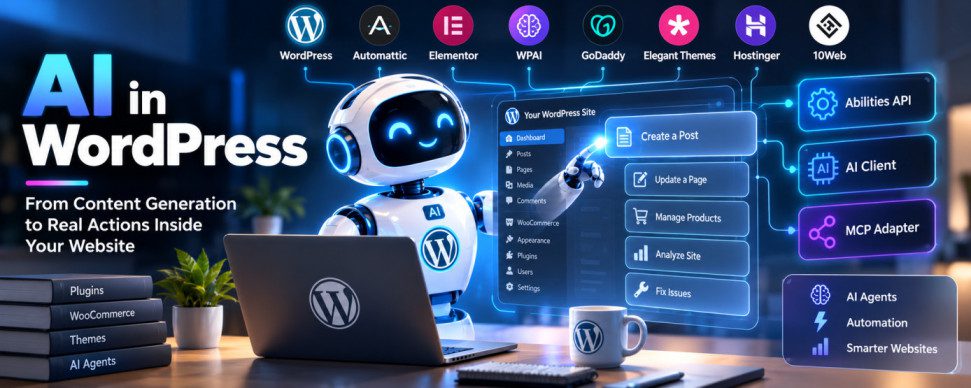
Companies such as Automattic, Elementor, WPAI, GoDaddy, Elegant Themes, Hostinger and 10Web have all explored different approaches to AI-powered WordPress development.
At the same time, WordPress itself is developing infrastructure such as the Abilities API, AI Client and MCP Adapter, creating a common foundation that allows AI agents to interact with WordPress.
But there is an important question:
Which WordPress companies are actually building AI models, and which are simply integrating existing AI models?
Let’s break down the current WordPress AI landscape.
1. WordPress Is Moving From AI Features to AI Infrastructure
The biggest development may not be a particular AI writing tool.
It is the fact that WordPress itself is becoming more prepared for AI agents.
WordPress introduced the Abilities API in WordPress 6.9.
The idea is relatively simple.
A plugin, theme, or WordPress core feature can register something that it knows how to do as an “ability.”
For example:
- Create a post
- Update a post
- Retrieve products
- Create a page
- Get WooCommerce orders
- Modify settings
- Perform a particular plugin action
These abilities can then be discovered and used programmatically.
WordPress describes the Abilities API as a standardized, machine-readable directory of things WordPress can do.
This is extremely important for AI.
Instead of an AI model simply generating instructions such as:
“Go to Posts and create a new post.”
an AI agent can potentially have access to a real WordPress capability that performs the operation.
That changes the relationship between AI and WordPress.
2. WordPress AI Client
Another important component is the WordPress AI Client.
The AI Client provides a provider-agnostic way for WordPress code to communicate with AI models.
In other words, a developer does not necessarily have to build completely different integrations for every AI provider.
The WordPress AI ecosystem now has several layers:
| Component | Purpose |
|---|---|
| AI Client | Communicates with AI providers |
| Abilities API | Defines what WordPress can do |
| AI Plugin | Provides ready-made AI features |
| MCP Adapter | Allows external AI agents to interact with WordPress |
WordPress’s own educational documentation describes these four components as the foundation of its emerging AI ecosystem.
3. WordPress MCP Adapter
This is where things become particularly interesting.
MCP stands for Model Context Protocol.
It provides a standardized way for AI applications to discover and interact with external tools and data.
WordPress has developed an MCP Adapter that connects WordPress Abilities with MCP.
This means an external AI client can potentially discover and execute WordPress capabilities.
For example, an AI coding assistant could potentially:
- Connect to a WordPress website
- Discover available capabilities
- Read information from the site
- Perform an authorized action
- Return the result
The official WordPress MCP Adapter supports AI clients and can expose WordPress abilities as MCP tools.
This is a major change from traditional WordPress AI plugins.
4. WPAI: One of the Most Interesting WordPress AI Companies
If the question is specifically:
“Who has actually worked on AI models specifically for WordPress?”
WPAI is one of the clearest examples.
WPAI was founded specifically around AI for WordPress.
Its research has included models for:
- WordPress
- WordPress plugins
- PHP
- Named entity recognition
- WordPress-specific tasks
WPAI states that it has developed base, NER and fine-tuned models focused on WordPress and related technologies.
The company also developed WPAIGPT-SQL-01, a model focused on generating SQL from natural-language queries for WordPress-related data.
That is fundamentally different from simply putting a ChatGPT API inside a WordPress plugin.
It is an example of attempting to make AI understand a WordPress-specific problem.
5. Automattic and WPAI
WPAI became particularly significant when Automattic acquired WPAI.
Automattic is the company behind major WordPress products and services including WordPress.com, WooCommerce and Jetpack.
WPAI’s technology and research became part of Automattic’s broader AI efforts. WPAI said its work would focus on applied AI solutions, AI standards and improvements to WordPress itself.
This is important because it connects two worlds:
WordPress infrastructure + specialized AI research.
WPAI’s product portfolio included:
- CodeWP
- AgentWP
- WP.Chat
- WordPress-focused AI research
- AI models
WPAI currently describes itself as a provider of AI-powered solutions for WordPress and lists AgentWP and CodeWP among its products and research efforts.
6. AgentWP: From AI Assistant to AI Agent
One of the most interesting ideas to emerge from WPAI is AgentWP.
Traditional AI assistants generally respond to prompts.
For example:
“Write PHP code that creates a custom post type.”
An AI agent aims to go further.
It could potentially:
Understand the request → inspect the environment → generate the code → execute an action → check the result → make corrections.
That is the difference between:
AI generation
and
AI automation.
WPAI described AgentWP as an AI agent for WordPress capable of coding, troubleshooting, maintenance and other WordPress tasks.
This concept is now becoming one of the major directions in WordPress AI.
7. Elementor and Angie
Another major player is Elementor.
Elementor introduced Angie, which it describes as an agentic AI system purpose-built for WordPress.
Unlike a simple content generator, Angie is designed to understand the WordPress environment and perform tasks.
Elementor says Angie can work with the site’s technical context, including themes, plugins, settings and custom fields.
For example, an AI system could potentially be asked to:
“Create a new landing page.”
Instead of only generating HTML, an agentic system can work with the actual WordPress environment.
This is a major evolution in WordPress AI.
8. Elementor MCP
Elementor has also moved into MCP.
Elementor’s MCP functionality allows external AI clients to interact with Elementor websites.
According to Elementor’s documentation, supported clients include tools such as:
- Claude
- Codex
- Cursor
- Other compatible AI clients
The AI can work with Elementor structures rather than simply producing a block of HTML.
This distinction is important.
Imagine asking an AI:
“Create a three-column services section using my existing design system.”
A conventional chatbot might return HTML/CSS.
An AI connected through an appropriate WordPress/Elementor integration could potentially create actual editable Elementor structures.
That is much closer to an AI website builder.
9. GoDaddy and AI Website Building
GoDaddy has also invested heavily in AI-powered website creation.
Its AI tools focus on helping users create and manage websites without requiring traditional web-development skills.
The broader direction is similar:
Describe what you want → AI creates or modifies the website.
This is especially relevant for small businesses.
Instead of hiring someone to build every part of a website, a user could increasingly describe:
“Create a website for my restaurant.”
and have AI generate the structure, content and design.
The difference between these systems and WordPress-specific AI models is that many website builders use AI as a service layer rather than developing a foundation model themselves.
10. Hostinger and AI
Hostinger has also incorporated AI heavily into its website-building products.
Its AI tools can help with tasks such as:
- Website generation
- Content generation
- Images
- Blog content
- Website structure
- Business websites
Hostinger’s approach is primarily focused on making website creation easier for non-technical users.
Again, this does not necessarily mean Hostinger trained a large foundation model from scratch.
Instead, the company is building an AI-powered website creation experience.
This distinction matters.
11. 10Web and AI WordPress Websites
10Web is another company that has pushed AI website generation.
Its platform focuses specifically on WordPress websites.
The basic idea is:
Describe the website → AI generates the website → WordPress powers the result.
This approach brings AI closer to the actual WordPress website rather than treating WordPress simply as a content database.
AI can help with:
- Website creation
- Page generation
- Content
- Design
- Website management
10Web therefore belongs to the growing category of AI-first WordPress platforms.
12. Elegant Themes and Divi AI
Elegant Themes has also integrated AI into its Divi ecosystem through Divi AI.
Divi AI is focused on helping users create:
- Text
- Images
- Layouts
- Code
- Website content
The important point is that Divi understands the context in which the AI is being used.
The AI isn’t simply operating as a generic chatbot.
It is integrated into a WordPress page-building workflow.
This is an important trend across WordPress builders:
AI is becoming part of the editor instead of living outside the editor.
13. Jetpack and Automattic’s AI Direction
Automattic’s AI work extends beyond WPAI.
Jetpack has also introduced AI-powered capabilities for WordPress users.
These tools can assist with content-related tasks such as:
- Writing
- Rewriting
- Summarizing
- Tone changes
- Content generation
But Automattic’s larger opportunity is much broader.
Because Automattic operates across WordPress.com, WooCommerce, Jetpack and other WordPress products, AI can potentially be connected to many different parts of the WordPress ecosystem.
That makes the development of WordPress AI infrastructure particularly important.
14. Are These Companies Building Their Own ChatGPT?
This is where the terminology can become confusing.
When a company says it has “AI,” it does not necessarily mean it has trained a model comparable to GPT, Claude or Gemini.
There are several levels.
Level 1 — AI API integration
A WordPress company uses:
- OpenAI
- Anthropic
- another AI provider
The company builds the WordPress interface around it.
Level 2 — Fine-tuned or specialized models
The company trains or fine-tunes a model for a particular task.
For example:
WordPress → SQL
This is closer to what WPAI has researched.
Level 3 — WordPress AI agents
The company connects an AI model to:
- WordPress APIs
- plugin functionality
- website data
- tools
- MCP
- automation
The AI can then perform tasks.
Level 4 — AI-native WordPress
At this level, AI isn’t just an additional feature.
The entire website-building workflow is designed around AI.
This is where the industry appears to be heading.
15. The Most Important Shift: From Generation to Action
The first generation of WordPress AI was mainly about generating content.
For example:
User:
Write a 1,000-word blog about WordPress security.
AI:
Here is your article.
Useful, but limited.
The next generation looks more like this:
User:
Find my five oldest plugins and check whether they need updating.
The AI could potentially:
- Inspect the WordPress installation
- Identify plugins
- Check versions
- Compare available updates
- Explain potential compatibility issues
- Ask for confirmation
- Perform approved actions
That is an AI agent rather than a content generator.
WordPress’s Abilities API and MCP Adapter are specifically aimed at enabling this type of machine-discoverable and executable functionality.
16. What This Means for WordPress Developers
This change could significantly affect WordPress development.
Traditionally, developers build interfaces for humans.
For example:
Admin Dashboard
      ↓
User clicks button
      ↓
Plugin executes function
With AI agents, the architecture can become:
AI Agent
    ↓
Discover WordPress Ability
    ↓
Understand parameters
    ↓
Request permission
    ↓
Execute WordPress function
    ↓
Return result
This creates a new type of WordPress development:
AI-readable WordPress functionality.
Plugins may increasingly need to expose their capabilities in ways that AI agents can discover and use.
17. What This Could Mean for WordPress Plugins
Imagine a WooCommerce plugin with abilities such as:
get_orders
create_product
update_product
get_inventory
update_inventory
create_coupon
An AI agent could potentially discover these capabilities.
A user might then say:
“Show me products that haven’t sold in 90 days.”
The AI could use the appropriate capability rather than simply guessing.
Or:
“Create a 10% coupon for these products and make it expire Friday.”
The AI could potentially perform the operation after appropriate authorization.
This is where WordPress plugins become much more interesting in an AI-first environment.
18. What About Themify?
This development is particularly interesting for WordPress page builders.
Imagine an AI system that understands:
- Themify Builder
- Builder modules
- Builder rows
- Builder columns
- Builder Pro
- PTB
- custom post types
- templates
- WooCommerce
- responsive settings
- theme settings
Instead of asking AI to generate CSS manually, a user could potentially say:
“Make this section two columns on desktop and one column on mobile.”
Or:
“Create a PTB template for my Excursions post type.”
Or:
“Find all pages using this old module and replace it.”
That would require deep integration with the builder rather than simply connecting a chatbot to WordPress.
This is one of the areas where MCP + WordPress Abilities + page-builder-specific abilities could become particularly powerful.
19. The Emerging WordPress AI Stack
The ecosystem can be visualized like this:
                  AI MODELS
        ┌─────────────────────────┐
        │ OpenAI                  │
        │ Anthropic               │
        │ Google                  │
        │ Other AI providers      │
        └────────────┬────────────┘
                     │
                     ▼
              WORDPRESS AI
        ┌─────────────────────────┐
        │ WordPress AI Client     │
        │ Abilities API           │
        │ AI Plugin               │
        │ MCP Adapter             │
        └────────────┬────────────┘
                     │
                     ▼
             WORDPRESS ECOSYSTEM
        ┌─────────────────────────┐
        │ Elementor              │
        │ WooCommerce             │
        │ Jetpack                 │
        │ Themes                  │
        │ Plugins                 │
        │ Custom Post Types       │
        │ Page Builders           │
        └────────────┬────────────┘
                     │
                     ▼
                 AI AGENTS
        ┌─────────────────────────┐
        │ Build                   │
        │ Edit                    │
        │ Debug                   │
        │ Maintain                │
        │ Analyze                 │
        │ Automate                │
        └─────────────────────────┘
This is much bigger than AI-generated blog posts.
20. Which Companies Are Actually Building Models?
A useful way to categorize the ecosystem is:
| Company / Project | WordPress AI Focus | Own specialized model? | AI Agent / Automation |
|---|---|---|---|
| WPAI | WordPress-specific AI research | Yes, specialized models | Yes |
| Automattic | WordPress AI infrastructure/products | Through WPAI research and broader AI work | Yes |
| WordPress Core | AI infrastructure | Not a GPT-style foundation model | Yes |
| Elementor | AI website creation | Primarily AI framework/product | Yes |
| Divi / Elegant Themes | AI design/content | Primarily AI integration | Increasingly |
| GoDaddy | AI website creation | AI-powered platform | Yes |
| Hostinger | AI website creation | AI-powered platform | Yes |
| 10Web | AI WordPress websites | AI-powered platform | Yes |
The key takeaway is that “AI company” and “AI model company” are not the same thing.
WPAI’s research is one of the clearest examples of WordPress-specific model development, while much of the broader ecosystem is focused on building products and agents around existing AI models.
21. Why WordPress Is a Perfect Environment for AI Agents
WordPress has something many AI environments don’t:
an enormous ecosystem of structured functionality.
A typical WordPress website can contain:
- Posts
- Pages
- Users
- Media
- Products
- Orders
- Custom post types
- Custom fields
- Taxonomies
- Forms
- Menus
- Themes
- Templates
- Plugins
- APIs
And thousands of plugins add even more capabilities.
The challenge has always been that these capabilities are not exposed in a consistent way.
The Abilities API attempts to solve part of this problem by creating a common, machine-readable way to register functionality.
MCP then provides a bridge for external AI agents to discover and interact with those capabilities.
22. The Security Question
There is also an important downside.
Giving AI access to WordPress means giving AI access to potentially sensitive functionality.
Imagine an AI agent with permission to:
- Delete posts
- Modify users
- Change plugins
- Edit WooCommerce products
- Access customer data
- Change site settings
This creates significant security concerns.
The WordPress MCP Adapter therefore includes permission controls, and WordPress abilities are not automatically exposed as public capabilities. The MCP Adapter documentation explicitly describes an opt-in approach for exposing abilities.
This will become one of the biggest issues in WordPress AI:
How much control should an AI agent have?
A sensible system should distinguish between:
Read
“Show me all products.”
Suggest
“Here are the products I recommend changing.”
Execute
“Update those products.”
These should not necessarily have the same permission level.
23. The Opportunity for WordPress Developers
Developers who understand both WordPress and AI may have a significant new area to explore.
Some emerging skills include:
- MCP
- WordPress Abilities API
- AI APIs
- AI agents
- Prompt engineering
- PHP
- REST APIs
- WooCommerce APIs
- WordPress plugin development
- AI tool calling
- AI security
- Automation
A WordPress developer who understands these technologies can build something much more valuable than a simple chatbot.
They can build:
AI-powered WordPress tools.
24. What Comes Next?
The next stage of WordPress AI may look very different from today’s AI plugins.
Instead of:
“AI writes my article.”
we could see:
“AI manages my website.”
Instead of:
“AI generates CSS.”
we could see:
“AI understands my theme and modifies the design.”
Instead of:
“AI tells me how to fix the plugin.”
we could see:
“AI diagnoses the problem and prepares the fix.”
And instead of:
“AI generates WooCommerce code.”
we could see:
“AI manages my WooCommerce store.”
The combination of AI models + WordPress Abilities + MCP + specialized WordPress plugins creates the infrastructure for this transition.
The WordPress AI revolution is no longer just about adding a “Generate with AI” button.
The ecosystem is moving toward AI that understands WordPress and can interact with it.
Companies such as WPAI, Automattic and Elementor are particularly interesting because they are working on WordPress-specific AI products, research, infrastructure and agents.
Meanwhile, companies such as GoDaddy, Hostinger, 10Web and Elegant Themes are integrating AI deeply into website creation and management.
But the most important development may actually be happening at the WordPress platform level.
The Abilities API gives WordPress a standardized way to describe what it can do.
The AI Client provides a common way to communicate with AI providers.
And the MCP Adapter gives external AI agents a standardized bridge into WordPress capabilities.
Together, these technologies point toward a future where WordPress is not simply a CMS that AI can write content for.
It could become a platform that AI agents can operate.
And that may be one of the biggest changes to WordPress since the introduction of the block editor.