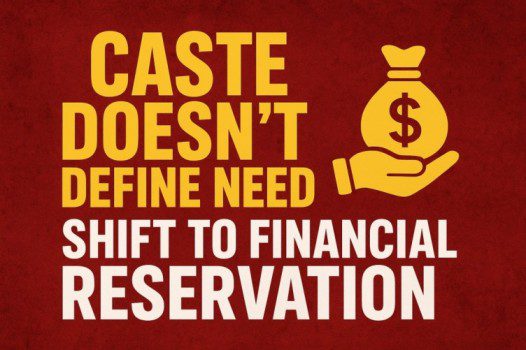
Reservations in India: A Bridge That Became a Wall — Why We Must Move to Financial-Based Support
When India achieved independence in 1947, the vision of our founding leaders was to create a nation where every individual would be free, equal, and empowered.
However, they were well aware of the historical injustices and deep-rooted caste discrimination that had left millions marginalized for centuries.
To correct this imbalance, reservations — or affirmative action — were introduced as a temporary support system. The idea was to provide education, jobs, and political representation to historically disadvantaged groups so they could compete on equal footing with others.
But here we are, 75+ years later, and instead of being a bridge to equality, reservations have become a permanent wall, often used as a tool for vote-bank politics rather than true empowerment.
The Original Purpose: A 10-Year Plan That Never Ended
Dr. B.R. Ambedkar, the architect of India’s Constitution, advocated for reservations as a short-term corrective measure, initially planned for 10 years.
“Political democracy cannot last unless there lies at the base of it social democracy.”
— Dr. B.R. Ambedkar
The intention was clear:
- Empower the marginalized so they could eventually compete without assistance.
- Build a level playing field where caste would no longer determine destiny.
- Phase out reservations once equality was achieved.
Unfortunately, instead of gradually reducing quotas, political parties extended and expanded them every decade to secure votes — creating a cycle of dependency and division.
From Temporary Support to Political Weapon
Over the decades, reservations have evolved far beyond their original purpose.
Timeline of Reservation Expansion
- 1950s: Quotas introduced for Scheduled Castes (SC) and Scheduled Tribes (ST).
- 1990: Mandal Commission adds 27% quota for Other Backward Classes (OBC), sparking nationwide protests.
- 2019: 10% reservation for Economically Weaker Sections (EWS) of the General category introduced.
Instead of asking “How do we empower everyone without needing reservations?”, politicians began asking “How do we add more groups to secure votes?”
This shift turned reservations into a permanent political strategy, not a tool for social justice.
Real-World Example: The Form Fee Inequality
Let’s look at a common recruitment scenario:
A state government posts 1,000 job vacancies.
Here’s how the application fees are structured:
- General Category (Unreserved): ₹500 – ₹1000 per form
- Reserved Categories (SC/ST/OBC): Free or minimal fee, like ₹50
Impact on Applicants
- Ravi, a general category student from a poor family, wants to apply for 10 different jobs.
- Cost = ₹500 x 10 = ₹5,000
- His family cannot afford it, so he applies for only 2 jobs.
- Arjun, from a reserved category, comes from a financially stable family, but since his forms are free:
- Cost = ₹0
- He applies for all 10 jobs, increasing his chances significantly.
💡 Result: Despite being equally capable, Ravi’s opportunities are limited purely by economic factors, while Arjun enjoys multiple chances even if he is financially well-off.
This form fee inequality clearly shows how caste-based reservation ignores real financial hardships.
The Education Trap: A Broken System
Consider two students:
- Meena, from a reserved category, gets admission to a top engineering college with relaxed cut-offs.
- Suresh, from the general category, narrowly misses the cut-off despite scoring higher marks.
Now, let’s see what happens:
- The government school system remains broken — poor infrastructure, underpaid teachers, lack of resources.
- Both students graduate, but unemployment remains high due to lack of jobs.
- Politicians ignore these systemic problems, continuing to sell the illusion of progress through reservations.
This is like putting a band-aid on a broken bone — it doesn’t fix the underlying issue.
Why 75+ Years Is Too Long for “Temporary” Quotas
India has made remarkable progress:
- Sent rockets to Mars 🚀,
- Built a global IT powerhouse 💻,
- And become the world’s fastest-growing major economy 🌍.
Yet, politicians still claim certain communities cannot succeed without perpetual quotas.
This reflects failure of governance, not incapability of the people.
If leaders still rely on caste quotas to win votes, it means they FAILED to provide quality education, jobs, and equal opportunities.
Why India Must Shift to Financial-Based Reservation
It’s time for India to abolish caste-based reservation and replace it with financial-based reservation that targets the genuinely poor — regardless of caste or religion.
Key Benefits
- True Equality: Support goes to those who need it most, whether they are SC, OBC, or General.
- End of Vote-Bank Politics: Politicians can no longer exploit caste divisions for electoral gain.
- Efficient Use of Resources: Funds are allocated to uplift the economically weak, not the politically influential.
- Merit and Empowerment Together: Opportunities go to deserving candidates while still providing a safety net for the poor.
Example: Financial-Based Reservation System
Imagine a system where:
- Any family earning less than ₹2.5 lakh/year qualifies for benefits, regardless of caste.
- Application form fees are waived only for economically disadvantaged candidates.
- College admissions and government jobs have reserved seats for financially weak students, not based on birth.
This approach levels the playing field without perpetuating caste divisions.
Real-Life Example: Maratha Reservation Protest
In Maharashtra, the Maratha community — traditionally considered upper caste — protested violently demanding reservation.
Why? Because economic hardship doesn’t discriminate by caste.
Many Marathas were struggling financially but excluded from existing quotas, while wealthy individuals from other castes continued to benefit.
This highlights the flawed logic of caste-based reservation in modern India.
Conclusion: A Call for Real Equality
Reservations were meant to heal India’s wounds, not keep them open for political gain.
By clinging to caste-based quotas, we are failing both the marginalized and the nation as a whole.
True equality comes when:
- Every child, regardless of caste, has access to quality education.
- Every citizen has a fair shot at opportunities.
- No one’s dreams are limited by economic hardship or political games.
Caste should not decide your future. Your hard work should.
It’s time India walks across the bridge of reservations and finally leaves it behind.