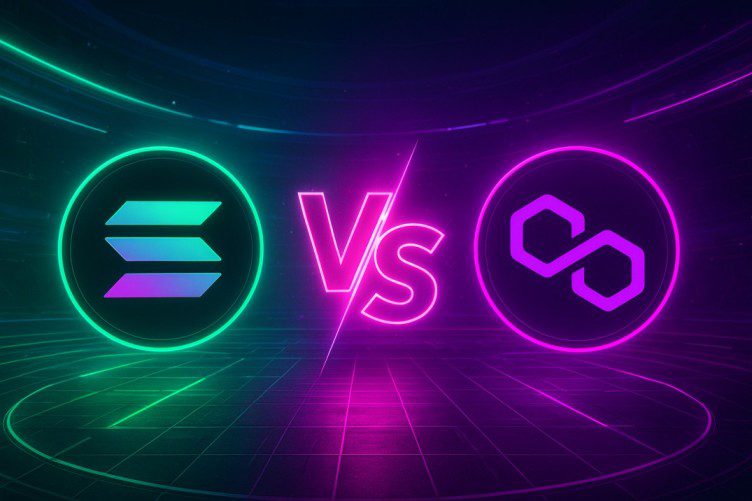
Solana vs. Polygon: The Battle for Web3 Dominance
Web3 is no longer a buzzword — it’s the foundation of the next internet revolution. But in this new era of decentralization, two blockchain giants are battling for dominance: Solana (SOL) and Polygon (MATIC).
Both promise faster transactions, lower fees, and thriving ecosystems for developers and investors. Yet, their paths to success couldn’t be more different. While Solana focuses on raw performance and building a lightning-fast blockchain from scratch, Polygon enhances Ethereum’s scalability, providing a bridge between innovation and compatibility.
So, who’s winning the Web3 war in 2025 — Solana or Polygon? Let’s find out. 🚀
⚙️ A Tale of Two Titans: Solana vs. Polygon
🧠 Solana: The Speed Demon of Blockchain
Solana is built for speed and scalability. Its secret weapon — Proof of History (PoH) — timestamps every transaction before it’s processed. This innovative system allows the network to handle up to 65,000 transactions per second, with transaction fees often less than $0.001.
Developers love Solana for gaming, real-time trading, and NFT platforms where milliseconds matter. But with great speed comes great responsibility — Solana has faced occasional network outages and high hardware requirements for validators.
Still, Solana remains one of the fastest-growing ecosystems in crypto.
🔗 Polygon: Ethereum’s Supercharger
Polygon, on the other hand, isn’t competing against Ethereum — it’s helping it scale. Think of Polygon as Ethereum’s layer-2 sidekick, making it faster and cheaper without sacrificing compatibility.
Its zkEVM (Zero-Knowledge Ethereum Virtual Machine) technology allows Ethereum smart contracts to run seamlessly while reducing gas fees by up to 90%. Projects like Aave, Uniswap, and OpenSea already use Polygon to scale operations efficiently.
Polygon’s approach makes it a developer favorite, especially for teams already working with Ethereum-based tools.
⚔️ Head-to-Head Comparison: Solana vs. Polygon
| Feature | Solana (SOL) | Polygon (MATIC) |
|---|---|---|
| Type | Layer-1 Blockchain | Layer-2 Scaling Solution for Ethereum |
| Transaction Speed | 50,000 – 65,000 TPS | 7,000+ TPS (zkEVM) |
| Transaction Fee | ~$0.001 | ~$0.002 |
| Consensus | Proof of History + Proof of Stake | Proof of Stake + zk-Rollups |
| Languages | Rust, C, C++ | Solidity (EVM-compatible) |
| Best For | Gaming, DeFi, NFTs | dApps, DeFi, NFT markets, bridges |
| Ecosystem Size | 2,000+ projects | 19,000+ dApps (Ethereum-compatible) |
| Market Rank (Oct 2025) | #5 by market cap | #14 by market cap |
💡 Developer Experience & Ecosystem
- Solana: Developers often say building on Solana feels like “coding for the future.” Rust-based apps are highly performant but require more technical skill.
- Polygon: Familiar ground for Ethereum developers. Deploying on Polygon is as easy as copy-pasting your Solidity contracts and updating RPC endpoints.
Winner: Polygon, for ease of use and massive developer base.
🔒 Security & Decentralization
- Solana’s high-performance design requires powerful validators, making it faster but slightly less decentralized.
- Polygon, through zkEVM rollups, inherits Ethereum’s security, offering stronger long-term protection for dApps.
Winner: Polygon, for better balance of speed and security.
🌍 Real-World Adoption (2025)
- Solana: Powering real-time apps like Helium, Star Atlas, and Magic Eden.
- Polygon: Partnered with Reddit, Starbucks, Nike, and Meta for NFT and Web3 integrations.
Winner: Polygon, for brand partnerships and enterprise adoption.
💰 2025 Price Predictions: SOL vs. MATIC
| Token | Current Price (Oct 2025) | 2025 End-Year Prediction | 2026 Potential |
|---|---|---|---|
| Solana (SOL) | ~$145 | $180 – $250 | Could reach $300 if adoption continues |
| Polygon (MATIC) | ~$0.85 | $1.20 – $1.80 | Could break $2 with new zk-rollout launches |
🔮 Expert Insight:
- Analysts predict Solana could outperform if network uptime improves and institutional adoption continues.
- Polygon’s steady growth depends on Ethereum’s roadmap and the success of zkEVM rollups.
Both tokens are among the top 20 most held assets by institutional crypto funds, showing long-term confidence in their ecosystems.
🌐 The Future of Web3: Cooperation, Not Competition
While fans love to debate, the truth is Solana and Polygon are not enemies — they’re complementary forces shaping Web3.
- Solana pushes the limits of speed and performance.
- Polygon expands Ethereum’s accessibility and scalability.
In the end, the Web3 future is multi-chain. Developers will deploy on the best chain for their use case — and users won’t even notice which chain they’re on.