The 2026 Privacy Roadmap for the XRP Ledger: Why It Matters (and What’s Next)
“Without privacy, financial institutions cannot safely use public ledgers. Without accountability, regulators cannot sign off. With programmable privacy, we can have both.”
— J. Ayo Akinyele, RippleX Senior Director of Engineering
(Source: U.Today)
Yes, we’re quoting the man himself. This tweet (and the broader RippleX post it reflects) marks a turning point in how XRPL is positioning itself for the future of institutional finance. It’s not just about speed or fees anymore — it’s about privacy with purpose.
Let’s walk through the story — with people, technology, and strategy in focus.
Why XRPL Needs Privacy (and So Do Institutions)
Imagine being a bank or asset manager wanting to issue tokenized bonds, manage collateral, or participate in DeFi — but not wanting everyone to see exactly how much money you have, who you’re transacting with, or what your collateral breakdowns are. For most institutions, that’s a nonstarter.
On the flip side, regulators want transparency and auditability. They need to trust that rules are followed, that illicit funds aren’t slipping through the cracks, and that any on-chain system is accountable.
So the question for XRPL is: can you give institutions just enough privacy — while still keeping the integrity, oversight, and trust that public blockchains bring?
That’s exactly what RippleX’s engineering director, Ayo Akinyele, is betting on: programmable privacy. Not absolute secrecy, but controlled, cryptographic discretion.
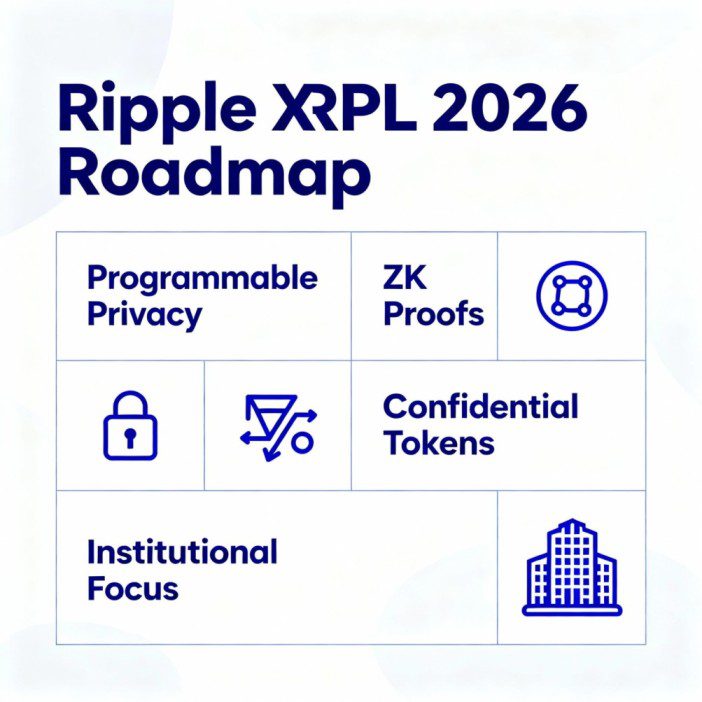
The Roadmap: What’s Coming in 2026 (and How It Might Work)
Here’s a more narrative, human-friendly version of the timeline and features — with color commentary:
1. Building Blocks: ZK Proofs, Credentials & MPTs
- Over the next 12 months, the team will lean heavily into zero-knowledge proofs (ZKPs). These let you prove statements (like “I passed KYC” or “the sum of inputs = sum of outputs”) without revealing sensitive data. (XRPL Blog)
- Work continues on Credentials / Verifiable Identity — so accounts can hold attestations (KYC, permission, accreditation) that they can selectively reveal.
- Already in motion is the Multi-Purpose Token (MPT) standard (XLS-33) that enables more complex token behavior — issuance, tranches, metadata — without needing custom smart contracts.
These are the foundations — once they are strong, more advanced privacy layers can sit on top.
2. Confidential MPTs: The Privacy Upgrade (Expected Q1 2026)
This is the “make or break” feature for the roadmap.
- Confidential MPTs aim to encrypt token balances and transfer amounts using advanced cryptography (e.g. EC-ElGamal + ZK proofs) so that the ledger can verify correctness without seeing everything.
- The design allows public ↔ confidential conversions: an issuer or user could move tokens between visible and hidden modes.
- Compliance hooks (clawbacks, audits, selective disclosure) are built-in so regulators or auditors can “peek” in limited ways when required.
- The goal? Private asset contracts, collateralization, lending, etc., with verifiability — not wildwest anonymity.
3. Institutional Tools & Integration
These are the supporting features that make privacy usable and practical:
- Permissioned Domains / Permissioned DEXs: Only accounts with certain credentials can transact, trade, or access certain markets.
- Audit & Oversight Tools: Deep Freeze, simulation, proof-of-reserves, transaction simulation — tools that help oversight without sacrificing confidentiality.
- Native Lending & Credit Layers: The roadmap already mentions a native lending protocol in XRPL Version 3.0, which will tie in with tokenization and collateral. (MEXC News)
- Wallet & UX Abstractions: For end users and institutions, cryptography needs to be wrapped in seamless UX — key management, proof generation, interface decisions around what to reveal or hide.
Trade-offs, Risks & Real Human Challenges
Because technology is never magic — it’s messy, human, and sometimes unpredictable. Here are the thorny parts:
| Challenge | Why It Matters | Possible Mitigations |
|---|---|---|
| Performance & Scalability | ZK proofs, encryption, proof verification cost CPU & memory. If nodes lag, the network suffers. | Use optimized proof systems, parallel processing, light client models, and incremental rollout. |
| Complexity for End Users | More keys, choices about privacy vs disclosure, risk of key loss or error. | Smart wallet abstractions, defaults, recovery mechanisms, good documentation & UI. |
| Regulatory Pushback | Strong privacy attracts scrutiny (money laundering, sanctions evasion). | Build audit/disclosure tools, selective proofs, clawbacks, and collaborate with regulators early. |
| Leak via Metadata | Even with encrypted amounts, subtle patterns (timing, transaction graph) might leak info. | Use mixing techniques, batch transactions, hiding metadata, padding. |
| Security Risks | New cryptographic systems often introduce new vulnerabilities. | Rigorous audits, bug bounties, gradual deployment, open review, fallback safety nets. |
What to Watch Over the Next Year
Here’s your insider’s radar — signals that the privacy roadmap is real, credible, and gaining traction:
- Amendment adoption & validator votes — Will Confidential MPTs make it through the standards process?
- Prototype wallets & pilot issuances — Are institutions or developers building early confidential token use cases?
- Regulator engagement & feedback — How are financial regulators reacting to selective disclosure proposals?
- Performance benchmarks & UX feedback — Are proofs too slow or heavy? Do wallet users get confused?
- Security reviews & audits published — Independent audits exposing (or catching) flaws will be key.
- Adoption in DeFi / RWA issuance — Are tokenized real-world assets using confidentiality? Are volumes rising in permissioned DEXs?
A Vision for Late 2026: What XRPL Might Look Like (In Real Life)
Picture this:
- You have both public and confidential token balances.
- You send tokens privately — only the recipient or certain auditors can decrypt amounts.
- A regulated institution issues tokenized bonds: investors’ holdings are invisible publicly, but auditors and regulators can verify proofs.
- A lending market runs on XRPL: collateral is confidential, but liquidation, reserve proofs, and compliance are verifiable.
- Wallets are clean, simple: “Show more / hide more” toggles. Key recovery is smooth.
- The XRPL remains fast: block times, syncs, costs are still low — thanks to design optimizations.
That’s not sci-fi. It’s the aim behind this roadmap.