India’s Finance Minister Urges Nations to Prepare for Stablecoins
India’s Finance Minister Nirmala Sitharaman Urges Nations to Prepare for Stablecoins: A Global Wake-Up Call
Introduction: A Shift in India’s Digital Finance Narrative 🇮🇳
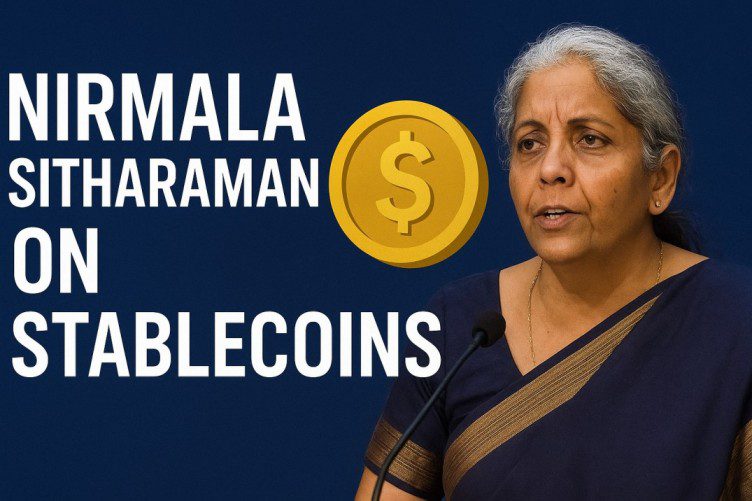
In a bold and forward-looking statement, India’s Finance Minister Nirmala Sitharaman has called on nations to “prepare to engage with stablecoins”—signaling a subtle yet significant shift in India’s stance toward digital finance.
Speaking at the Kautilya Economic Conclave 2025, Sitharaman emphasized that tokenized money and stablecoins are no longer theoretical concepts but real forces reshaping global capital flows. Her message was clear: either nations adapt, or they risk being left behind.
What Are Stablecoins? 💡
Before diving deeper, let’s clarify the term.
Stablecoins are cryptocurrencies pegged to real-world assets—most commonly the US dollar, euro, or gold—to maintain price stability. Examples include USDT (Tether), USDC (Circle), and DAI (MakerDAO).
Unlike volatile cryptocurrencies such as Bitcoin or Ethereum, stablecoins are designed for smooth payments, remittances, and DeFi operations. They bridge the gap between traditional finance (TradFi) and decentralized finance (DeFi).
Sitharaman’s Key Message: Adaptation Is Not Optional 🌍
According to reports from Crypto Times, Sitharaman warned that global money and capital flows are evolving faster than regulatory systems can keep up.
“Whether nations welcome it or not, the global economy is moving toward tokenization. We cannot remain passive,” she said.
This acknowledgment marks a significant change from India’s traditionally cautious tone on digital assets. Instead of categorically opposing cryptocurrencies, the FM’s focus now appears to be risk management, not rejection.
Tokenization of Currency: A Double-Edged Sword ⚖️
In an earlier speech covered by LiveMint, Sitharaman highlighted that tokenization introduces both opportunity and complexity.
She called for global oversight mechanisms to prevent financial instability, cyber fraud, and regulatory arbitrage.
Her stance underscores that the tokenization of assets and currencies—where digital tokens represent real-world value—is not just an innovation story but also a governance challenge.
India’s Regulatory Crossroads 🧭
India’s journey with crypto regulation has been cautious. Since 2022, the government has imposed a 30% tax on crypto gains and 1% TDS on transactions, signaling control rather than encouragement (CBDT notification).
However, Sitharaman’s latest remarks suggest a maturing policy approach:
- The government recognizes technological inevitability.
- Stablecoins might soon find a regulatory niche, distinct from speculative cryptocurrencies.
- Collaboration with IMF, G20, and FATF could shape a shared stablecoin framework.
Impact on India’s Financial Ecosystem 💰
- Boost to Fintech & Payments
Stablecoins can revolutionize cross-border remittances, making them faster and cheaper—a key benefit for India, the world’s largest remittance receiver (World Bank report). - CBDC vs. Stablecoins: A New Balance
The RBI’s Digital Rupee (CBDC) is still in pilot mode. Sitharaman’s remarks may indicate a future where CBDCs and stablecoins coexist, with regulatory clarity defining their boundaries. - Foreign Investment Flows
A clear framework for stablecoins could attract foreign fintech investment into India’s Web3 and DeFi sectors, enhancing liquidity and innovation. - Risk of Unregulated Tokens
Without coordinated oversight, unbacked or poorly managed stablecoins could threaten financial stability—a concern Sitharaman strongly hinted at.
A Call for Global Collaboration 🌐
Sitharaman’s broader point is that no nation can tackle this alone.
Tokenized currencies transcend borders, and so must regulation. She urged multilateral institutions to evolve and coordinate global standards for stablecoins and digital assets.
“The multilateral system itself must be redefined to keep up with digital transformation,” she asserted.
This vision aligns with India’s G20 Digital Public Infrastructure (DPI) agenda, which promotes global cooperation on tech-driven financial inclusion.
The Road Ahead 🚀
India stands at the crossroads of innovation and regulation. Sitharaman’s message isn’t just for policymakers—it’s for fintech leaders, crypto innovators, and investors alike.
The next steps could include:
- Drafting a Stablecoin Regulation Framework in collaboration with the RBI and MeitY
- Encouraging pilot programs for regulated stablecoin usage in trade and remittances
- Integrating blockchain monitoring tools to track tokenized money flows
If executed wisely, India could lead the way in building a safe, inclusive, and globally integrated digital financial system.
The Dawn of a New Monetary Era 🌅
Finance Minister Nirmala Sitharaman’s statements represent more than just economic foresight—they symbolize India’s growing readiness to shape global digital finance.
Stablecoins, once seen as a threat, are now being recognized as tools for innovation—if properly regulated. The world is watching how India, a G20 powerhouse, defines the next chapter in tokenized money.