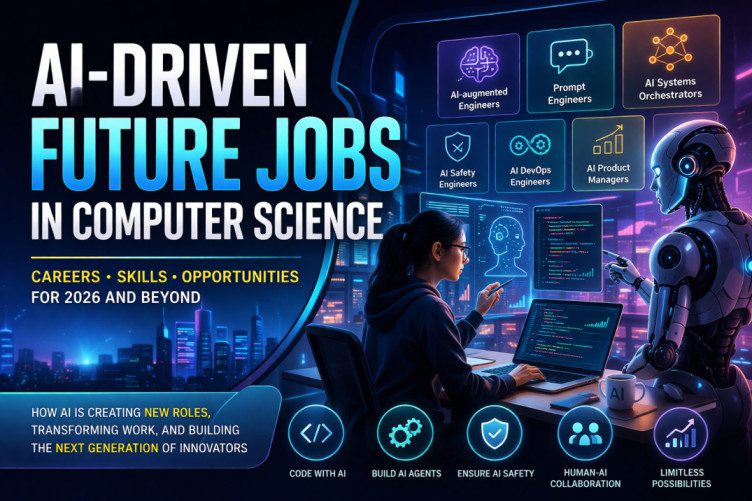
AI-Driven Future Jobs in Computer Science (2026 & Beyond)
Artificial Intelligence is not just changing the tech industry—it’s redefining what it means to work in computer science. The traditional role of writing code line-by-line is rapidly evolving into something far more strategic: collaborating with AI systems, orchestrating intelligent agents, and designing human-AI ecosystems.
If you’re planning your career (or pivoting into AI), this guide will help you understand the most important future job roles, required skills, and why they matter.
🔮 The Shift: From Coding → Orchestrating AI
Before diving into roles, here’s the big picture:
👉 Old Model: Humans write code → Machines execute
👉 New Model: Humans guide AI → AI generates, tests, and optimizes systems
This shift is creating entirely new job categories.
💼 Core AI-Driven Future Jobs
1. 🤖 AI-Augmented Software Engineer
What they do:
Work alongside AI tools (like coding copilots) to design, generate, test, and optimize software.
Skills Required:
- Programming (Python, JS, etc.)
- Prompt engineering
- System design
- Debugging AI-generated code
Why it’s emerging:
AI is writing more code than ever. Engineers now review, guide, and integrate AI outputs rather than writing everything from scratch.
2. 💬 Prompt Engineer / AI Interaction Designer
What they do:
Design prompts and workflows to get the best results from AI systems.
Skills Required:
- NLP understanding
- UX design
- Experimentation mindset
- Domain expertise
Why it’s emerging:
AI is powerful—but only if used correctly. This role ensures humans communicate effectively with AI.
3. 🧩 AI Systems Orchestrator (Agent Architect)
What they do:
Build systems where multiple AI agents collaborate (e.g., research agent + coding agent + testing agent).
Skills Required:
- APIs & integrations
- Automation tools
- Distributed systems
- Reasoning frameworks
Why it’s emerging:
AI agents are evolving fast. Someone needs to coordinate these digital workers.
4. 🛡️ AI Safety Engineer
What they do:
Ensure AI behaves ethically, safely, and predictably.
Skills Required:
- Machine Learning
- Risk analysis
- Cybersecurity
- Ethics
Why it’s emerging:
As AI becomes autonomous, mistakes become costly and dangerous.
5. 🧪 Synthetic Data Engineer
What they do:
Create artificial datasets to train AI models without using real sensitive data.
Skills Required:
- Data engineering
- Simulation tools
- Machine learning
Why it’s emerging:
Privacy laws + data scarcity = demand for synthetic data solutions.
6. 🤝 Human-AI Collaboration Designer
What they do:
Design systems where humans and AI work efficiently together.
Skills Required:
- UX/UI design
- Behavioral science
- Product thinking
Why it’s emerging:
AI alone isn’t enough—productivity depends on collaboration design.
7. ⚙️ AI DevOps Engineer (MLOps++)
What they do:
Deploy, monitor, and improve AI systems in real-world environments.
Skills Required:
- DevOps tools
- ML pipelines
- Cloud computing (AWS, GCP)
Why it’s emerging:
AI systems require continuous training, monitoring, and optimization.
8. 🪞 Digital Twin Engineer
What they do:
Create virtual replicas of real systems to simulate outcomes.
Skills Required:
- Simulation modeling
- Data systems
- Engineering fundamentals
Why it’s emerging:
Used in smart cities, healthcare, and manufacturing for predictive optimization.
9. 🔍 Autonomous Software Auditor
What they do:
Use AI to scan codebases for bugs, security issues, and compliance.
Skills Required:
- Cybersecurity
- Static analysis
- AI tools
Why it’s emerging:
AI can analyze millions of lines of code faster than humans.
10. 📊 AI Product Manager
What they do:
Lead development of AI-powered products.
Skills Required:
- Product management
- AI understanding
- Market strategy
Why it’s emerging:
Companies need leaders who understand both AI capabilities and user needs.
🧠 More Radical / Emerging Roles
🧬 Cognitive Architecture Engineer
Designs AI systems that mimic human reasoning. Learn more about cognitive architecture.
🎭 AI Personality Designer
Shapes how AI behaves (tone, personality, emotion). Explore AI behavior design concepts.
🚀 Autonomous Startup Builder
Solo founders running companies using AI agents. See how AI startups are evolving.
⚖️ Algorithmic Governance Specialist
Regulates and audits AI decisions in organizations. Read about algorithmic regulation.
🌍 AI Simulation World Designer
Creates virtual worlds for training AI systems. Learn about simulation environments.
🧑🏫 Personal AI Trainer
Customizes AI tools for individuals and businesses. Explore machine learning basics.
🔥 Key Skills You MUST Learn (Future-Proof Yourself)
🧠 1. Systems Thinking
Understand how complex systems interact—not just individual code. Learn more about systems thinking.
🤖 2. AI Literacy
🧩 3. Problem Framing
The real value is not coding—it’s:
👉 Asking the right questions
👉 Defining the right problems
⚙️ 4. Automation & Tools
- APIs (what is an API?)
- No-code / low-code (learn more)
- AI workflows
☁️ 5. Cloud + Data Skills
- AWS / GCP (cloud computing)
- Data pipelines (overview)
- Model deployment
📈 Career Roadmap (Beginner → Advanced)
🟢 Beginner (0–3 months)
- Learn Python basics (start here)
- Understand AI tools (ChatGPT, Copilot)
- Start prompt engineering
🟡 Intermediate (3–6 months)
- Build small AI projects
- Learn APIs + automation
- Explore ML basics (course)
🔴 Advanced (6–12 months)
- Build AI agents
- Learn MLOps (what is MLOps?)
- Specialize in one role (e.g., AI Safety, AI DevOps)
💡
✅ Most jobs won’t disappear—they will evolve
✅ The real shift is from doing work → directing AI systems
✅ Individuals using AI may outperform entire teams
🚀 The Biggest Opportunity
The winners in this AI era won’t be:
❌ Just coders
❌ Just AI users
👉 They will be AI orchestrators—people who can combine tools, systems, and intelligence into powerful solutions.