MCP 2.0 Explained: The Future of AI Agents, Automation, and Intelligent Workflows
MCP 2.0 Explained: Why It Could Change AI Forever
Artificial Intelligence is evolving at lightning speed.
We’ve gone from simple chatbots to intelligent AI agents that can code, deploy applications, manage workflows, search databases, and even automate real-world business tasks.
But there has always been one major challenge:
How do AI systems communicate with external tools, databases, apps, and services in a standardized way?
That’s where MCP (Model Context Protocol) enters the picture.
And now, with massive architectural upgrades, what many developers are informally calling “MCP 2.0” is reshaping how AI assistants interact with the digital world. While it is still officially called MCP, the scale of changes makes it feel like a completely new generation of AI infrastructure.
If AI is the brain, MCP is the nervous system connecting it to the real world.
In this guide, we’ll break down:
- What MCP is
- Why it matters
- What changed in MCP 2.0
- Stateless architecture explained simply
- MCP Apps & Extensions
- Security upgrades
- Real-world examples
- Future predictions for AI ecosystems
Let’s dive in.
What is MCP (Model Context Protocol)?
At its core, Model Context Protocol (MCP) is a communication standard that allows AI assistants to interact with external systems, tools, apps, APIs, databases, and services.
Think of MCP as a universal language for AI systems.
Instead of every AI company building custom integrations for everything, MCP creates a standardized protocol so agents can communicate consistently.
Simple Definition:
MCP is a protocol that helps AI agents connect with tools, systems, documentation, and applications in a structured way.
Imagine using an AI assistant like:
Without MCP, these assistants would have limited access to updated information or external functionality.
With MCP, they can:
✅ Deploy applications
✅ Access databases
✅ Read updated documentation
✅ Run tools and workflows
✅ Automate repetitive tasks
✅ Connect with cloud systems
In simple words:
MCP gives AI real-world capabilities.
Why MCP Matters in AI
Most AI models have a limitation called a knowledge cutoff.
An AI model may know information only up to a certain date.
For example:
An LLM may not know:
- Newly updated APIs
- Latest documentation
- Real-time databases
- Internal company systems
This creates a huge problem.
An AI assistant can be smart, but without updated context, it becomes less useful.
That’s exactly where MCP becomes important.
Instead of retraining the model repeatedly, MCP allows the AI system to fetch:
- Fresh documentation
- Live system access
- External tools
- Real-time actions
This turns AI from:
“An assistant that knows things”
into
“An assistant that can actually do things.”
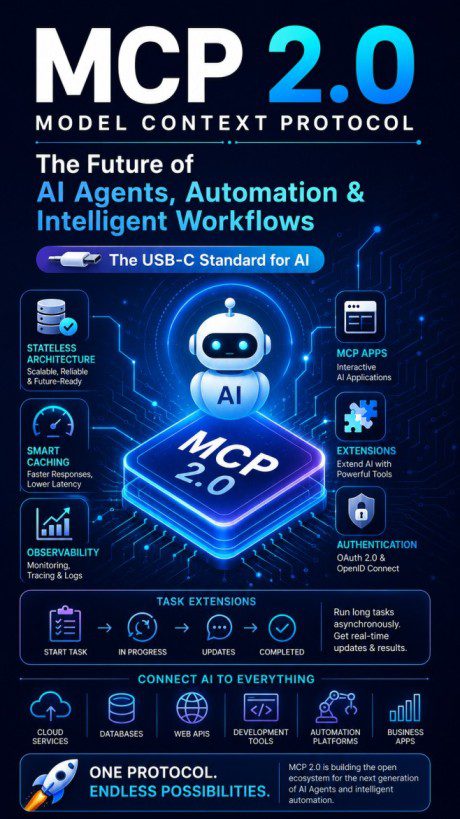
Think of MCP Like USB-C for AI
One of the best ways to understand MCP is through an analogy.
Remember how messy charging cables used to be?
Different devices needed:
- Different connectors
- Different charging systems
- Different ports
Then USB-C became the universal standard.
Now almost everything connects seamlessly.
MCP is trying to become the USB-C for AI applications.
Instead of every tool building unique AI integrations:
One standard protocol = Universal compatibility.
This could completely transform how software ecosystems work.
What Changed in MCP 2.0?
The newest MCP upgrades introduce major improvements including:
1. Stateless Architecture
2. MCP Apps
3. Task Extensions
4. Better Authentication
5. Smarter Traffic Management
6. Caching Improvements
7. Observability & Monitoring
8. Formal Extension Ecosystem
Let’s understand each in simple language.
1. Stateless Architecture: The Biggest MCP Upgrade
This is arguably the most important change.
Older MCP systems were stateful.
That means:
Every interaction depended on a session ID.
Think of it like this:
Imagine a grocery shop gives you a token.
Every time you buy something:
You must show the same token.
Lose the token?
Problem.
Change shops?
Token useless.
This is how older MCP systems worked.
Problems With Stateful Systems
Stateful systems create issues like:
❌ Hard to scale
❌ Requires session storage
❌ Database dependency
❌ Server coordination complexity
Every request needed memory of previous requests.
This slows scalability.
MCP 2.0 Goes Stateless
Now MCP moves toward a stateless protocol.
Every request contains everything needed to process it.
Similar to how modern web requests work.
Instead of:
“Remember my previous session.”
The request says:
“Here’s everything you need.”
Why This Matters
Benefits include:
Faster Scaling
You can add more servers instantly.
Better Reliability
No broken session issues.
Improved Load Balancing
Any server can process requests.
Higher Availability
Less system dependency.
This makes MCP significantly more scalable for production AI systems.
Real Example: AI Deployment with MCP
Imagine your AI assistant is connected to hosting infrastructure.
Previously:
You needed to:
- Open hosting dashboard
- Login manually
- Configure deployment
- Trigger deployment
With MCP:
You simply say:
“Deploy my application.”
The AI can:
- Connect hosting
- Authenticate
- Trigger deployment
- Monitor progress
All automatically.
That’s the power of MCP.
2. Server-to-Client Communication Gets Smarter
A common question appears:
If MCP is stateless, how do systems continue conversations?
Good question.
MCP introduces better structured communication.
Enter: Elicitation
Sometimes AI systems need clarification.
For example:
The assistant asks:
“Do you really want to delete these 3 files?”
Before executing actions.
This process is called:
Elicitation
Instead of random interruptions, MCP defines rules for how clarification should happen.
New Rule: In-Flight Communication
Servers can ask questions only during active request processing.
Meaning:
No random popups.
No unexpected interruptions.
Everything remains predictable.
This improves:
- Security
- Reliability
- User trust
3. MCP Apps: AI Is Becoming an Ecosystem
This might be the most exciting part.
MCP is slowly becoming a platform, not just a protocol.
Think of Android.
You don’t use Android itself.
You use:
- Apps
- Extensions
- Services
MCP is moving in a similar direction.
MCP Apps
Developers can now build:
Interactive applications for AI agents
Imagine an AI hotel booking flow.
Instead of plain text:
The AI can show:
- Hotel cards
- Pricing UI
- Selection buttons
- Booking confirmation
All inside the assistant experience.
This means AI interactions become:
More visual
More interactive
More powerful
We’re moving beyond chat.
We’re moving toward AI operating systems.
4. Task Extensions: Long-Running Workflows
Some tasks take time.
Examples:
- Large code generation
- Data processing
- Spreadsheet automation
- Report generation
- Cloud deployments
Old systems struggled here.
MCP now introduces Task Extensions.
How It Works
Instead of waiting forever:
The AI returns a task handle.
Then:
The client can:
- Poll status
- Subscribe to updates
- Resume workflows
Example:
You ask:
“Analyze 10,000 rows in Excel.”
Instead of freezing:
The AI says:
Task started…
Then updates progress.
This creates a much smoother user experience.
5. Authentication Finally Gets Better
Security was previously a headache.
Older MCP systems heavily relied on:
API Tokens
Which meant:
- Copy token
- Paste token
- Rotate token
- Manage secrets manually
For non-technical users?
A nightmare.
MCP 2.0 Introduces OAuth & OpenID
Now authentication supports:
- OAuth 2.0
- OpenID Connect
- Standard login flows
Meaning:
You can simply:
Login with Google
Login with GitHub
Login with Microsoft
Much easier.
Much safer.
This is huge for mainstream adoption.
Because non-technical users hate token management.
6. Smarter Traffic Management
MCP now improves request routing.
Before:
Systems had to inspect entire messages.
Now:
Headers include:
- MCP method
- MCP name
This means systems can route traffic much faster.
Example:
If an AI request is for weather:
The system instantly routes it.
No deep inspection required.
Benefits:
✅ Better performance
✅ Easier load balancing
✅ Lower latency
7. Caching Makes MCP Faster
Repeated requests waste resources.
MCP now introduces smarter caching.
Including:
TTL (Time to Live)
How long responses should stay cached.
Scope-Based Cache
Who gets the cache?
- Single user
- Multiple users
- Global system
Example:
Food delivery apps don’t load the entire country menu.
They load your local city data.
Same idea.
This dramatically improves speed.
8. Better Monitoring & Observability
Debugging AI systems is hard.
Imagine:
An AI workflow breaks.
Where did it fail?
- Database?
- API?
- Authentication?
- Server?
MCP improves observability using:
Distributed Tracing
Developers can now track:
- Request timing
- API failures
- Response delays
- Service bottlenecks
This is critical for enterprise AI systems.
MCP Extensions: The Beginning of an App Store?
Another major shift:
MCP is formalizing extensions.
Every extension gets:
Unique naming conventions
Usually based on domains.
Like Android package systems.
Example:
com.company.extension
This avoids conflicts.
Why This Is Huge
Imagine an ecosystem like:
MCP App Store
Where you install:
- Hosting extension
- Database extension
- CRM extension
- SEO extension
- Analytics extension
And your AI assistant suddenly becomes infinitely more capable.
This could become the next big software revolution.
Real-World MCP Use Cases
1. Software Deployment
“Deploy my app to production.”
2. SEO Research
“Analyze my website rankings.”
3. Hosting Management
Restart servers automatically.
4. Business Automation
Generate reports from CRM.
5. AI Coding Agents
Manage repositories intelligently.
6. Customer Support
Pull live company data instantly.
Pros and Cons of MCP 2.0
Pros ✅
- Better scalability
- Faster performance
- More secure authentication
- Easier AI integrations
- Long-running workflows
- Standardized ecosystem
- Interactive applications
Cons ❌
- Breaking changes for developers
- Older MCP servers require updates
- Still evolving rapidly
- Documentation maturity is improving
The Future of MCP
MCP feels like where Android was in its early years.
Right now:
We’re seeing the foundation.
But soon?
We may see:
AI App Stores
Intelligent Workflows
Autonomous Agents
Multi-Agent Collaboration
Universal AI Connectors
The biggest companies are already racing here.
Whether it’s OpenAI, Anthropic, Google, or emerging startups—
Everyone wants to build the future operating system for AI.
And MCP might become the protocol powering it all.
Frequently Asked Questions (FAQs)
What is MCP in AI?
MCP stands for Model Context Protocol, a system that allows AI models to connect with tools, APIs, databases, and external systems.
Is MCP 2.0 officially called MCP 2.0?
No. Officially, it is still called MCP, but many developers informally call it MCP 2.0 because of the massive upgrades.
Why is MCP important?
MCP gives AI assistants real-world capabilities by enabling tool access and live contextual understanding.
Is MCP better than APIs?
MCP does not replace APIs.
Instead, it acts as a standardized layer for AI systems to interact with APIs more intelligently.
Which AI tools support MCP?
AI systems like Claude, Cursor, and developer-focused AI tools are increasingly adopting MCP integrations.
MCP is not just another AI trend.
It may become one of the most important infrastructure layers in artificial intelligence.
The shift toward:
Stateless systems + Apps + Authentication + Extensions + AI workflows
signals something much bigger:
We are entering the age of AI ecosystems, not just AI chatbots.
And if MCP succeeds, it may become the USB-C standard of AI automation.
The biggest question now is:
Who will build the dominant MCP ecosystem first? 🚀