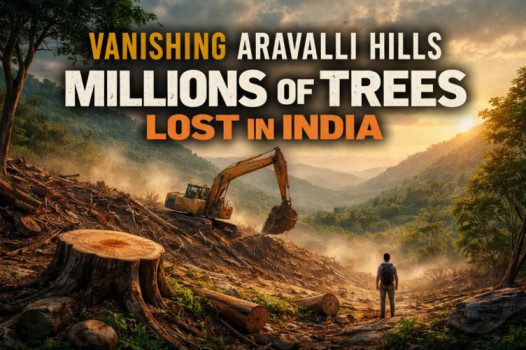
The Aravalli Hills and India’s Silent Tree Loss: A Story of Vanishing Forests
Early one morning, the Aravalli hills stood unusually silent. No birds, no rustling leaves—only the low rumble of machines in the distance. These hills, older than the Himalayas, have witnessed centuries of civilizations rise and fall. Yet today, they face one of their greatest threats: unchecked development, mining pressure, and large-scale tree cutting.
This is not just a story about a mountain range. It is the story of India’s forests, its disappearing trees, and the price the country may pay for ignoring nature’s warnings.
The Aravalli Hills: India’s Oldest Natural Shield
Stretching across Rajasthan, Haryana, Gujarat, and Delhi NCR, the Aravalli range plays a crucial role in:
- Preventing desertification from the Thar Desert
- Recharging groundwater aquifers
- Reducing air pollution in North India
- Supporting native wildlife and vegetation
Despite being ancient and ecologically critical, large parts of the Aravallis are classified as “scrub land,” making them vulnerable to mining, real estate expansion, and infrastructure projects. Environmental experts have repeatedly raised concerns about this classification, including reports published by the Centre for Science and Environment.
The 100-Metre Definition Controversy
In recent years, a major controversy erupted around how the Aravalli hills are officially defined. A new benchmark proposed that only hills rising more than 100 metres from surrounding land qualify as “Aravalli hills” for protection.
Environmentalists warn this narrow definition could exclude vast stretches of low-lying hills that still perform vital ecological functions—holding soil, absorbing rainwater, and regulating temperature. Several conservation groups have highlighted this risk in representations to the Ministry of Environment, Forest and Climate Change.
If a hill doesn’t meet a technical height requirement, does it lose its right to survive?
The Bulldozers and the Broken Balance
As legal debates continue, ground reality moves faster. Mining pits expand. Roads cut through green corridors. Trees fall—sometimes legally, sometimes illegally.
Local communities report drying wells, rising temperatures, and increased dust storms. What once took centuries to form is disappearing in months.
And this is not limited to the Aravallis.
How Many Trees Have Been Cut in India in the Last 10 Years?
This is one of the most important—and misunderstood—questions.
There are two ways tree loss is measured in India:
1. Official Tree Felling (Government Permissions)
Based on government disclosures and parliamentary data:
- Over 10.9 million trees were officially cut with permission in a five-year period
- Around 3.1 million trees were cut in a single year (2020–21)
- Across multiple reports, India has officially allowed the cutting of tens of millions of trees in the last decade
These figures have been cited in parliamentary answers and reports published by the Government of India.
These numbers include trees removed for:
- Highways and expressways
- Mining projects
- Urban expansion
- Power plants and infrastructure
This does not include illegal tree cutting.
2. Satellite-Measured Tree Cover Loss
Satellite data captures the actual loss of forest and tree cover, regardless of legal permissions.
Key findings:
- India has lost over 2.3 million hectares of tree cover since the early 2000s
- A significant portion of this loss occurred in the last 10 years
- Loss of primary (old-growth) forests has accelerated in recent years
This data is supported by global forest monitoring platforms such as Global Forest Watch.
Millions of trees are disappearing quietly—far beyond what paperwork alone captures.
Why “Compensatory Afforestation” Isn’t Enough
When trees are cut, authorities often promise compensatory afforestation—planting new trees elsewhere.
But there’s a problem:
- A 100-year-old forest cannot be replaced by saplings
- Many plantations fail due to poor soil or lack of water
- Monoculture plantations do not restore biodiversity
- Groundwater and micro-climate damage remains irreversible
Environmental assessments published by UN Environment Programme consistently highlight these limitations.
The Human Cost of Tree Loss
Tree loss isn’t just an environmental issue. It affects people directly:
- Higher summer temperatures
- Falling groundwater levels
- Increased respiratory diseases
- More frequent dust storms
- Reduced agricultural productivity
In cities near the Aravallis, residents now experience harsher heatwaves and worsening air quality—issues also flagged in studies by the World Health Organization.
A Choice India Must Make
Development is necessary. Infrastructure is important. But destruction is not the only path forward.
India stands at a crossroads:
- Protect forests based on ecological value, not technical definitions
- Enforce existing laws strictly
- Restore native forests, not cosmetic plantations
- Treat hills like the Aravallis as natural infrastructure, not empty land
Because once these trees are gone, no court order, policy revision, or budget allocation can bring them back.
Conclusion: The Silence After the Last Tree
One day, the machines will stop. Projects will finish. Cities will expand.
When the last tree falls and the last hill is flattened, who will protect us then?
The Aravalli hills are not asking for sympathy. They are asking for recognition—before their silence becomes permanent.