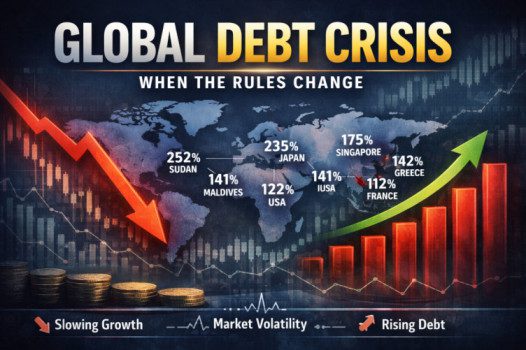
The Global Debt Crisis: Why the World Doesn’t End — But the Rules Change
When people hear “debt crisis,” they often imagine financial Armageddon. In reality,
a debt crisis doesn’t mean the world ends tomorrow — it means the rules quietly shift:
- Economic growth slows
- Market volatility rises
- Liquidity tightens
- Traditional playbooks stop working
This is not fear-mongering — it’s grounded in how
debt, confidence, and macro cycles interact in the real economy.
📊 Global Debt at a Glance
The scale of debt in the world today is historic:
- Global debt surpassed an estimated $313 trillion in 2023, up from about
$210 trillion a decade earlier, according to the Institute of International Finance.
(Source: Reuters)
- Debt across public and private sectors now amounts to
over 330% of global GDP.
(Source: Reuters)
That doesn’t mean collapse — but it
reshapes investment, credit availability, and growth dynamics.
🌍 Top 10 Countries by Public Debt as % of GDP (2025)
One of the most telling measures of fiscal strain is the
debt-to-GDP ratio, which highlights how much a government owes relative to
the size of its economy. According to IMF-linked reporting:
(Source: The Indian Express)
| Rank | Country | Debt (% of GDP) |
|---|---|---|
| 1 | Sudan | ~252% |
| 2 | Japan | ~235% |
| 3 | Singapore | ~175% |
| 4 | Greece | ~142% |
| 5 | Bahrain | ~141% |
| 6 | Maldives | ~141% |
| 7 | Italy | ~137% |
| 8 | United States | ~122% |
| 9 | France | ~116% |
| 10 | Canada | ~112% |
These ratios are not static; they change with economic performance, borrowing, and
fiscal policy.
(Source: The Indian Express)
👉 Note: Some smaller economies appear high due to smaller GDP bases, but
large economies like Japan and the U.S. also show heavy debt burdens.
💡 Fact: Absolute Debt Leaders
In terms of total dollars owed, the largest debts belong to the world’s
biggest economies:
- United States leads by a large margin
- China ranks second globally
- Together, the top five countries account for
nearly 70% of global government debt before adjusting for GDP size.
(Source: Visual Capitalist)
This highlights the difference between size of debt and
debt risk — total figures influence markets, while ratios reflect sustainability.
📌 Why This Matters for Investors and Policymakers
🧠 Confidence Drives the System
Debt only works if creditors and markets believe it will be repaid. When confidence fades:
- Credit costs rise
- Liquidity dries up
- Risk premiums spike
This is why cracks often appear before outright defaults.
📉 Macro cycles don’t announce themselves
- Cycles unfold slowly
- Market pricing adjusts incrementally
- Risks compound until stress becomes visible
🔁 What Changes in High-Debt Cycles
✔ Traditional high-leverage strategies become riskier
✔ Safety and liquidity command a premium
✔ Capital shifts from growth toward stability
In essence:
Debt reshapes markets — not necessarily destroys them.
📈 From Stress to Opportunity
- They create mispricing
- Trigger forced reallocations
- Offer asymmetric opportunities to prepared participants
History shows long-term returns often favor the
disciplined, not the panicked.
🧭
A debt crisis doesn’t mark an endpoint — it
changes the economic landscape:
- Growth slows
- Volatility rises
- Liquidity tightens
- Old models fail
- New opportunities arise
Understanding these dynamics — and the figures behind them —
is no longer optional. It’s essential for navigating the next cycle.