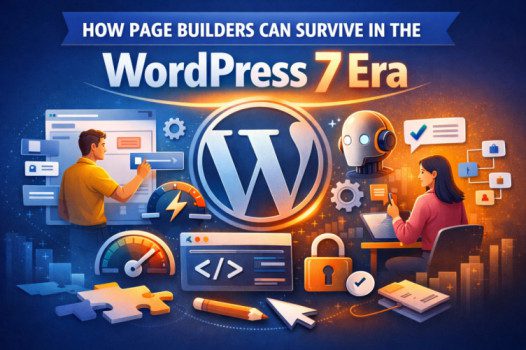
What Page Builders Must Do to Survive in the WordPress 7 Era
The arrival of WordPress 7.0 changes the rules of website building. WordPress is no longer just a CMS with an editor — it has evolved into a collaborative, block-based, and AI-ready site-building platform.
For page builders, this is a moment of truth.
This article explains in simple language what page builders must do to survive (and grow) in the WordPress 7 era — without hype, fear, or technical jargon overload.
First, understand the new reality
WordPress 7 now offers features that page builders once sold as premium:
- Advanced layouts and design controls
- Full Site Editing (headers, footers, templates)
- Per-block styling and CSS
- Real-time multi-user editing
- Foundations for AI features
Because of this, many users are asking:
“Why do I still need a page builder?”
Builders like Themify Builder, Elementor, Divi, and WPBakery can no longer rely on drag-and-drop alone.
1. Stop fighting WordPress — work with it
The biggest mistake a page builder can make today is trying to replace the WordPress editor.
What users don’t want anymore
- Separate editing modes
- Confusing interfaces that feel “non-WordPress”
- Content that breaks when the builder is disabled
What users expect now
- Builders that feel native
- Blocks that work inside the WordPress editor
- Compatibility with themes, templates, and global styles
Simple rule:
If a builder feels like it’s fighting WordPress, users will eventually abandon it.
2. Move beyond basic layouts
WordPress 7 already handles:
- Columns and grids
- Fonts, spacing, colors
- Responsive behavior
So page builders must stop selling basic design tools and start offering advanced building power.
What actually adds value now
- Ready-made advanced components (pricing tables, comparisons, dashboards)
- Dynamic content (custom fields, filters, queries)
- Conditional visibility (show content based on user, device, or action)
- Reusable design systems for teams and agencies
Think less: “Drag elements anywhere”
Think more: “Solve real business problems faster”
3. Support real-time collaboration properly
WordPress 7 introduces multi-user, real-time editing.
This matters because:
- Teams work together
- Agencies build sites with multiple editors
- Content is created faster than ever
Page builders must:
- Allow multiple users to edit safely
- Avoid conflicts and broken layouts
- Respect WordPress permissions and locking
Builders that break collaboration will quietly be removed by serious users.
4. Treat AI as a core feature, not a gimmick
WordPress 7 lays the groundwork for AI-powered workflows.
Users will expect builders to:
- Suggest layouts automatically
- Generate page sections from goals (sales, signup, content)
- Maintain consistent design across pages
- Improve accessibility and performance automatically
What won’t work anymore:
- “AI text generator” buttons only
- Rebranded prompts with no real value
AI should help users build better sites — not just write text.
5. Specialize instead of trying to do everything
Generic page builders are the most at risk.
The future belongs to builders that clearly say:
- “We are best for WooCommerce”
- “We are built for landing pages”
- “We specialize in LMS or memberships”
- “We power enterprise design systems”
Users trust specialists, not all-in-one promises.
6. Performance must be excellent by default
WordPress core is getting faster and cleaner.
This means page builders can no longer get away with:
- Too many nested divs
- Heavy inline CSS
- Loading everything on every page
Builders must:
- Produce clean HTML
- Load only what’s needed
- Respect Core Web Vitals
Today, a slow builder is not just annoying — it’s a reason to quit.
7. Remove fear of lock-in
Modern WordPress users care deeply about ownership and portability.
They want:
- Content that remains usable if the builder is removed
- Real blocks, not shortcodes
- Clean fallbacks
Builders that trap users create distrust — and distrust kills long-term products.
8. Build for developers as well as beginners
WordPress itself is becoming easier for beginners.
So page builders must:
- Offer APIs and hooks
- Allow customization
- Support modern workflows
- Work with headless and hybrid setups
The future WordPress user is not a beginner forever — they grow, and their tools must grow with them.
What the future looks like
In the WordPress 7 era:
- Many small page builders will disappear
- Some will pivot into block libraries
- A few will become powerful platforms
- WordPress itself will handle most basic sites
Page builders won’t vanish — but only the best-adapted ones will survive.
To survive WordPress 7, page builders must:
- Work with WordPress, not against it
- Offer real value beyond basic layouts
- Be fast, clean, and reliable
- Use AI meaningfully
- Avoid locking users in
- Focus on clear use-cases
WordPress 7 doesn’t kill page builders.
It simply raises the bar.