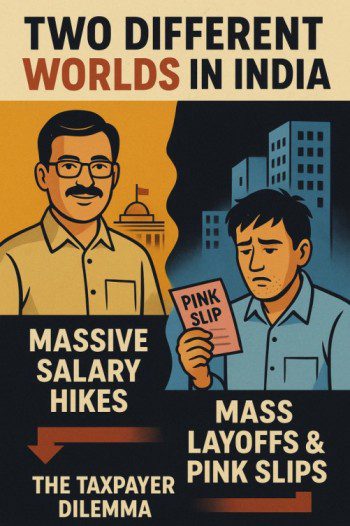
Two Different Worlds in One Country: Who Really Feeds the System?
India, the world’s largest democracy, is often celebrated for its diversity, resilience, and economic growth. But beneath the headlines, a stark irony prevails—one that affects millions of working citizens every single day.
On one side, government employees are witnessing significant salary hikes, generous allowances, and job security. For example:
- The 8th Pay Commission (for central government employees) is projected to deliver a salary and pension increase of 30‑34% when implemented, potentially benefiting some 11 million employees and pensioners. The Economic Times
- A recent amendment raised the “Dearness Allowance” (DA) for central government employees from 53% to 55% of basic pay—effective 1 Jan 2025—benefiting around 48.66 lakh employees and 66.55 lakh pensioners. Jagranjosh.com
- Previous data estimate that the minimum basic pay under the 7th Pay Commission rose from ₹7,000 to ₹18,000. The Financial Express
Thus, roughly tens of millions of public servants are covered under rising pay + allowances + perks.
On the other side, the private‑sector tells a different story: mass layoffs, job insecurity, squeezed benefits. A few data points:
- In the Indian startup ecosystem alone, more than 9,000 employees lost jobs in 2024; while smaller than the peak layoff years, it still highlights the fragility of private employment. Inc42 Media
- In the huge Indian IT/outsourcing sector (which employs ~56.7 lakh people and accounts for over 7% of GDP), firms like Tata Consultancy Services (TCS) cut over 12,000 jobs, signalling major disruption. Reuters
For many private employees, job security is no longer a given; annual increments are uncertain; perks are being scaled back.
The Taxpayer’s Irony
Here’s the uncomfortable truth: the very people funding government salaries through Income Tax, GST, and countless levies are often the ones left stranded when disaster strikes in the private sector.
Some hard numbers:
- Only about 0.3% of the adult population in India account for 76 % of total personal income‐tax receipts. That’s ~3.2 million people bearing the bulk of direct income tax. The Economic Times
- Meanwhile, indirect taxes such as GST are booming: e.g., the gross GST collection in March 2024 rose 11.5% year‑on‑year to ₹1.78 trillion (≈ $21.35 billion), and for FY 2023‑24 the annual GST collection was about ₹20.1 trillion (~12% higher than previous year). Reuters
So many private‐sector workers pay taxes and contribute, yet when they lose jobs or face hardship—they find little systemic support.
And when a common taxpayer dares to question the system—inefficiencies, corruption, favouritism—the response is often silence. The trust gap widens.
Thus the cycle:
- The system feasts on the taxpayer: Government salaries and perks rise; allowances are generous.
- Private employees bear the brunt: Job losses, shrinking benefits, less security.
- Dissent is muted: Those who question get little accountability or response.
Why This Matters
This divide between government and private sector is more than economic—it’s a societal and moral issue. When workers feel exploited, ignored, or powerless, the social contract erodes.
Consider: If millions of private workers feel they’re paying their dues but getting no protection or voice in return, how long before cynicism, disengagement, and resentment take root?
And with economic growth dependent on private‐sector vitality (jobs, innovation, taxes), neglecting that segment puts future momentum at risk.
What Can Change?
While systemic reform is challenging and long‑term, there are actionable steps:
- Strengthen social security for private employees. For instance, better unemployment support, re‑skilling programmes, bridging assistance when layoffs happen.
- Greater transparency in government spending. Taxpayers deserve to see how their taxes are used: salary bills, allowances, perks, versus delivering public goods.
- Encourage meaningful dialogue. Channels for private‐sector employees and taxpayers to raise concerns, with responsive institutional mechanisms.
- Rebalance tax burdens and incentives. As only a small fraction pay major personal income tax, the system must ensure fairness and that benefits flow across sectors.
Conclusion
India is a land of paradoxes—a country where the taxpayer bleeds so the system can feast. It’s a stark reminder that economic growth and job security must go hand in hand—and that those who fuel the nation deserve more than silence when they question the system.
It’s time to bridge the divide and create a society where both government and private employees can thrive—and where the taxpayer is not just a number, but a respected citizen.