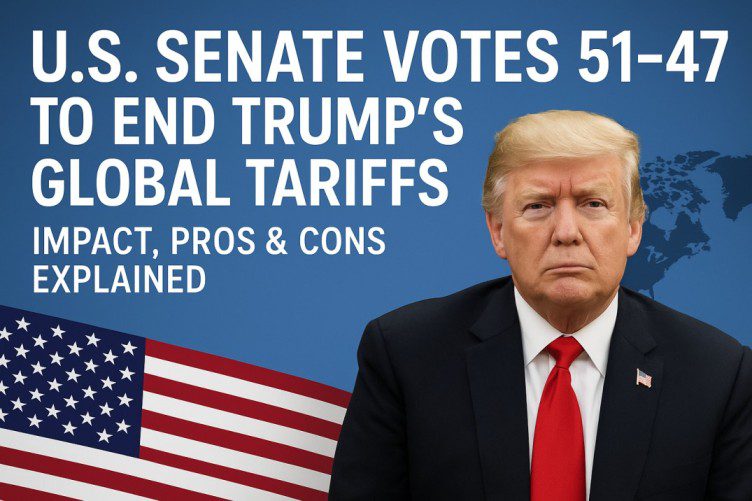
U.S. Senate Votes 51–47 to End Trump’s Global Tariffs — Here’s What It Means
In a major political and economic move, the U.S. Senate voted 51–47 to overturn former President Donald Trump’s global tariffs, which were originally imposed under a national emergency declaration. While the vote marks a significant challenge to Trump’s trade agenda, it does not yet officially end the tariffs — further approval from the House and potentially a presidential signature are required.
Still, this narrow vote sends a strong message about how divided Washington remains on global trade policy, protectionism, and America’s role in the international market.
🧭 Background: What Were Trump’s Global Tariffs?
Donald Trump introduced a sweeping set of tariffs during his presidency, targeting over 100 countries under the argument of protecting American industries from “unfair trade practices.” These included steel, aluminum, and consumer goods, affecting allies like Canada, the EU, and Japan — as well as major rivals like China.
Trump’s team justified the tariffs under the “Reciprocal Trade Act” and a national emergency provision, which gave the president broad authority to adjust import duties without congressional approval.
🏛️ What the Senate Vote Means
The Senate resolution (S.J.Res. 88) seeks to revoke the national emergency that enabled these global tariffs. Four Republican Senators — Mitch McConnell, Susan Collins, Lisa Murkowski, and Rand Paul — joined Democrats in supporting the measure.
However:
- The House of Representatives still needs to pass a matching resolution.
- Even if it passes, Trump (or a future administration) could veto it.
- Therefore, the tariffs remain in effect for now — but politically, the pressure to roll them back has grown sharply.
📊 Economic Impact
Short-Term Effects
- Market Volatility: The vote triggered mixed reactions on Wall Street. Investors in manufacturing and steel dipped slightly, while tech and import-heavy sectors (like retail and autos) rose on optimism of lower costs. (Source: CNBC Markets)
- Supply Chain Relief: Importers anticipate potential cost reductions if tariffs are eventually lifted, improving global supply chains disrupted since 2018.
- Currency Shifts: The U.S. dollar softened slightly amid expectations of a more open trade stance. (Source: Bloomberg)
Long-Term Effects
- Global Trade Relations: Allies view the vote as a sign of goodwill and potential return to multilateral cooperation.
- U.S. Manufacturing: Some domestic industries may face renewed competition from cheaper imports, especially in metals and machinery.
- Inflation Pressure: Reduced import duties could ease certain price pressures, helping to stabilize inflation rates in 2026.
✅ Pros of Ending the Global Tariffs
- Lower Consumer Prices:
Removing tariffs cuts import costs — meaning cheaper electronics, appliances, and cars for American households. - Stronger Global Alliances:
Allies like the EU, Japan, and Canada have long criticized U.S. protectionism. Ending tariffs could rebuild diplomatic and economic trust. - Supply Chain Stability:
Companies that rely on international components would benefit from smoother operations and lower overhead costs. - Reduced Inflation:
With imports becoming cheaper, inflation could cool slightly — a positive for both consumers and the Federal Reserve’s long-term goals. - Encourages Fair Competition:
It levels the playing field for global trade, encouraging innovation and efficiency rather than dependence on government protection.
❌ Cons of Ending the Global Tariffs
- Domestic Industry Pressure:
Sectors like steel, aluminum, and energy could face stiffer competition from cheaper imports, risking layoffs and reduced profit margins. - Trade Deficit Concerns:
Lower tariffs might widen the U.S. trade deficit, as imports rise faster than exports. - Political Backlash:
Many in the Republican base view tariffs as a symbol of “America First.” Rolling them back could deepen political divides ahead of the 2026 elections. - Loss of Negotiating Leverage:
Tariffs, while controversial, gave the U.S. leverage in trade deals — particularly with China and emerging economies. - Short-Term Market Uncertainty:
Policy reversals can spook investors, leading to volatility as industries adjust to new pricing dynamics.
🔮 The Road Ahead
The Senate’s 51–47 vote is symbolic but significant. It signals growing bipartisan fatigue with aggressive protectionism, even among Republicans once loyal to Trump’s trade stance. The final decision now depends on the House of Representatives and, potentially, the next administration’s economic strategy.
If the resolution eventually becomes law, it could mark the largest rollback of U.S. trade barriers in decades — reshaping global commerce and signaling a return to a more cooperative, rules-based system.
🧩
The Senate’s decision to end Trump’s global tariffs reflects a larger shift in how America approaches trade, diplomacy, and inflation management. Whether it becomes law or not, the message is clear: the U.S. is reconsidering its role as a global trade partner rather than a trade combatant.
For businesses and consumers alike, this moment could redefine prices, partnerships, and priorities in the global economy. 🌍💬