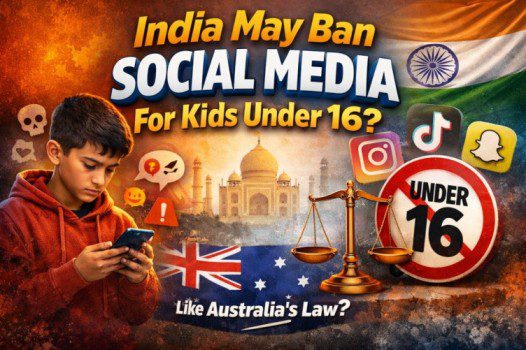
India May Ban Social Media for Kids Under 16? Madras High Court Suggests Australia-Style Law
Social media has become a daily habit for millions of children—scrolling reels, watching shorts, chatting with friends, and discovering trends in seconds. But with rising concerns about online safety, harmful content, cyberbullying, addiction, and privacy risks, a big question is now being asked in India:
👉 Should children under 16 be allowed to use social media at all?
Recently, the Madras High Court suggested that the Centre should consider making a law similar to Australia’s age-based restriction, which aims to stop children under 16 from accessing social media platforms, mainly to protect minors online.
So… Is India really going to ban social media for kids under 16?
Let’s break it down in a simple, SEO-friendly and engaging way.
📌 Quick Summary (For Busy Readers)
✅ Madras High Court suggested the Centre consider a law like Australia
✅ Australia has an under-16 social media restriction model
✅ India may explore age-based access control for minors
⚠️ But a nationwide ban is not confirmed yet
📌 Biggest challenge: Age verification + privacy + enforcement
🔥 Why India Is Talking About a Social Media Ban for Under-16
Let’s be honest—kids today are online earlier than ever.
Even children aged 10–15 are actively using platforms like:
- Snapchat
- YouTube Shorts
- X (Twitter)
- Telegram groups
- Gaming chats and communities
And while social media can be fun and educational, it also comes with serious risks.
⚠️ Major online risks for children
✔️ Exposure to inappropriate content
✔️ Cyberbullying and harassment
✔️ Online predators and grooming
✔️ Addiction and attention issues
✔️ Body image pressure
✔️ Dangerous trends and challenges
✔️ Data tracking and privacy loss
This is why courts, governments, and parents worldwide are now pushing for stronger child protection laws online.
⚖️ What Did the Madras High Court Say?
The Madras High Court suggested the Union Government should consider a law similar to Australia’s new social media restriction for minors.
The goal is simple:
✅ Protect children from online harm
✅ Reduce exposure to harmful content
✅ Make platforms accountable
Important point:
📌 A suggestion by the court does not automatically mean a ban is confirmed, but it does increase the chances of policy action.
🌏 Australia’s Under-16 Social Media Restriction: What’s the Model?
Australia has taken a bold step.
Instead of “advising parents” or “asking platforms nicely,” Australia introduced a strict approach:
🇦🇺 What Australia’s rule means
🔹 Children under 16 should not be allowed to create/keep social media accounts
🔹 Platforms must take “reasonable steps” to block underage accounts
🔹 Big penalties can be applied if companies fail to comply
💡 The focus is mainly on platform responsibility, not punishing children.
That’s why India is being advised to consider a similar structure.
🇮🇳 If India Bans Social Media Under 16, What Could Change?
If the Centre introduces an Australia-style law, here’s what it might look like in India:
✅ Possible changes
✔️ Social media platforms may require stricter age verification
✔️ Under-16 accounts could be blocked or removed
✔️ Platforms may face legal penalties for allowing minors
✔️ Parents might need to give consent for certain services
✔️ Teen accounts may become limited by default
🧠 The BIGGEST Challenge: Age Verification in India
This is where the debate gets serious.
To restrict under-16 users, the system must know:
👉 Who is under 16?
👉 Who is above 16?
🔍 Common age verification methods
✅ Self-declared age (easy to lie)
✅ Phone number verification (not enough)
✅ Government ID verification (privacy risk)
✅ Face scan / AI estimation (accuracy + privacy concerns)
✅ Parental consent systems (hard to implement at scale)
So yes—the biggest hurdle is enforcement without harming privacy.
📱 Which Apps Could Be Affected?
If India applies this rule, it could include:
Social platforms likely to be targeted
- Snapchat
- TikTok (if allowed again in future)
- X (Twitter)
- Threads
- Some short-video platforms
But what about:
❓ WhatsApp
❓ YouTube
❓ Telegram
❓ Discord
❓ Gaming chats
This is why lawmakers will have to define what counts as “social media” very clearly.
✅ Pros of Banning Social Media for Under 16 (Supporters’ View)
Supporters say this could bring huge benefits.
🌟 Advantages
✅ Less exposure to adult content
✅ Lower cyberbullying risk
✅ Reduced screen addiction
✅ Better mental health outcomes
✅ More focus on studies and real-life friendships
✅ Less data tracking of children
✅ Stronger accountability for big tech companies
Many parents feel this is overdue.
❌ Cons of a Social Media Ban Under 16 (Critics’ View)
Critics argue that banning may create new problems.
⚠️ Disadvantages
❌ Kids may still find ways around it (fake DOB)
❌ Privacy concerns if ID verification becomes mandatory
❌ Rural and digital learners may lose useful access
❌ Teens may shift to unsafe or unregulated platforms
❌ Enforcement could be difficult in India’s huge user base
❌ Could affect content creators under 16
So the real challenge is balancing:
⚖️ Safety vs Freedom vs Privacy
🛡️ What India Can Do Instead of a Full Ban (Alternative Solutions)
Even if India doesn’t fully ban social media under 16, it can still protect children using smarter rules.
💡 Better options India can consider
✅ “Teen mode” by default (limited features)
✅ No targeted ads for minors
✅ Stronger content filters
✅ Restricted DMs from strangers
✅ Mandatory parental controls for under 16
✅ Screen-time limits built into apps
✅ Strong action against cyberbullying and predators
This approach protects children without creating a complete “shutdown.”
👨👩👧 What Parents Should Do Right Now (Practical Tips)
While the government debates laws, parents can act immediately.
✅ Best safety steps for parents
🔹 Enable parental controls on phones
🔹 Keep accounts private
🔹 Turn off unknown DMs
🔹 Restrict sensitive content in Instagram/YouTube
🔹 Monitor screen time
🔹 Talk openly about online dangers
🔹 Teach kids not to share photos, location, school info
📌 The best protection is tech + trust + communication.
🔮 What Happens Next? (Future Outlook)
At the moment, India is still in the discussion stage.
But the Madras High Court’s suggestion signals that:
📌 India may soon take stricter action on child social media safety
📌 New laws or age-based rules could be introduced
📌 Platforms may face tougher compliance requirements
Whether it becomes a complete ban or a controlled access system, one thing is clear:
✅ Child online safety is now a top priority topic in India.
Will India Ban Social Media Under 16?
👉 Not confirmed yet.
But yes, it is possible in the future.
India may choose:
✅ a full ban model (like Australia)
OR
✅ a partial restriction model (parental consent + safety features)
Either way, the goal will remain the same:
🛡️ Protect minors from online harm and make social media safer.