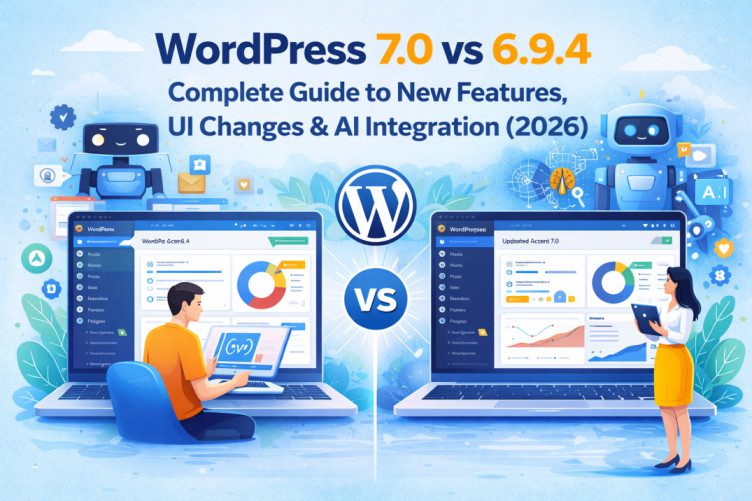
WordPress 7.0 vs 6.9.4: Complete Guide to New Features, UI Changes & AI Integration
The release of WordPress 7.0 marks one of the most significant updates in recent years.
From visual redesigns to AI integration infrastructure, WordPress is clearly evolving toward a smarter, faster, and more collaborative future.
In this blog, we’ll break down:
- Key differences between WordPress 7.0 and 6.9.4
- New features and improvements
- What it means for bloggers, developers, and businesses
1. Refreshed UI & Better Visual Experience
One of the first noticeable changes in WordPress 7.0 is the updated admin interface.
What’s new:
- Higher contrast colors
- Darker, more readable typography
- Improved highlight colors (especially blue tones)
Why it matters:
This makes the dashboard:
- Easier on the eyes
- More accessible
- Better for long working sessions
👉 Small change, but big impact on usability.
2. Smoother Page Transitions (No More Jarring Reloads)
In WordPress 6.9.4, switching between pages like:
- Dashboard
- Plugins
- Pages
…causes a full reload.
WordPress 7.0 improvement:
- Smooth fade-like transitions
- Feels like a modern web app
- Faster and more responsive experience
👉 This gives WordPress a more premium, app-like feel.
3. Command Palette Enhancement (Ctrl + K)
The command palette gets more prominence in WordPress 7.0.
Changes:
- Shortcut (Ctrl + K / Cmd + K) is highlighted
- Notification UI now encourages usage
Benefit:
- Faster navigation
- Power-user friendly workflow
4. AI API Infrastructure (Game-Changer 🚀)
This is one of the biggest long-term updates.
What is it?
A central AI API system inside WordPress.
Problem before:
- Each plugin used its own AI system
- Multiple subscriptions & API keys
- Messy and expensive
Solution in WordPress 7.0:
- Add your own AI API key (e.g., GPT, Claude)
- Plugins use the same centralized system
Why this matters:
- Unified AI ecosystem
- Lower cost
- Better scalability
👉 Think of it like:
App Store (infrastructure) → Plugins (apps)
5. Collaborative Editing (Like Google Docs)
Coming soon (planned feature):
Features:
- Multiple users editing the same post
- Live collaboration
- Comments + real-time updates
Use case:
- Content teams
- Agencies
- Bloggers with editors
👉 This turns WordPress into a true collaboration platform.
6. Improved Revision System
The revision feature gets a major upgrade.
WordPress 6.9.4:
- Hard-to-read code-based differences
- No visual clarity
WordPress 7.0:
- Visual diff system
- Green = added content
- Red = removed content
- Image previews included
👉 Huge improvement for content editors.
7. Cover Block Now Supports Video URLs
New feature in the Cover block:
Added option:
- Embed video via URL
Benefits:
- No need to upload heavy files
- Faster media usage
- Cleaner workflow
8. Advanced Navigation Menu Customization
Menus are more powerful in WordPress 7.0.
New feature:
- Overlay template customization
What you can do:
- Design mobile menus visually
- Customize layout without CSS
- Create unique navigation experiences
👉 Great for designers and non-coders.
9. New Native Blocks
Breadcrumbs Block
- Previously required plugins
- Now built-in
- SEO-friendly navigation
Icons Block
- Native SVG icon support
- No external libraries needed
- Fully customizable
👉 Reduces dependency on plugins.
10. Inline CSS Editing (Huge for Designers)
Before:
- Add CSS classes → write code separately
Now:
- Add CSS directly inside blocks
Example:
- Adjust shadow
- Spacing tweaks
- Minor styling
👉 Faster design workflow without touching theme files.
11. Better Patterns & Template Editing
Enhancements include:
- Easier identification of synced patterns
- Improved editing focus (like spotlight mode)
👉 Helps maintain consistency across sites.
12. Faster Heading Selection
Old way:
- Add heading → change level → edit
New way:
- Select heading level instantly (H1–H6)
👉 Saves time for content creators.
13. Built-in Font Management (No Plugins Needed)
One of the most requested features is finally here.
New capabilities:
- Upload custom fonts
- Connect to Google Fonts
- Manage fonts globally
👉 Works even without block themes!
14. Client-Side Image Processing
A major performance upgrade.
How it works:
- Images processed in browser before upload
Benefits:
- Reduces server load
- Faster uploads
- Lower hosting costs
- Better performance
👉 Could replace many image optimization plugins.
15. Developer-Focused Improvements
Key updates:
- Client-side capabilities API
- Always iframed post editor
- PHP-only block registration
- UI component standardization
- CodeMirror updates
PHP Support Change:
- Dropped support for PHP 7.2 & 7.3
- Recommended: PHP 8+
👉 Better performance, security, and modern development standards.
Final Thoughts
WordPress 7.0 is not just an update—it’s a shift toward the future.
Biggest highlights:
- AI-ready infrastructure
- Better UX and UI
- Collaboration tools
- Performance improvements
- Reduced plugin dependency
What it means for you:
- Faster workflows
- Lower costs
- Smarter websites
Conclusion
If you’re using WordPress regularly, upgrading to 7.0 will bring:
✅ Better speed
✅ Cleaner interface
✅ Advanced features
✅ Future-ready AI integration
👉 This update clearly shows that WordPress is evolving into a modern, intelligent website platform.