Why You Shouldn’t Use AI Code Directly in WordPress
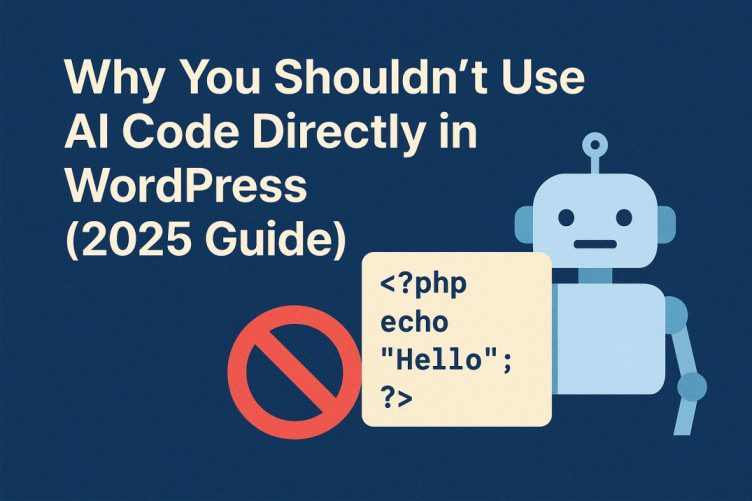
Why You Shouldn’t Use AI Code Directly in WordPress (2025 Guide)
Artificial Intelligence (AI) has changed how we work online — from writing content to designing websites. But when it comes to coding in WordPress, you should think twice before copying and pasting AI-generated code directly into your site. 🚫
In this article, we’ll explain why AI code can sometimes harm your WordPress site, what risks are involved, and how to use AI safely to make your website better — without breaking it.
🤖 What Is AI-Generated Code?
AI tools like ChatGPT, Claude, and Gemini can generate PHP, CSS, or JavaScript snippets within seconds. They can help you add a new feature, fix an error, or even customize a WordPress theme.
Sounds amazing, right?
Well, not always.
AI doesn’t truly understand your site’s structure, active plugins, or theme setup — it only predicts what code might work. That’s why blindly using AI-generated code can cause unexpected problems.
⚠️ 1. AI Code Isn’t Context-Aware
AI tools don’t have access to your site’s exact setup. So even if the snippet looks perfect, it might not fit your WordPress version, PHP settings, or installed plugins.
For example:
- The AI might use deprecated functions that no longer work.
- It might conflict with your page builder, like Themify, Elementor, or Divi.
- It could override your theme’s hooks or templates.
Result? Your website could break, show errors, or behave oddly on mobile devices.
🧩 Tip: Always test new code in a staging site before applying it live.
🔐 2. Security Risks You Can’t Ignore
AI doesn’t always follow WordPress’s security standards. It might skip sanitization, nonces, or data escaping — which are essential to prevent hacking attempts.
Example of risky code:
$input = $_GET['user'];
echo "Welcome $input!";
If someone enters a malicious script in the URL, it could inject harmful JavaScript into your site.
✅ Safer way:
$input = sanitize_text_field($_GET['user']);
echo "Welcome " . esc_html($input);
Always ensure any code that touches user input is secure.
🧩 3. Theme and Plugin Conflicts
WordPress themes and plugins rely on a delicate balance of hooks, filters, and functions. AI doesn’t know that.
Adding an AI-generated snippet to functions.php could:
- Disable key theme functions
- Interfere with plugin scripts
- Cause header or footer duplication
- Break dynamic elements like sliders or menus
Example:
You ask AI to “add a new header,” and it creates one manually — ignoring that your theme already has a header.php file. The result? A broken layout.
🧠 Pro Tip: Instead of replacing theme files, use child themes or the Code Snippets plugin to test changes safely.
🛠️ 4. Difficult to Debug Later
AI-generated code often looks clean but may lack proper structure or comments. This makes it tough to maintain or debug months later.
When your website updates (or a plugin changes), that AI code might suddenly stop working — and you won’t know why.
💬 Real-World Example:
A user added AI-generated PHP to change product prices dynamically. It worked fine for weeks, until WooCommerce updated — and the checkout page crashed.
Always ask AI to explain the code line by line before using it. Understanding what it does helps you maintain your site long-term.
💡 5. Better, Safer Alternatives
Instead of adding raw AI code to your WordPress files, here’s a safer approach:
✅ Use the Code Snippets Plugin
This plugin lets you add small PHP scripts safely — without editing theme files. If a snippet breaks, it automatically disables itself instead of crashing your site. Learn more here.
✅ Test on a Staging Site
Use your hosting provider’s staging environment or plugins like WP Staging to test changes before pushing them live.
✅ Use AI as a Tutor, Not a Mechanic
Let AI explain how something works, help you learn hooks, or write draft code — but always review it before applying.
✅ Validate with a Developer
If you’re unsure about a code snippet, run it by a developer or a WordPress support community. Two minutes of checking can save hours of downtime.
🌐 Example: The Right Way to Add Custom Scripts
Instead of adding this directly:
add_action('wp_head', function() {
    echo "<script>alert('Hello');</script>";
});
Do this:
function my_custom_script() {
    wp_enqueue_script('my-script', get_stylesheet_directory_uri() . '/js/custom.js', [], false, true);
}
add_action('wp_enqueue_scripts', 'my_custom_script');
This method respects WordPress’s native system for handling scripts — secure, update-proof, and conflict-free.
✨
AI is a powerful ally for WordPress users — but it’s not a magic wand. It can speed up development, spark new ideas, and simplify learning, as long as you use it wisely.
🔑 Key takeaway:
“AI should assist your creativity, not replace your understanding.”
So the next time an AI tool gives you code, don’t just paste it — review, test, and verify it first. That’s the difference between a broken site and a professional one. 💻💪