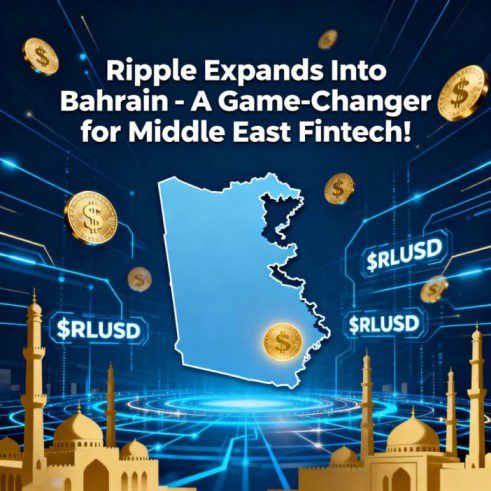
Ripple Expands Into Bahrain in a Boost for $RLUSD — A Game-Changer for the Middle East Fintech Scene!
🌍 Ripple’s Global Vision Takes a Middle Eastern Turn
Ripple — the blockchain powerhouse behind XRP and the newly launched RLUSD (Ripple USD) stablecoin — just made a major move! 🚀
On October 9, 2025, Ripple announced its expansion into the Kingdom of Bahrain through a partnership with Bahrain FinTech Bay (BFB), one of the Gulf’s most innovative financial technology hubs.
This expansion marks a bold step in Ripple’s mission to build real-world blockchain adoption — and could be a major win for both the company and its flagship stablecoin, $RLUSD.
So, what’s the big deal about Bahrain? And how does this help Ripple and RLUSD take center stage in the global stablecoin race? Let’s break it down 👇
🇧🇭 What Exactly Happened?
Ripple isn’t just “opening an office” — it’s partnering with Bahrain FinTech Bay to:
- Develop pilot blockchain projects with local financial institutions 💡
- Launch educational programs and fintech accelerators for startups 📚
- Promote tokenization and digital asset infrastructure 🏦
- Explore RLUSD integrations with banks and payment providers 💱
This collaboration aims to position Bahrain as a regional blockchain innovation hub, supported by Ripple’s enterprise-grade technology and stablecoin ecosystem.
💵 Meet RLUSD — Ripple’s Regulated Stablecoin
RLUSD (Ripple USD) is Ripple’s U.S. dollar-backed stablecoin, designed for global payments, tokenized assets, and institutional finance.
Unlike speculative cryptocurrencies, RLUSD’s value is tied 1:1 with the U.S. dollar, making it ideal for cross-border payments and stable settlement systems.
Ripple plans to pilot RLUSD directly in Bahrain, leveraging the country’s clear digital asset regulations. This could give RLUSD the credibility it needs to compete with giants like USDC and USDT.
🕌 Why Bahrain? Ripple’s Smart Strategic Choice
Bahrain might be small, but it punches well above its weight in fintech innovation. Here’s why Ripple chose it:
1. Pro-Crypto Regulations ✅
Bahrain was among the first countries in the Middle East to roll out a regulatory framework for crypto and stablecoins — under the Central Bank of Bahrain (CBB).
That means Ripple can operate in a clear, compliant environment, rather than dealing with legal uncertainty.
2. Sharia-Compliant Finance ☪️
In the Gulf, Islamic finance compliance is a major factor. Bahrain’s framework ensures digital assets meet Sharia principles, helping Ripple access a broader investor base.
3. Regional Gateway 🌍
Located strategically between Saudi Arabia, the UAE, and Qatar, Bahrain is a financial bridge to the entire GCC region — giving Ripple a launchpad into multiple markets.
4. Fintech Ecosystem 💼
Bahrain FinTech Bay collaborates with regulators, banks, and startups — meaning Ripple gets direct access to key decision-makers and innovators.
🚀 What This Means for RLUSD and Ripple
This isn’t just a PR move — it’s a power play. Here’s what Ripple stands to gain:
🏦 1. Institutional Adoption
Ripple can onboard banks and fintechs to use RLUSD for remittances and settlements, turning it into a true utility coin rather than a speculative token.
📜 2. Regulatory Credibility
Launching in a regulated Middle Eastern market gives RLUSD trust and legitimacy — crucial for institutions wary of crypto risk.
🌐 3. Expansion Gateway
From Bahrain, Ripple could easily expand into Saudi Arabia, Oman, and the UAE, tapping into billions in cross-border payments.
💰 4. Competing With USDC & USDT
By emphasizing regulation and transparency, RLUSD could become the preferred institutional stablecoin, especially in the MENA region.
🔗 5. Real-World Tokenization
Ripple has long advocated for real-world asset tokenization (RWA) — think real estate, bonds, or commodities on blockchain. RLUSD could be the stable backbone for that ecosystem.
⚠️ Challenges Ahead
Of course, it’s not all smooth sailing. Ripple still faces:
- Regulatory delays: Getting approvals from Bahrain’s Central Bank takes time.
- Liquidity issues: RLUSD needs deep markets to be useful.
- Competition: Stablecoin leaders like USDT and USDC won’t stand still.
- Integration hurdles: Convincing traditional banks to use blockchain tools is never easy.
But Ripple has proven before — through years of legal battles and innovation — that it plays the long game.
🔮 What’s Next?
Ripple’s Bahrain entry could mark the start of a “Middle East Ripple Network” — connecting major economies via blockchain.
Keep an eye on:
- Announcements of pilot projects with Bahrain banks 🏦
- RLUSD being listed on Gulf-based exchanges 💹
- Ripple’s expansion into Saudi Arabia or Qatar next 🌍
If these happen, RLUSD could become the stablecoin of choice for institutional finance in the region.
💬
Ripple’s move into Bahrain isn’t just another global office opening — it’s a strategic leap into the world’s fastest-growing fintech region.
By aligning with Bahrain’s forward-thinking regulators and fintech ecosystem, Ripple is positioning RLUSD as a trusted, regulated, and globally relevant stablecoin.
Whether you’re a crypto investor, a fintech enthusiast, or just curious about the next big shift in digital payments — keep an eye on Bahrain. Ripple’s story there might just redefine how the world moves money 🌍💸