Can Anthropic Survive the AI Race? The Hidden Cost of Intelligence Could Become Its Biggest Problem
The artificial intelligence race has entered a new phase. Companies are no longer competing only to build smarter chatbots, more capable coding assistants or powerful reasoning models. They are competing to build intelligence at a scale that millions of businesses and individuals can afford to use.
Among the biggest players in this race is Anthropic, the company behind Claude. Its rapid growth, strong enterprise adoption and ambitious infrastructure investments have made it one of the most closely watched companies in technology.
But there is a problem hiding behind its success: building advanced AI is becoming incredibly expensive, and running it at scale could become an even bigger challenge.
Anthropic needs massive computing infrastructure, expensive specialised chips, enormous amounts of electricity and highly skilled researchers to remain competitive. Every new generation of AI models creates opportunities, but it also raises questions about profitability and long-term sustainability.
The question is no longer simply whether Anthropic can build better AI than its competitors. It is whether Anthropic can afford to keep doing so.
Anthropic’s Rise: From AI Startup to Industry Heavyweight
Founded in 2021 by former OpenAI researchers, Anthropic set out to develop advanced artificial intelligence systems with a strong emphasis on safety, reliability and responsible development.
Its flagship product, Claude, has grown into a widely used AI assistant for writing, research, software development, business automation and complex reasoning.
Anthropic has differentiated itself through Claude models, Claude Code, enterprise AI services and a prominent focus on AI safety research. Its business growth has been remarkable, but the economics behind that growth are considerably more complicated than the headline revenue figures suggest.
The Hidden Cost of Artificial Intelligence
When someone asks Claude a question, the process appears simple. A user enters a prompt, the system generates an answer and the interaction finishes. Behind that experience is an enormous computing operation.
Every AI response requires computational resources. More complicated tasks, longer conversations, sophisticated reasoning and large context windows can require substantially more resources than a simple question. Anthropic must pay for the infrastructure that makes these interactions possible.
1. Expensive AI Chips
Training and operating frontier AI models requires specialised processors, including GPUs and custom AI accelerators. These chips are expensive to acquire and operate. They also require high-speed networking, storage, cooling systems and power distribution.
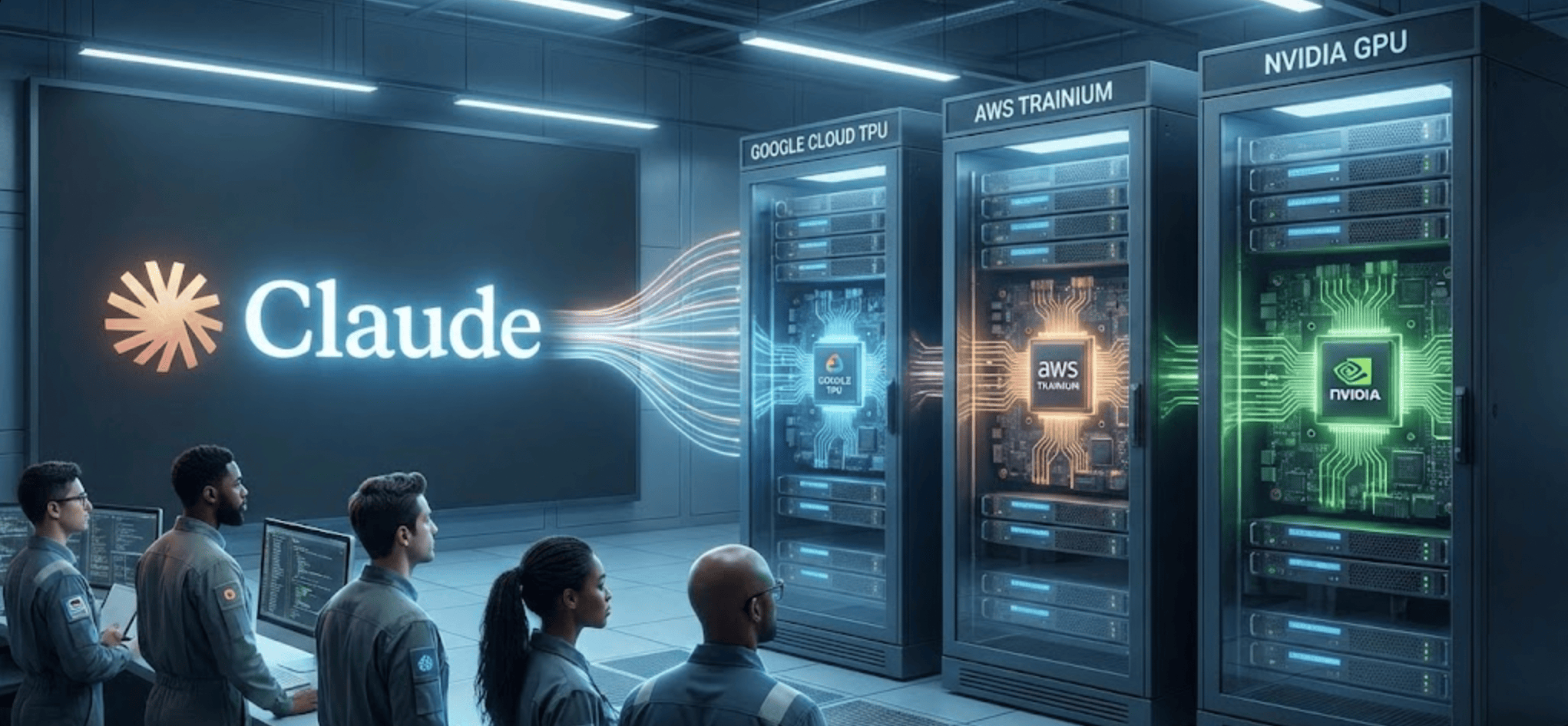
Anthropic has pursued a multi-chip strategy involving AWS Trainium, Google TPUs, NVIDIA GPUs and AMD GPUs. The objective is to improve performance, expand capacity and reduce dependence on any single hardware provider. Operating across different hardware platforms also requires significant engineering investment.
2. Data Centres and Electricity
AI data centres are not ordinary server facilities. They require large amounts of electricity, advanced cooling systems, specialised networking and reliable infrastructure. As demand for AI services increases, the amount of computing capacity required grows significantly.
The electricity bill is only one part of the problem. Companies must also secure data centre space, hardware deliveries and long-term infrastructure agreements. A shortage of available computing capacity can become a serious competitive disadvantage.
3. Model Training and Research
Developing increasingly capable models requires extensive research, experimentation and computing resources. Not every training experiment produces a commercial product. Research teams must test different approaches, evaluate model capabilities and improve reliability. These activities require substantial investment before a company can generate revenue from a new model.
4. Inference Costs
Inference refers to the computing required to operate an already-trained AI model and generate responses for users. This is particularly important because a successful AI product can attract millions of users, creating continuous operating expenses.
A company might spend heavily to train a model, but it must continue paying to serve customers every day. The more advanced and widely used its products become, the more important inference efficiency becomes.
The Numbers: Anthropic’s Financial Challenge
Anthropic’s November 2026 financial disclosures provide an unusually clear picture of the economics of building frontier AI.
According to reporting based on its amended IPO filings, the company reported third-quarter 2026 revenue of approximately $16.96 billion, representing 47% growth over the previous quarter.
But its infrastructure expenditure is equally significant. Anthropic disclosed approximately $18.8 billion in compute and infrastructure expenses for the first nine months of 2026, compared with approximately $4.4 billion during the same period in 2025. That represents an increase of approximately 329%.
Its amended disclosures also highlighted nearly $895.4 billion in aggregate computing and infrastructure purchase commitments and lease agreements, including commitments extending into future years.
These figures demonstrate the enormous scale of the infrastructure required to compete in the AI industry. The company also reported a third-quarter net loss of approximately $23.3 billion, although accounting adjustments and financing-related items make the headline net-loss figure different from its operating performance.
The important point is that rapid revenue growth does not automatically guarantee sustainable profitability.
Why Anthropic’s Revenue Growth Is Not the Whole Story
A growing customer base is valuable, but the economics of AI depend on how much it costs to serve each customer.
Consider a simplified example. Imagine an AI company earns $100 from a customer but spends $60 on the computing required to provide its services. The remaining $40 must help cover research, salaries, sales, administration and other expenses.
Now imagine computing costs increase to $80 while revenue stays at $100. The company is still generating revenue, but its financial flexibility has become much smaller.
This is the challenge facing frontier AI companies. As Claude becomes more capable, customers may expect it to complete increasingly complex tasks. Those tasks could require more computation, longer reasoning processes and greater infrastructure capacity.
Anthropic therefore needs to improve its ability to generate more economic value from every dollar spent on compute. The company has highlighted inference efficiency and its multi-chip infrastructure strategy as important elements of its approach. Technological efficiency is just as important as model intelligence.
Nearly $900 Billion in Infrastructure Commitments: Opportunity or Risk?
One of the most important developments in Anthropic’s financial disclosures is the scale of its future infrastructure commitments.
The company’s amended filing disclosed approximately $895.4 billion in aggregate purchase and lease commitments, substantially related to computing and infrastructure. A significant portion is expected to be incurred over the coming years.
This is not the same as money already spent or a single immediate cash payment. These are contractual commitments that can become payable according to the terms, delivery schedules and other conditions of the agreements.
Nevertheless, the scale is enormous. Computing capacity is becoming one of the most valuable resources in artificial intelligence. Without enough chips, servers and data centre capacity, even the best AI models cannot serve customers at the scale the business requires.
These agreements can help Anthropic secure future capacity and plan its expansion. However, they also create risks. What happens if AI demand grows more slowly than expected? What happens if a new generation of processors makes existing infrastructure less competitive? What happens if data centre projects are delayed or financing becomes more expensive?
Anthropic could find itself facing substantial financial obligations even if the market changes. Its IPO disclosures also identified risks associated with infrastructure partners and the financing needed to deliver future computing capacity.
This is one of the biggest differences between a traditional software company and a frontier AI developer: the latter must secure enormous physical infrastructure before it can fully monetise future demand.
Anthropic vs OpenAI: Who Can Win the AI Race?
Anthropic is not competing in an empty market. It faces competition from some of the most powerful technology companies in the world.
OpenAI
OpenAI remains one of Anthropic’s most important competitors through ChatGPT, its developer platform and its growing ecosystem of AI products. Its strength comes from consumer adoption, product distribution, model development and extensive infrastructure partnerships.
Google has a substantial advantage through its research capabilities, custom AI chips, cloud infrastructure and global distribution. Its ability to develop both AI models and the hardware infrastructure supporting them gives it a significant competitive position.
Meta
Meta has taken a different approach by investing heavily in AI research and open-weight models. Its strategy could increase competition by making capable AI models available to developers without requiring them to rely entirely on proprietary services.
xAI
xAI has emerged as another major competitor, with ambitions to develop advanced AI systems backed by substantial computing infrastructure.
The Open-Source Threat
Anthropic must also consider smaller developers and open-weight AI models. Businesses increasingly have options beyond purchasing access to a single proprietary AI platform. Some may choose smaller models, self-hosted systems or specialised AI solutions that provide sufficient performance at a lower cost.
This creates pricing pressure. If a competitor can deliver similar results using fewer computing resources, Anthropic may have to improve efficiency or reduce prices to retain customers.
Is Claude Becoming Too Expensive to Run?
This is perhaps the most important question in Anthropic’s long-term strategy. AI models are becoming more capable, but greater capability does not always translate into better profit margins.
A customer using Claude for complex coding, research or autonomous workflows may generate significantly more value than someone using it for basic conversations. However, that customer may also consume substantially more computing resources.
Anthropic needs to align pricing with the economic value its products deliver. It can pursue more efficient models, smarter model routing, enterprise subscriptions, usage-based pricing and custom infrastructure to improve its economics without sacrificing product quality.
Why Enterprise AI Could Become Anthropic’s Biggest Advantage
Consumer AI subscriptions can generate significant revenue, but enterprise adoption could be even more important.
Businesses are increasingly interested in using AI to automate workflows, improve software development, analyse documents and support employees. For companies, the value of AI is not simply the ability to generate text. It is the ability to reduce operational costs, increase productivity and complete work faster.
Claude’s developer and enterprise capabilities could help Anthropic build deeper customer relationships. Enterprise customers may also provide more predictable revenue than individual consumers, particularly when they adopt AI tools across entire departments.
However, enterprise customers also demand reliability, security, privacy, predictable pricing and strong performance. Anthropic must deliver on these requirements while managing its infrastructure costs.
The Biggest Risks That Could Hurt Anthropic
1. Infrastructure Costs Could Grow Too Quickly
If compute expenses grow faster than revenue, profitability could remain difficult to achieve.
2. Competition Could Reduce Pricing Power
OpenAI, Google, Meta and other developers are investing heavily in AI. If customers gain access to comparable models at lower prices, Anthropic may struggle to maintain its margins.
3. Hardware Could Become Obsolete
AI hardware evolves quickly. Long-term infrastructure commitments could create challenges if newer processors offer significantly better performance or lower costs.
4. Customer Demand Could Change
AI demand is growing, but businesses must eventually demonstrate measurable returns on their AI investments. If adoption slows or customers reduce usage, Anthropic’s massive infrastructure commitments could become a burden.
5. Safety and Regulation
Anthropic has built part of its identity around responsible AI development. As AI systems become more autonomous and capable, safety evaluations, regulatory requirements and legal scrutiny could increase development costs. The company must balance innovation with the responsibility to deploy increasingly capable technology safely.
Can Anthropic Survive the AI Race?
Anthropic has several advantages that make its long-term position worth taking seriously. It has established Claude as a major AI product, built developer and enterprise offerings, developed relationships with major infrastructure providers and pursued a multi-chip strategy.
Its research capabilities and focus on AI safety also provide important differentiation. But none of these advantages guarantees long-term financial success.
The AI race is increasingly becoming a competition between intelligence, infrastructure and economics. The companies that survive will not necessarily be those with the largest models. They will be the companies that can deliver the best results at a sustainable cost.
Anthropic must prove that its increasing computing investments can translate into durable revenue, stronger margins and long-term profitability.
What the Future Could Look Like for Anthropic
Scenario 1: Anthropic Becomes a Sustainable AI Leader
The company improves inference efficiency, secures affordable computing capacity and expands enterprise adoption. Revenue grows faster than infrastructure costs, allowing the business to improve its margins. In this scenario, Anthropic becomes one of the leading sustainable AI businesses.
Scenario 2: Growth Continues, but Profitability Remains Difficult
Claude adoption continues to increase, but the cost of developing and operating frontier models remains enormous. Anthropic may continue to require substantial capital to fund its research and infrastructure expansion. In this scenario, it remains a major AI competitor but faces persistent financial pressure.
Scenario 3: Cheaper AI Changes the Competitive Landscape
New models and specialised AI systems deliver comparable performance at significantly lower costs. Customers become more price-sensitive, forcing Anthropic to reduce prices and rethink its infrastructure strategy. In this scenario, the company could struggle to justify its spending commitments.
These are possibilities rather than predictions. The outcome will depend on customer demand, technological efficiency, competition and access to capital.
Final Verdict: Intelligence Is Expensive, but Efficiency Will Decide the Winner
Anthropic has already demonstrated that it can compete at the highest level of artificial intelligence. Its Claude models, enterprise business and developer ecosystem have given it a strong position in the industry.
However, the company’s financial disclosures reveal a fundamental challenge facing the entire AI sector: building intelligence is expensive, and delivering it to millions of customers may be even more expensive.
Anthropic’s biggest challenge may not be whether it can create the next generation of advanced AI models. It may be whether it can make those models economically sustainable.
The future of the AI industry will depend on more than intelligence benchmarks, product launches and funding announcements. It will depend on computing efficiency, infrastructure economics, customer value and the ability to turn technological leadership into lasting profits.
Anthropic may have the intelligence to compete. Now it needs to prove that the business behind that intelligence can survive.
Disclaimer: This article is for informational and educational purposes only. It does not constitute investment advice. Financial figures are based on company disclosures and reporting available as of November 20, 2026.
Sources and Further Reading
- Anthropic amended SEC registration statement (November 2026)
- Reuters: Anthropic valued at $1.5 trillion as IPO raises record $81 billion
- TechCrunch: Anthropic is still grappling with the economics of compute
- Anthropic company announcements
Disclaimer: This article is for informational and educational purposes only. It does not constitute investment advice. Financial figures are based on company disclosures and reporting available as of November 20, 2026.