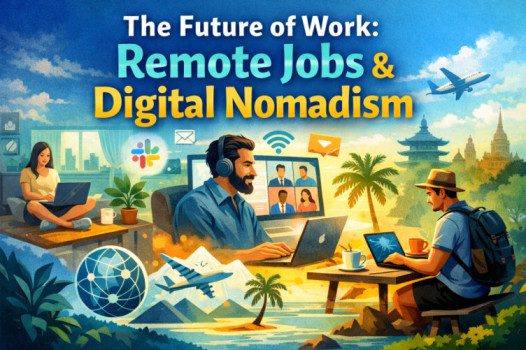
Remote Work, Digital Nomadism & Future of Work
The way humans work is undergoing one of the biggest transformations since the Industrial Revolution.
Offices are shrinking, borders are becoming less relevant, and laptops have replaced cubicles.
Remote work and digital nomadism are no longer fringe ideas — they are shaping the
future of work globally.
This shift is powered by technology, accelerated by global events, and driven by a new generation that
values freedom, flexibility, and purpose over rigid 9–5 routines.
Let’s explore what remote work and digital nomadism really mean, why they’re growing, and how they will
define the future of jobs.
What Is Remote Work?
Remote work means doing your job outside a traditional office, usually from home, a coworking
space, or any location with internet access. Employees collaborate using digital tools instead of
physical presence.
Remote work models include:
- Fully remote – No physical office at all
- Hybrid – Mix of office and remote days
- Remote-first – Office exists, but remote workers are the priority
Companies like GitHub, Automattic, and Zapier have proven that remote teams can scale globally without losing productivity.
Digital nomads are remote workers who combine work with travel. Instead of working from one
fixed location, they move between cities or countries while earning online.
A digital nomad might be:
- A developer working from Bali 🌴
- A content creator traveling across Europe ✈️
- A freelancer living between cities
- An entrepreneur running a global business remotely
Popular digital nomad hubs include Bali, Lisbon, andChiang Mai, thanks to affordable living, strong internet, and coworking culture.
Why Remote Work Is Growing So Fast
1. Technology Made Location Optional
Cloud computing, video conferencing, and collaboration tools like Zoom, Slack, and Notion removed the need for physical offices.
2. The Pandemic Changed Everything
COVID-19 proved that work can continue without offices. Many companies saw equal or higher
productivity, forcing leaders to rethink old assumptions.
3. Workers Want Flexibility
- Work–life balance
- Mental health
- Autonomy
- Time with family
Flexibility is now a top priority, not a perk.
4. Companies Save Money
- Office rent
- Utilities
- Relocation expenses
Hiring globally also gives companies access to worldwide talent.
Benefits of Remote Work
For Employees
- No daily commute 🚗
- Flexible schedules
- Location independence
- Better focus and productivity
- Improved quality of life
For Employers
- Access to global talent
- Lower operational costs
- Higher retention
- Happier, more loyal employees
Challenges of Remote Work
- Isolation and loneliness
- Blurring of work-life boundaries
- Time zone coordination
- Communication gaps
- Burnout from always being online
Successful remote teams invest heavily in
clear communication, documentation, and trust-based management.
Digital Nomadism: Opportunity or Risk?
Advantages
- Travel while earning
- Cultural exposure
- Personal growth
- Lower cost of living in some countries
Risks
- Visa restrictions
- Income instability (for freelancers)
- Healthcare access
- Internet reliability
- Loneliness on the road
Many countries now offermdigital nomad visas to support long-term remote workers.
The Future of Work
Skills Over Degrees
Companies increasingly value skills, portfolios, and experience over formal education.
AI Will Redefine Jobs
AI tools like OpenAI and automation platforms will replace repetitive tasks, create new roles,
and increase individual productivity.
Rise of Freelancing
- Independent work
- Personal branding
- Online income streams
Best Websites to Find Remote Jobs
- We Work Remotely
- Remote OK
- FlexJobs
- AngelList Talent
- Remote.co
- JustRemote
- Jobspresso
- Working Nomads
- Upwork
- Fiverr
Remote work and digital nomadism are not trends — they are structural shifts.
The future of work will be location-independent, skill-driven, technology-powered,
and human-centered.
Those who adapt early will enjoy freedom, flexibility, and global opportunities.
Those who resist may find themselves stuck in outdated systems.
The office is no longer a place — it’s a choice.