How AI Agents Will Change WordPress Development in 2027
WordPress development is entering a new era. Artificial Intelligence (AI) has already transformed how developers create website content, generate code, design layouts, and manage online businesses. However, the next major development will go beyond AI-powered writing assistants and coding tools. It will involve AI agents capable of performing complete tasks with minimal human intervention.
Imagine asking an AI agent to create a WordPress website, configure its homepage, install the necessary plugins, optimize its SEO, check website performance, and identify security issues. Instead of simply providing instructions, the AI agent could interact with WordPress, execute supported actions, and report the results.
This is the direction in which WordPress development is moving towards 2027.
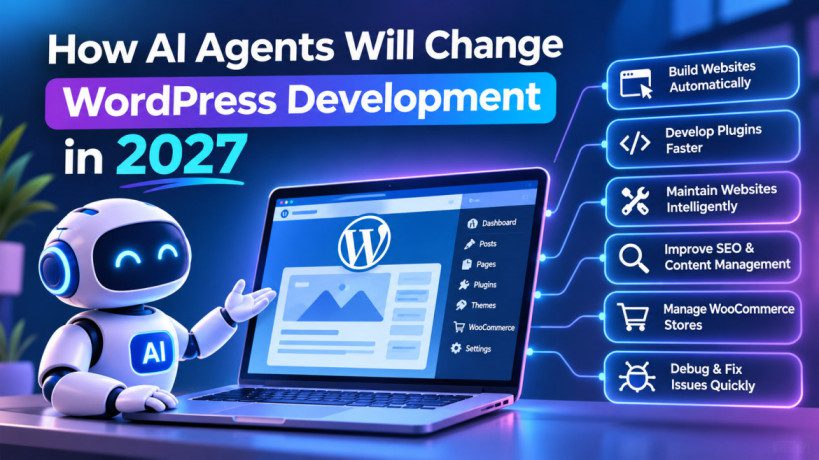
AI agents could change almost every aspect of website development, including theme customization, plugin development, website maintenance, WooCommerce management, SEO optimization, and technical troubleshooting.
For WordPress developers, freelancers, agencies, and website owners, this transformation presents significant opportunities. It could reduce repetitive work, improve productivity, and make complex website management more accessible.
In this article, we will explore how AI agents will change WordPress development in 2027, the technologies making this possible, practical examples, potential challenges, and the skills developers should learn to prepare for the future.
1. What Are AI Agents and How Do They Work?
AI agents are intelligent software systems that can understand objectives, make decisions, use tools, and perform multiple actions to complete a task.
Traditional AI tools generally work through a question-and-answer approach. You provide a prompt, and the AI generates information, content, or code.
For example, you might ask ChatGPT to generate a custom PHP function for WordPress. It provides the code, but you must manually add it to your website, test it, and resolve any errors.
AI agents take this process further.
An AI agent can understand the objective, break it into smaller tasks, select appropriate tools, execute authorized actions, and evaluate the results.
Consider a simple example.
You ask an AI agent:
“Check my WordPress website and identify all published articles that are missing featured images.”
The agent could connect to WordPress, retrieve published articles, examine their featured image information, and generate a report identifying posts that need attention.
If it also has authorized image-management capabilities, it could help assign suitable images after receiving approval.
The difference is important: traditional AI helps developers generate solutions, while AI agents can help implement those solutions through connected tools.
By 2027, this ability to perform multi-step workflows could become one of the most important developments in the WordPress ecosystem.
2. WordPress Abilities API Will Make AI Integration Easier
One of the most important developments supporting AI agents in WordPress is the Abilities API.
Introduced in WordPress 6.9, the Abilities API provides a standardized way for developers to register and describe functionality that other applications can discover and execute.
Think of it as creating a directory of actions that WordPress can make available to compatible applications.
For example, a plugin developer could register abilities to:
- Retrieve published posts.
- Create new articles.
- Update existing content.
- Retrieve product information.
- Generate website reports.
- Perform specific plugin operations.
Each ability can define its input and output requirements, permission checks, and execution functionality.
Practical Example
Imagine you develop a WordPress plugin for managing blog content.
You could register abilities such as:
- Get published posts.
- Create a new post.
- Update post information.
- Analyze article content.
An AI agent connected to WordPress could discover these abilities and use them to complete a content-management task.
Instead of developing a completely separate integration for every AI application, developers can expose functionality through a standardized system.
This creates an opportunity for plugin developers to make their products more accessible to AI-powered applications.
3. Model Context Protocol Will Connect AI Agents With WordPress
Another important technology is Model Context Protocol, commonly known as MCP.
MCP provides a standardized way for AI applications to communicate with external systems and access their tools and information.
The WordPress MCP Adapter connects WordPress functionality with MCP-compatible AI applications.
This means AI clients can discover and interact with supported WordPress abilities through an MCP server.
Practical Example
Imagine connecting an AI coding assistant to your WordPress development website.
You could ask:
“Find all published articles that do not have SEO descriptions.”
The AI agent could:
- Connect to the WordPress MCP server.
- Discover the available content-management abilities.
- Retrieve the published articles.
- Check their SEO information through an available integration.
- Identify articles with missing descriptions.
- Prepare a report.
If the necessary update functionality is available, the agent could also prepare suggested descriptions for your approval.
For WordPress developers, MCP could make it easier to connect websites with AI assistants, development tools, and external applications.
Combined with the Abilities API, it provides an important foundation for more intelligent WordPress workflows.
4. AI Agents Will Automate WordPress Website Development
Building a WordPress website involves several activities, including selecting a theme, installing plugins, creating pages, designing layouts, configuring menus, and optimizing performance.
Many of these tasks are repetitive and time-consuming.
AI agents could automate significant portions of this process.
Imagine giving an AI agent the following instruction:
“Create a professional website for a digital marketing agency with a homepage, about page, services page, blog, contact page, and responsive navigation.”
The agent could potentially:
- Understand the website requirements.
- Suggest suitable themes and plugins.
- Create the required pages.
- Generate initial website content.
- Build layouts using supported page-builder integrations.
- Configure navigation menus.
- Set up contact forms.
- Check responsive layouts.
- Identify missing website elements.
The website owner would review the result and approve important changes.
This could significantly reduce the time needed to build basic business websites.
However, complex websites involving custom functionality, payment systems, third-party integrations, and advanced database structures will still require experienced developers.
5. AI Agents Will Transform WordPress Page Builders
Page builders have made WordPress development easier for people without extensive programming knowledge.
Tools such as Elementor and Themify Builder allow users to create professional websites using visual interfaces.
However, developers still need to spend considerable time arranging modules, adjusting spacing, configuring typography, creating responsive layouts, and customizing individual elements.
AI agents could make page builders considerably more intelligent.
Instead of manually dragging and dropping every module, users could describe the design they want.
For example:
“Create a modern homepage for a technology company with a hero section, services, testimonials, pricing table, recent blog posts, and footer.”
An AI agent connected to the page builder could potentially create the requested sections, select appropriate modules, add content, configure buttons, adjust spacing, and prepare responsive layouts.
What Could This Mean for Themify Builder?
For developers working with Themify Builder, AI agents could introduce several interesting possibilities.
Imagine asking an AI agent:
“Create a product landing page using my existing website design. Include a product gallery, pricing information, features, customer testimonials, and related products.”
With an appropriate Themify integration, the agent could potentially create layouts using existing modules and templates.
It could also help developers:
- Generate custom CSS for individual modules.
- Create reusable layouts.
- Configure Post Modules.
- Set up advanced post filters.
- Work with custom fields.
- Create dynamic content templates.
- Troubleshoot layout problems.
- Customize Builder Pro templates.
For example, while developing a WooCommerce website using Themify Builder Pro, you could ask an AI agent to help create a custom single-product template.
The agent could suggest the appropriate modules, arrange product information, and generate supporting CSS.
This would not eliminate the need to understand the page builder. Instead, developers could spend less time on repetitive design tasks and more time improving the overall user experience.
6. AI Agents Will Make WordPress Plugin Development Faster
Plugin development is another area where AI agents could make a significant difference.
Developing a WordPress plugin requires knowledge of PHP, JavaScript, CSS, WordPress hooks, filters, REST APIs, database operations, and security practices.
AI coding assistants already help developers generate code. AI agents could take this further by managing larger development workflows.
Example: Creating a Reading Time Plugin
Suppose you want to develop a plugin that automatically displays the estimated reading time of blog posts.
You could instruct an AI coding agent:
“Create a WordPress plugin that calculates reading time based on article word count and displays it before the post content.”
The agent could:
- Create the plugin directory and main PHP file.
- Register the necessary WordPress hooks.
- Develop the reading-time calculation function.
- Add a shortcode.
- Create customization options.
- Generate CSS for the display.
- Write basic automated tests.
- Check for common security problems.
- Prepare installation documentation.
A more advanced workflow could involve multiple specialized agents.
One agent could write the PHP code, another could review security, a third could run tests, and another could prepare documentation.
A human developer would supervise the process and approve the final implementation.
This approach could make plugin development faster, especially for smaller projects and repetitive functionality.
7. AI Agents Will Improve WordPress Website Maintenance
Website maintenance is an ongoing responsibility for every WordPress website owner.
Regular tasks include updating WordPress core, themes, and plugins, checking website uptime, monitoring security, reviewing performance, creating backups, and resolving compatibility issues.
Missing these responsibilities can result in security vulnerabilities, website errors, and poor user experiences.
AI agents could become intelligent website maintenance assistants.
Practical Example: Automated Website Monitoring
Imagine connecting an AI agent to your WordPress website and giving it this instruction:
“Monitor my website and report performance, security, and plugin compatibility problems.”
The agent could:
- Check website availability.
- Review available software updates.
- Identify outdated plugins.
- Examine performance reports.
- Identify broken links.
- Analyze available error logs.
- Generate maintenance reports.
- Recommend corrective actions.
For low-risk operations, an agent could perform approved actions automatically.
For important changes, such as updating critical plugins or modifying security settings, human approval should remain necessary.
This could be particularly useful for WordPress agencies managing dozens or hundreds of client websites.
Instead of manually checking every website, developers could use AI-powered monitoring systems to identify problems and prioritize maintenance activities.
8. AI Agents Will Transform WordPress SEO and Content Management
SEO requires continuous work. Publishing an article is only one part of the process.
Website owners must optimize titles, meta descriptions, headings, internal links, images, structured data, and website performance.
AI agents could help manage these activities through connected SEO and content-management tools.
Practical Example: Optimizing a Blog Post
Imagine publishing an article about WordPress security.
You could ask an AI agent:
“Review this article and improve its SEO.”
The agent could:
- Analyze the article topic.
- Suggest a focus keyphrase.
- Generate an SEO-friendly title.
- Write a meta description.
- Identify missing headings.
- Suggest relevant internal links.
- Generate image alt text.
- Identify broken links.
- Recommend appropriate structured data.
With the required SEO plugin integration, it could also update selected metadata fields.
AI-Powered Content Publishing
Content websites could use different AI agents for different publishing activities.
A research agent could collect information and identify sources.
A writing agent could prepare article drafts.
An SEO agent could optimize metadata and internal links.
An editorial agent could review readability and grammar.
A publishing agent could prepare content for scheduling.
This could create a more organized content-production process.
However, human editors will remain important for checking facts, verifying sources, maintaining originality, and ensuring that published articles provide genuine value to readers.
9. AI Agents Will Change WooCommerce Store Management
WooCommerce powers millions of online stores and provides extensive functionality for managing products, orders, payments, customers, and inventory.
Managing a large online store can become complicated, particularly when hundreds or thousands of products are involved.
AI agents could simplify several WooCommerce activities.
Practical Example: Managing Product Listings
Imagine running an online electronics store.
You could ask an AI agent:
“Review my product catalog and identify products with incomplete descriptions, missing images, or incorrect categories.”
The agent could retrieve product information, identify incomplete listings, generate suggested descriptions, check categories, and prepare a report.
With suitable permissions, it could update approved product information.
Other possible applications include:
- Automated product descriptions.
- Inventory monitoring.
- Product recommendations.
- Sales reporting.
- Customer support assistance.
- Order-status inquiries.
- Abandoned-cart workflows.
For example, an inventory agent could monitor stock levels and notify the store owner when a product reaches a predefined minimum quantity.
A customer-support agent could retrieve order information and prepare responses to common customer questions.
These capabilities could make WooCommerce management more efficient, especially for growing online businesses.
10. AI Agents Will Make WordPress Debugging Easier
Every WordPress developer has encountered technical problems that require hours of investigation.
Common issues include plugin conflicts, PHP fatal errors, JavaScript errors, database connection problems, broken layouts, and compatibility issues after updates.
Traditional troubleshooting requires developers to inspect logs, deactivate plugins, test themes, and identify the source of the problem.
AI agents could automate several steps.
Practical Example: Identifying a Plugin Conflict
Suppose your website displays a critical error after installing a new plugin.
You could ask an AI debugging agent:
“Find out why my WordPress website is showing a critical error after installing this plugin.”
The agent could:
- Review available PHP error logs.
- Identify relevant error messages.
- Locate the file and function involved.
- Check whether a plugin or theme is responsible.
- Suggest possible solutions.
- Reproduce the problem in a staging environment.
- Test the proposed fix.
- Prepare a troubleshooting report.
The developer could review the suggested solution before applying it to the live website.
This could reduce debugging time and make WordPress technical support more efficient.
11. AI Agents Will Change the Role of WordPress Developers
One of the biggest changes in 2027 could be the changing responsibilities of WordPress developers.
Traditionally, developers spent considerable time writing code, creating layouts, configuring plugins, and resolving repetitive problems.
As AI agents become more capable, some of these activities could be delegated to automated systems.
Developers could focus more on:
- Website architecture.
- Custom functionality.
- Plugin development.
- Third-party integrations.
- Security and performance.
- Reviewing AI-generated code.
- Testing complex workflows.
- Improving user experience.
- Managing AI-powered development systems.
For example, instead of manually writing every line of a custom plugin, a developer could define its architecture