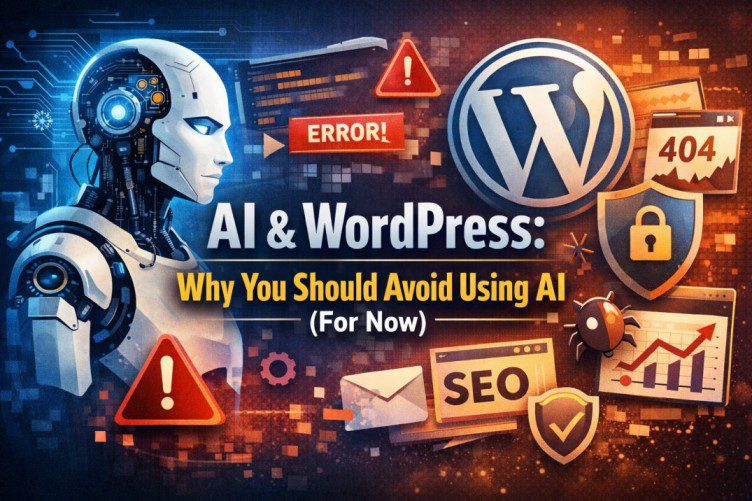
AI and WordPress: Why You Should Be Careful Using AI (For Now)
Artificial Intelligence (AI) is revolutionizing the way websites are built and managed. From generating blog content to designing layouts and even writing code, AI promises to simplify workflows and boost productivity.
But when it comes to working with WordPress, relying too heavily on AI can actually do more harm than good.
In this article, we’ll explore why you should avoid using AI blindly in WordPress (for now), the risks involved, and how to use it wisely.
🚀 The Rise of AI in WordPress
AI tools are becoming deeply integrated into the WordPress ecosystem. Today, users can:
- Generate blog posts in seconds
- Build full website layouts automatically
- Create custom CSS and PHP without coding knowledge
- Optimize SEO using AI-driven suggestions
- Automate customer interactions via chatbots
Popular AI-powered tools and plugins claim to save time and eliminate the need for technical expertise. For beginners, this sounds like a dream.
However, the reality is more complex.
⚠️ Why You Should Avoid Heavy AI Usage in WordPress
1. ❌ AI Generates Unreliable Code
One of the biggest risks of using AI in WordPress is incorrect or outdated code generation.
- Invalid CSS rules
- Deprecated WordPress functions
- Incorrect PHP logic
Even worse, the code may look correct but still break your site.
- Layout issues
- Builder failures
- White screen errors
If you’re using page builders like Themify or Elementor, even a small mistake can cause major problems.
2. 🔌 Compatibility Issues with Themes and Plugins
WordPress is not a simple system—it’s an ecosystem of themes, plugins, and custom configurations.
- Theme frameworks (e.g., Themify Ultra)
- Plugin dependencies
- Custom hooks and filters
As a result:
- Features may not work properly
- Styling may break across devices
- Backend editors may stop loading
👉 This is especially frustrating when troubleshooting, as AI-generated solutions often miss the root cause.
3. 📉 AI Content Can Hurt Your SEO
AI-generated content might look impressive, but it often lacks:
- Depth and originality
- Real-world insights
- User intent alignment
Search engines like Google are evolving rapidly. Thin or generic content can result in:
- Lower rankings
- Reduced organic traffic
- Higher bounce rates
👉 SEO is not just about keywords—it’s about value. And AI still struggles to deliver that consistently.
🔍 Target Keywords (for SEO Optimization)
- AI in WordPress
- WordPress AI tools
- Should you use AI for WordPress
- AI content SEO risks
- AI website builder problems
- WordPress automation risks
- AI-generated code issues
4. 🧠 Lack of Real Experience
AI does not have hands-on experience. It doesn’t test websites, debug real issues, or understand business goals.
- It may recommend a plugin without considering performance impact
- It may suggest outdated solutions
- It may ignore hosting limitations
👉 This makes AI unreliable for real-world WordPress decision-making.
5. 🔧 Debugging Becomes More Difficult
When you rely on AI-generated solutions, you often don’t fully understand how they work.
- You use AI to fix a problem
- The fix introduces another issue
- You go back to AI again
👉 Over time, debugging becomes harder—not easier.
6. ⚡ Performance Optimization Is Ignored
AI tools often prioritize functionality over performance.
- Page load speed
- Script optimization
- Asset management
This can result in:
- Slow-loading pages
- Poor Core Web Vitals
- Negative SEO impact
👉 Performance is critical for both user experience and rankings.
7. 🔐 Potential Security Risks
AI-generated code can introduce vulnerabilities such as:
- Unsanitized inputs
- Unsafe database queries
- Weak validation
This can expose your website to:
- Malware attacks
- Data breaches
- Unauthorized access
👉 Security is not something you want to “guess” with AI.
8. 🎨 Generic Website Design
AI-generated designs often:
- Look repetitive
- Lack brand identity
- Follow predictable patterns
While they may look clean, they rarely stand out.
👉 If you’re building a brand or business, uniqueness matters.
🧠 The Real Problem: Over-Reliance on AI
The biggest danger isn’t AI itself—it’s how people use it.
- Reduced learning
- Blind copy-pasting
- Lack of problem-solving skills
In the long run, this can:
- Hurt your career growth
- Limit your technical understanding
- Make you dependent on tools
✅ When You SHOULD Use AI in WordPress
✔️ Good Use Cases
- Brainstorming blog ideas
- Creating content drafts (then editing manually)
- Learning new concepts
- Generating code snippets for reference
❌ Avoid Using AI For
- Directly deploying code without testing
- Complex debugging
- Writing final SEO content
- Security-related implementations
👉 Think of AI as an assistant—not an expert.
🔮 The Future of AI in WordPress
AI is evolving rapidly, and its future in WordPress looks promising.
- Better understanding of themes and plugins
- Cleaner and more reliable code generation
- Real-time debugging assistance
- Deeper integration with builders
But as of now, AI is still in its early practical stage for WordPress workflows.
AI is changing the future of web development, and WordPress is no exception. However, the technology is not mature enough to fully replace human judgment, especially when it comes to performance, SEO, and debugging.
Use AI wisely, stay in control, and keep learning.