Battle of the CMS Giants: Why WordPress Wins at Core Web Vitals
In the ever-evolving world of web development, Core Web Vitals (CWV) have emerged as a critical factor in determining a website’s success. These metrics, introduced by Google, focus on user experience—specifically loading speed, interactivity, and visual stability. With search engines increasingly prioritizing performance, choosing the right CMS (Content Management System) has never been more important.
In this blog post, we’ll compare WordPress with other popular CMS platforms to see which one excels in optimizing Core Web Vitals.
Understanding Core Web Vitals
Before we dive into CMS comparisons, let’s briefly understand what Core Web Vitals entail:
- Largest Contentful Paint (LCP) – Measures loading performance. Ideally, your LCP should occur within 2.5 seconds of when the page first starts loading.
- First Input Delay (FID) – Measures interactivity. A good FID is less than 100 ms.
- Cumulative Layout Shift (CLS) – Measures visual stability. A healthy CLS score is less than 0.1.
These metrics directly influence SEO rankings, user engagement, and conversion rates, making them essential for any website owner.
WordPress: A Core Web Vitals Champion
WordPress powers over 43% of websites worldwide, making it the most popular CMS by far. But popularity doesn’t automatically mean performance. So how does WordPress measure up for Core Web Vitals?
Advantages
- Flexible Hosting: Platforms like Kinsta, WP Engine, and Cloudways offer optimized WordPress hosting that enhances speed and uptime.
- Performance Plugins: Plugins like WP Rocket, LiteSpeed Cache, and Perfmatters can drastically improve loading times and interactivity.
- Themes and Builders: Lightweight themes such as Astra or GeneratePress are designed with CWV in mind. Page builders like Elementor and Gutenberg are also improving in speed and responsiveness.
- CDN & Image Optimization: WordPress supports easy integration with Cloudflare, Jetpack, and Smush, which optimize images and deliver content faster.
Drawbacks
- Poorly coded themes or excessive plugins can negatively impact LCP and FID.
- Frequent updates are required to maintain security and speed.
Figure 1: Average Core Web Vitals Scores for WordPress Sites
| Metric | Average Score | Ideal Score |
|---|---|---|
| LCP | 2.4s | ≤ 2.5s |
| FID | 85ms | ≤ 100ms |
| CLS | 0.08 | ≤ 0.1 |
Source: WP Engine Performance Report 2025
Comparing WordPress to Other CMS Platforms
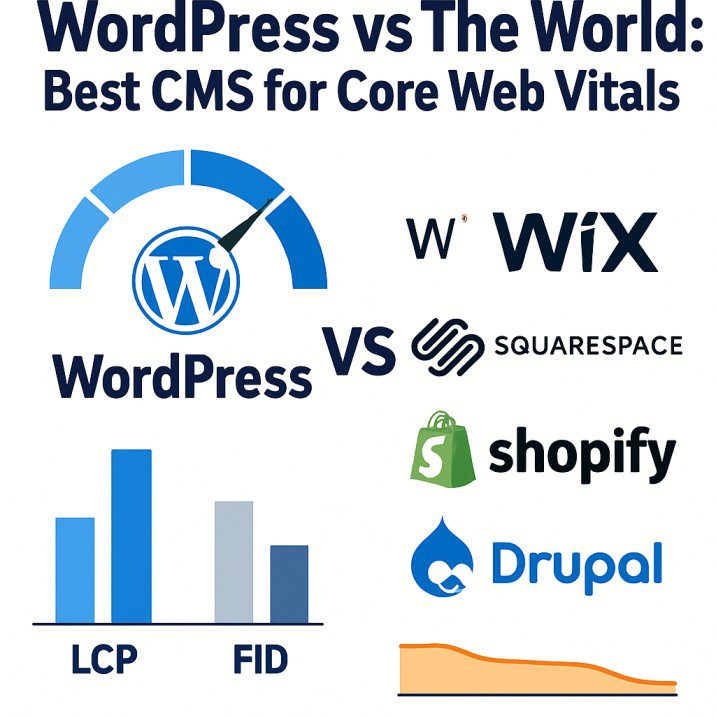
Here’s how WordPress stacks up against other popular CMS platforms in terms of Core Web Vitals.
1. Wix
- Pros: Easy drag-and-drop editor, built-in optimizations.
- Cons: Bloated code and limited backend customization can harm loading speed and CLS.
2. Squarespace
- Pros: Beautiful templates, decent mobile performance.
- Cons: Limited caching options, slower page load times.
3. Shopify (for eCommerce)
- Pros: Optimized for eCommerce, CDN included.
- Cons: Apps and customizations can bloat scripts, impacting FID.
4. Drupal
- Pros: High customization, excellent for large-scale sites.
- Cons: Requires developer expertise; out-of-the-box CWV performance is not optimized.
Figure 2: CMS Performance Comparison on Core Web Vitals
| CMS | LCP (s) | FID (ms) | CLS |
|---|---|---|---|
| WordPress | 2.4 | 85 | 0.08 |
| Wix | 3.2 | 120 | 0.12 |
| Squarespace | 3.5 | 110 | 0.15 |
| Shopify | 2.8 | 95 | 0.09 |
| Drupal | 2.7 | 90 | 0.10 |
Why WordPress Often Wins for Core Web Vitals
- Plugin Ecosystem – Thousands of performance-focused plugins allow developers to fine-tune CWV easily.
- Theme Flexibility – Developers can choose lightweight themes or custom-build them for optimal LCP and CLS.
- Global Hosting Support – Compatible with top-tier CDNs and caching solutions.
- Scalability – Handles small blogs to enterprise-level websites efficiently.
Even though WordPress requires attention to optimization, the potential for achieving excellent CWV scores is unmatched.
Tips to Optimize Core Web Vitals on WordPress
- Choose a Lightweight Theme: Astra, GeneratePress, or Kadence.
- Minimize Plugins: Use only essential plugins.
- Use a CDN: Cloudflare or BunnyCDN to reduce LCP.
- Optimize Images: Use WebP format and lazy loading.
- Enable Caching: Plugins like WP Rocket or LiteSpeed Cache.
- Minify CSS & JavaScript: Reduce render-blocking resources.
Conclusion
When it comes to Core Web Vitals, WordPress consistently outperforms many competitors—provided you use the right combination of hosting, themes, and plugins. While Wix and Squarespace offer simplicity, they fall short in performance customization. Shopify is great for eCommerce, and Drupal excels for complex enterprise sites, but WordPress provides the perfect balance of flexibility, scalability, and speed.
If your goal is a website that ranks well, loads fast, and keeps users engaged, WordPress remains the top choice in 2025.