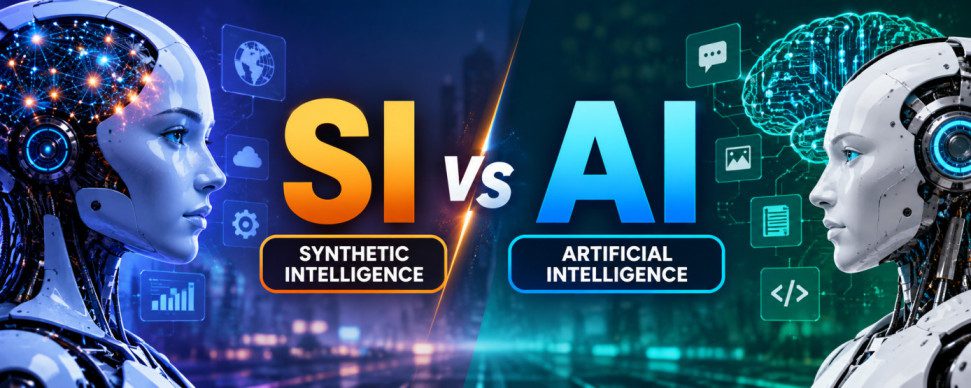
SI vs AI: Understanding the Difference Between Synthetic Intelligence and Artificial Intelligence
Artificial Intelligence (AI) has become one of the most important technologies of the modern digital era. From chatbots and image generators to autonomous systems and intelligent software, AI is changing the way people work, communicate, create content, and solve problems.
But as AI continues to evolve, another term is increasingly being discussed: SI, or Synthetic Intelligence.
So, what is the difference between SI vs AI? Are Synthetic Intelligence and Artificial Intelligence actually different technologies, or are they simply different ways of describing intelligent machines?
In this guide, we will explore SI vs AI, how both concepts work, their key differences, real-world applications, advantages, limitations, and what they could mean for the future of technology.
What Is Artificial Intelligence (AI)?
Artificial Intelligence (AI) refers to technologies that enable computers and machines to perform tasks that traditionally require human intelligence.
These tasks can include:
- Understanding language
- Recognizing images and objects
- Learning from data
- Making predictions
- Solving problems
- Generating content
- Understanding patterns
- Making recommendations
- Automating decisions
Modern AI is largely built using technologies such as machine learning, deep learning, neural networks, natural language processing, and generative AI.
For example, when you ask an AI chatbot a question and receive a detailed response, several AI technologies may work together to understand your request, process information, and generate an answer.
Examples of AI
AI is already part of everyday life.
Examples include:
- ChatGPT and other AI assistants
- Google Search algorithms
- Voice assistants
- Netflix and YouTube recommendations
- Fraud detection systems
- AI-powered medical analysis
- Autonomous driving technologies
- AI image and video generators
- Translation software
- Customer-service chatbots
AI therefore represents a broad field covering many different approaches to creating intelligent machines.
What Is Synthetic Intelligence (SI)?
Synthetic Intelligence (SI) is a less standardized term than Artificial Intelligence and can be used in different ways depending on the context.
Broadly, Synthetic Intelligence can describe the development of artificially created intelligent systems that exhibit intelligent behavior, potentially combining multiple technologies and capabilities into a more comprehensive synthetic form of intelligence.
Rather than focusing only on individual AI tasks, the concept of SI is sometimes used to describe systems designed to create more general, adaptive, autonomous, or human-like intelligence.
The term should not be confused with a universally accepted replacement for AI. Today, Artificial Intelligence remains the established technical and industry term.
Synthetic Intelligence is better understood as a conceptual or emerging term whose meaning can vary between researchers, technologists, and futurists.
SI vs AI: The Basic Difference
The simplest way to understand the difference is:
AI is the established field of creating machines capable of performing tasks associated with intelligence, while SI can refer to broader or more synthesized forms of machine intelligence.
However, there is significant overlap between the two concepts.
| Feature | Artificial Intelligence (AI) | Synthetic Intelligence (SI) |
|---|---|---|
| Meaning | Artificially created intelligence | Intelligence synthesized through artificial systems |
| Industry adoption | Very widespread | Much less standardized |
| Definition | Relatively established | Varies by context |
| Main focus | Intelligent tasks and systems | Potentially broader integrated intelligence |
| Examples | Chatbots, recommendation systems, computer vision | Conceptual advanced autonomous intelligence |
| Current status | Mature and rapidly evolving field | Emerging/conceptual terminology |
| Research | Extensive | More experimental and interdisciplinary |
| Public awareness | Very high | Relatively low |
Why Is SI Becoming a Topic of Discussion?
AI systems have progressed dramatically.
Early AI systems were often designed to perform a specific task. For example, one system might recognize faces while another might translate languages.
Modern AI systems are increasingly capable of handling multiple types of tasks.
A single model can potentially:
- Understand text
- Analyze images
- Generate content
- Write code
- Reason through problems
- Work with documents
- Interact with software
- Process different forms of information
This progression has led researchers and technology enthusiasts to discuss what comes after today’s AI systems.
Could future intelligent machines combine reasoning, learning, perception, memory, planning, creativity, and autonomous action into a single integrated system?
This is where concepts such as Synthetic Intelligence can become relevant.
AI Is Usually Task-Oriented
One important characteristic of traditional AI is that many systems are built around specific objectives.
For example, an AI system might be designed to:
- Detect spam emails
- Recommend products
- Predict stock movements
- Recognize speech
- Detect objects in photographs
- Generate text
- Analyze medical images
Although modern AI models can perform many tasks, their behavior is still determined by their architecture, training, data, objectives, and operating environment.
AI doesn’t necessarily mean that a machine possesses human-like intelligence.
SI Could Represent More Integrated Intelligence
Synthetic Intelligence can be viewed conceptually as an attempt to build systems where different intelligent capabilities work together.
Imagine an intelligent system capable of:
- Perceiving its environment
- Understanding context
- Learning from experience
- Remembering previous interactions
- Reasoning about problems
- Planning future actions
- Using external tools
- Adapting to changing circumstances
- Acting autonomously
- Evaluating the results of its actions
Such a system would represent a much more integrated form of machine intelligence.
This does not necessarily mean that SI would be conscious or equivalent to human intelligence.
AI vs SI: Intelligence
The biggest conceptual difference is the way intelligence is viewed.
AI
AI typically focuses on building systems that can perform tasks requiring intelligence.
For example:
Input → AI Model → Output
A user asks a question, the model processes it, and the system generates an answer.
SI
Synthetic Intelligence could involve a more continuous intelligent process:
Perception → Understanding → Reasoning → Planning → Action → Learning → Adaptation
This resembles a complete intelligent agent rather than a system that simply produces an output.
AI and Machine Learning
To understand AI properly, it is important to understand Machine Learning (ML).
Machine learning allows systems to learn patterns from data rather than relying exclusively on manually written rules.
For example, instead of programming thousands of rules for identifying cats in photographs, developers can train a machine-learning model using large numbers of examples.
The model learns statistical patterns that help it distinguish between different objects.
Machine learning is therefore one of the major technologies powering modern AI.
Deep Learning and Modern AI
Deep learning is a subset of machine learning that uses multi-layer neural networks.
Deep learning has been responsible for major advances in areas such as:
- Computer vision
- Speech recognition
- Natural language processing
- Generative AI
- Robotics
- Autonomous systems
Large language models are an important example of modern deep-learning systems.
These models can process enormous amounts of information and generate human-like text.
Generative AI
Generative AI represents another major development in artificial intelligence.
Unlike traditional systems that primarily classify or predict information, generative AI can create new content.
It can generate:
- Articles
- Images
- Videos
- Music
- Software code
- Presentations
- Summaries
- Marketing content
Generative AI has significantly expanded public awareness of artificial intelligence.
However, generative AI should not automatically be considered Synthetic Intelligence.
It is better understood as one category within the broader AI ecosystem.
Could SI Include Generative AI?
Potentially, yes.
If Synthetic Intelligence is interpreted as a broader integrated intelligence system, generative AI could become one of its components.
For example, a future intelligent agent could combine:
- A language model
- Computer vision
- Speech recognition
- Long-term memory
- Planning
- Robotics
- External tools
- Real-time data
- Autonomous decision-making
Together, these technologies could produce a much more sophisticated intelligent system.
SI vs AI in Automation
AI is already transforming automation.
Businesses use AI to automate tasks such as:
- Customer support
- Data analysis
- Document processing
- Email classification
- Marketing
- Software development
- Financial analysis
- Inventory forecasting
Synthetic Intelligence could potentially push automation further.
Instead of automating individual tasks, future systems could potentially manage entire workflows.
For example, imagine an intelligent business system that receives a customer request and independently:
- Understands the request
- Checks the customer’s account
- Identifies the problem
- Searches relevant documentation
- Determines a solution
- Updates the system
- Responds to the customer
- Escalates the issue if necessary
- Learns from the outcome
That represents a more autonomous approach to automation.
AI vs SI in Robotics
Robotics is another area where the distinction becomes interesting.
Today’s robots can use AI for:
- Object detection
- Navigation
- Speech recognition
- Motion planning
- Visual perception
A more advanced intelligent robot could combine these capabilities with:
- Memory
- Planning
- Adaptation
- Decision-making
- Environmental awareness
- Long-term objectives
This type of integrated intelligence could be described conceptually as Synthetic Intelligence.
However, it is important to emphasize that the terminology is not universally standardized.
Advantages of Artificial Intelligence
AI already provides significant benefits.
1. Automation
AI can automate repetitive tasks and reduce manual work.
2. Productivity
AI tools can help people write, analyze, research, code, and create content faster.
3. Data Analysis
AI can process enormous quantities of information much faster than humans.
4. Personalization
AI can provide personalized recommendations, education, advertising, and services.
5. Accessibility
AI-powered tools can help people translate languages, generate captions, convert speech to text, and interact with computers.
Potential Advantages of Synthetic Intelligence
If future systems achieve more integrated intelligence, the potential benefits could include:
Greater Autonomy
Systems could potentially complete complex workflows with less human intervention.
Better Adaptability
An intelligent system could potentially adapt to changing circumstances rather than following a fixed workflow.
Multi-Modal Understanding
Future systems may combine text, images, video, audio, sensors, and environmental information.
Long-Term Planning
Advanced intelligent systems could potentially plan and execute multi-step objectives.
More Natural Human-Computer Interaction
People could interact with intelligent systems more naturally through conversation, gestures, images, and other forms of communication.
Limitations of AI
AI has major limitations despite its impressive capabilities.
AI Can Make Mistakes
AI models can produce incorrect information.
This is particularly important when AI is used for:
- Healthcare
- Finance
- Law
- Scientific research
- Security
Human oversight remains important.
AI Can Reflect Bias
AI systems learn from data.
If training data contains biases, the resulting system can reproduce or amplify those biases.
AI Requires Significant Computing Resources
Training and operating advanced AI systems can require substantial computational infrastructure.
AI Does Not Automatically Understand the World Like Humans
An AI system can produce highly convincing language without necessarily possessing human-like understanding, consciousness, or subjective experience.
Limitations and Challenges of SI
Because Synthetic Intelligence is not a universally defined technology, its challenges depend heavily on what the term means in a particular context.
Potential challenges include:
Safety
A highly autonomous system could make unintended decisions.
Alignment
An intelligent system must reliably pursue objectives that are consistent with human intentions.
Accountability
If an autonomous system makes a harmful decision, determining responsibility could become complicated.
Security
More capable intelligent systems could create new cybersecurity risks.
Control
The more autonomous a system becomes, the more important reliable monitoring and intervention mechanisms become.
Is SI Better Than AI?
Not necessarily.
It is more accurate to think of SI and AI as overlapping concepts rather than two competing technologies.
AI is the established scientific and technological field.
SI is a term that can be used to describe certain ideas about artificially created or synthesized intelligence, particularly more integrated forms of intelligence.
Therefore, asking whether SI is “better” than AI is somewhat like asking whether a particular future architecture is better than the broader field of AI.
SI vs AI vs AGI
Another term that frequently appears in discussions about advanced intelligence is AGI — Artificial General Intelligence.
These concepts should not be confused.
AI
Artificial Intelligence is the broad field of creating intelligent machines.
AGI
Artificial General Intelligence generally refers to a hypothetical or aspirational form of AI capable of performing a broad range of intellectual tasks at a level comparable to humans.
SI
Synthetic Intelligence is a less standardized term that may describe artificially synthesized or integrated intelligence.
A simplified relationship could look like:
AI → Broad field of machine intelligence
AGI → Goal/concept involving general-purpose intelligence
SI → Emerging/variable term for synthesized or integrated artificial intelligence
SI vs AI vs AGI: Comparison
| Technology | Main Idea | Current Status |
|---|---|---|
| AI | Machines performing intelligent tasks | Widely deployed |
| Generative AI | AI that creates content | Widely deployed |
| AGI | General-purpose human-level machine intelligence | Not established as a confirmed technology |
| SI | Synthetic/integrated artificial intelligence | Emerging and not universally defined |
Real-World Examples of AI
AI is already everywhere.
Smartphones
AI powers:
- Face recognition
- Camera enhancement
- Voice assistants
- Predictive text
E-Commerce
AI recommends products based on customer behavior.
Streaming
Services use algorithms to recommend movies, shows, and music.
Healthcare
AI can assist with medical imaging, research, and clinical decision support.
Finance
AI can help detect fraud and analyze financial patterns.
Software Development
AI coding assistants can generate, explain, debug, and transform code.
What Could Future Synthetic Intelligence Look Like?
Imagine a personal digital system that knows your goals, understands your environment, remembers previous interactions, and can perform complex tasks.
You might say:
“Plan my business trip next month.”
The system could potentially:
- Determine your preferences
- Analyze your calendar
- Search for suitable flights
- Compare hotels
- Build an itinerary
- Prepare meeting information
- Create a schedule
- Remind you about important tasks
The important difference is that the system would not simply answer questions.
It would potentially understand a goal and execute a sequence of actions.
This is one possible direction toward increasingly autonomous intelligent systems.
Will SI Replace AI?
It is unlikely that the term AI will simply disappear.
Artificial Intelligence has become an established academic, commercial, and technological field.
Even if future systems become significantly more advanced, researchers will likely continue using terms such as:
- AI
- Machine Learning
- Deep Learning
- Generative AI
- AI Agents
- AGI
- Robotics
Synthetic Intelligence may become more common if researchers and companies adopt it as a useful term, but its meaning will depend on how the technology and terminology evolve.
The Future of AI and Synthetic Intelligence
The future is likely to involve increasingly capable AI systems.
Some important areas of development include:
AI Agents
Systems capable of performing multi-step tasks.
Multimodal AI
Models that can understand text, images, audio, video, and other information.
Robotics
AI systems interacting directly with the physical world.
Personalized AI
Digital assistants tailored to individual users.
Autonomous Software
AI systems capable of planning and executing complex software workflows.
Human-AI Collaboration
Rather than replacing every human role, AI may increasingly work alongside people.
Why the Difference Matters
Understanding SI vs AI matters because the technology landscape is changing rapidly.
Today’s AI systems are already capable of performing tasks that once required specialized human expertise.
The next major step may involve systems that can:
- Reason